



Russia sent troops to help control a countrywide uprising in Kazakhstan on Thursday, as fresh clashes between protesters and security forces erupted in the main city of Almaty.
Police in Almaty have reported killing dozens of rioters since the protests in Almaty turned violent on Wednesday Wednesday. Authorities said at least 18 members of the security forces had been killed, including two found decapitated. More than 2,000 people have been arrested.
The TASS news agency quoted witnesses as saying more people were killed and wounded in renewed battles in Almaty's main square, which was occupied alternately by troops and protesters on Thursday.
Explosions and gunfire were heard as military vehicles and scores of soldiers advanced, although the shooting stopped after nightfall.
Earlier, military personnel regained control of the main airport from protesters.
Kazakh President Kassym-Jomart Tokayev said on Friday that "constitutional order" had mostly been restored in the Central Asian country.
"An anti-terrorist operation has been launched. The forces of law and order are working hard. Constitutional order has largely been restored in all regions of the country," Mr Tokayev was quoted as saying in a statement issued by his office.
The Kazakh interior ministry said in a separate statement that 26 "armed criminals" had been "liquidated" and more than 3,000 detained.
The arrival of Russian troops followed a call by Mr Tokayev for assistance from the Collective Security Treaty Organisation (CSTO), a Moscow-led military alliance of former Soviet states. He blamed the unrest on “foreign-trained terrorists” who he said had seized buildings and weapons.
The internet has been shut down across the country, making it difficult to gauge the extent of the unrest.
The violence is the worst since Kazakhstan declared independence three decades ago. Following its independence, the country was ruled by Nursultan Nazarbayev.
Although he stepped down as president three years ago, Mr Nazarbayev, 81, held on to the reins of power through other positions.
Moscow said it was sending troops on a “counter-terrorist operation” and has backed Mr Tokayev's claim that the uprising is being led by foreign-trained terrorists.
-
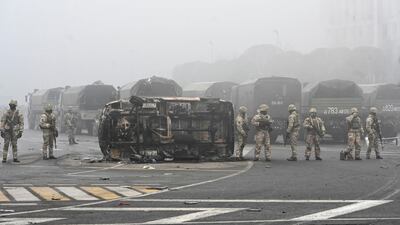
Troops at the main square in Almaty, where hundreds were protesting after authorities' decision to lift price caps on liquefied petroleum gas in Kazakhstan. Reuters -
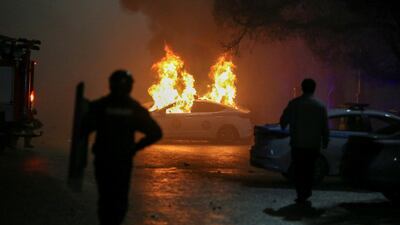
A burning police car during a protest against the LPG price rise in Almaty. Reuters -
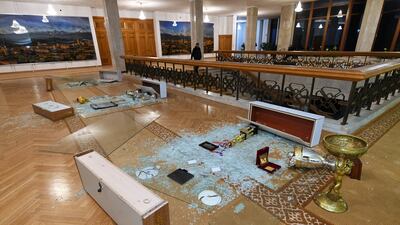
Debris litters the floor of the mayor's office after it was stormed by demonstrators. Reuters -
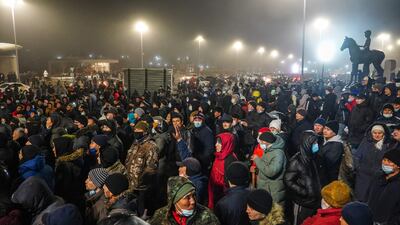
Protesters take part in the rally over a rise in energy prices in Almaty. AFP -
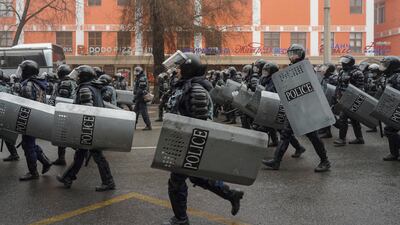
Riot police patrol a street during the rally. EPA -

Kazakh President Kassym-Jomart Tokayev declared a state of emergency until January 19. EPA -
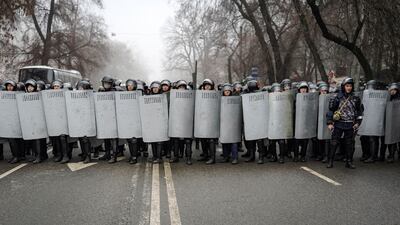
Riot police officers make a wall of shields in Almaty. EPA -

Kazakh armed police on patrol during state of emergency. EPA -

A damaged room inside the mayor's office in Almaty after it was stormed by demonstrators during protests triggered by the fuel price increase. Reuters


The general secretary of the CSTO told the Russian RIA news agency that the overall peacekeeping force would number about 2,500, and could be strengthened if necessary.
It was expected to be a short mission of “a few days or weeks”, RIA quoted him as saying.
The US said it was closely monitoring reports of the deployment and had questions about whether the forces were legitimately invited to the country.
“We have questions about that deployment precisely because Kazakhstan, the government of Kazakhstan ... has its own resources, and the government is, and has been, well fortified,” State Department spokesperson Ned Price said.
“We will be watching very closely for any violations of human rights and any efforts or actions on the part of foreign forces to seize Kazakh institutions,” he added.
The uprising, which began as protests against a New Year's Day fuel price rise, grew violent on Wednesday when protesters chanting slogans against Mr Nazarbayev stormed and torched public buildings in Almaty and other cities.
Mr Tokayev responded by dismissing his Cabinet, reversing the fuel price rise and distancing himself from his predecessor, including by taking over a powerful security post Mr Nazarbayev had retained.
But those moves have failed to appease the protesters.

