


Follow the latest updates on Afghanistan here
China has indicated a willingness to work with a Taliban government in Afghanistan.
Its enthusiasm suggests it may seek to fill the void left by the West after the militants seized control of the country.
Western backers of the fallen Afghan government left behind tens of billions of dollars’ worth of reconstruction and development projects in various stages of completion. But China was one of the few countries to keep its embassy in Kabul open.
In July, its foreign minister, Wang Yi, said Beijing would welcome co-operation with the Taliban but wants the group to commit to cutting ties with militants outside Afghanistan.
“The Taliban have repeatedly expressed their hope to develop good relations with China, and that they look forward to China’s participation in the reconstruction and development of Afghanistan,” he said.
China has already invested in Afghanistan’s vast mineral wealth. It was in talks with the previous government to bring the mountainous, landlocked country into its Belt and Road Initiative − Beijing's multi-decade, multi-trillion-dollar trans-continental infrastructure project.
In 2007, the US Geological Survey reported that Afghanistan was rich in rare earth metals, which are vital for the manufacture of modern electronics. The value of its reserves is estimated to be more than $1 trillion.
That same year, the Metallurgical Corporation of China and Jiangxi Copper Corporation signed investment deals with the Afghan government reported to be worth more than $3 billion, the majority of which would be spent on developing a copper mine in Mes Aynak.
The site, 40 kilometres from Kabul, holds one of the world’s largest copper reserves and demand for the metal is soaring. The world could face a supply deficit by 2030, commodity traders Trafigura and CRU Group said.
-

A US marine cradles an infant while waiting for the mother to return during an evacuation at Hamid Karzai International Airport. Reuters -
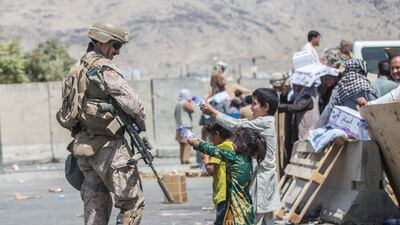
Children playfully squirt a US Marine with water during an evacuation at Hamid Karzai International Airport, Kabul. Reuters -
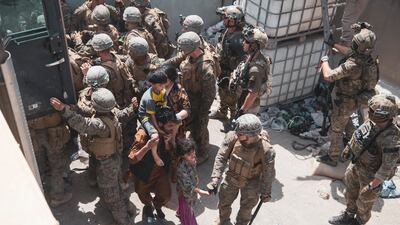
US marines and Norwegian coalition forces provide security during an evacuation at Kabul's airport. Reuters -

Afghans wait outside the foreign military-controlled part of the airport in Kabul, hoping to flee the country following the Taliban's military takeover of Afghanistan. AFP -
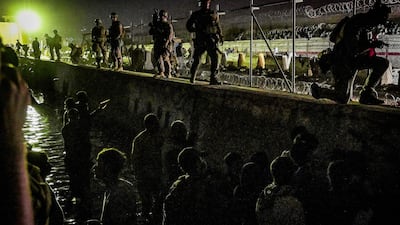
British and Canadian soldiers stand guard near a canal as Afghans wait outside the foreign military-controlled part of the airport in Kabul. AFP -
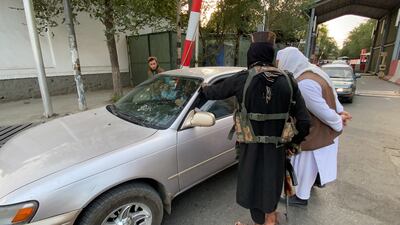
Taliban members check vehicles at the entrance to the Green Zone in Kabul. EPA -

A Taliban check on a car entering the Green Zone, where most of the embassies are located. EPA -

A Green Zone checkpoint manned by the Taliban. EPA -
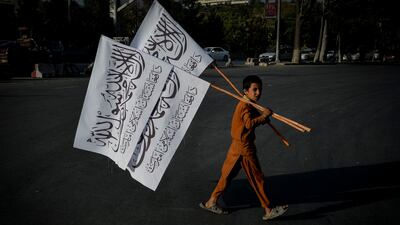
A boy carries Taliban flags to sell at the Karte Mamorin area of Kabul. AFP -
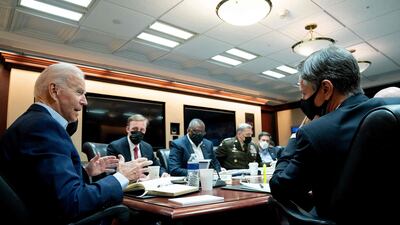
US President Joe Biden speaks to his national security team during a briefing on Afghanistan at the White House. AFP -
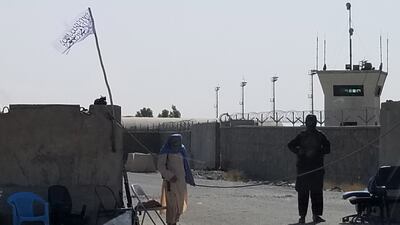
Taliban members stand guard at the main entrance to Kandahar International Airport. EPA -
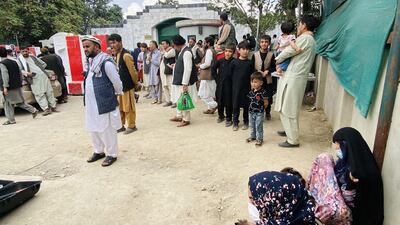
People gather outside the Pakistani embassy to obtain a visa after Taliban took over in Kabul. EPA


That the mine has not produced copper hints at the challenges to come for the Chinese or, indeed, any investor in Afghanistan’s mining sector.
The country is 169th of 189 countries on the UN’s Human Development Index.
Poor infrastructure and a lack of electricity were key factors in the project’s delays.
Investment in the kind of development the BRI has focused on – rail links, highways, digital infrastructure and power plants – would boost China’s chance of success in extracting Afghan minerals.
Electricity is needed for extracting and processing metal ore, something Afghanistan still desperately lacks. The country’s entire power supply is only 1,600 megawatts, of which 1,000 MW is imported from neighbouring countries. By comparison, New York City alone requires 20,100 MW during peak demand in winter.
Road networks also have to be in top condition. The good news for Chinese mining companies is that the US has spent at least $2.8bn rebuilding and repairing roads and bridges in Afghanistan since 2002, according to America’s Special Inspector General for Afghanistan Reconstruction.
But the Taliban insurgency and government neglect mean billions of dollars more in investment is still needed for roads and bridges, Sigar reported.
Whether conditions will be different with the Taliban in control remains to be seen, but the US and China have both experienced challenges building power plants in Afghanistan.
At Mes Aynak, China planned a 400 MW coal-fired plant only to find there would not be enough local coal to operate it, and that the roads to transport it there were in poor condition. Half of the power produced, had the plant been built, would have gone to the national grid.
For the US, a $110 million power project in north-east Afghanistan almost ended in failure when it was found that a local contractor had not secured land rights for power lines, Sigar reported in 2018.
The $300m project to restore the Kajaki hydroelectric power plant in southern Afghanistan, which faced more than a decade of delays and cost $170m more than projected, is another example of the challenges the US faced, although there were major security hurdles in the area.
That is a problem the Chinese might not face if they work with the Taliban, although ISIS is active in many of the country’s provinces.
Despite this, an offer of help with electricity could be a significant diplomatic carrot, giving Beijing more influence over Taliban behaviour. According to the Global Environment Institute in Beijing, BRI coal-fired power projects added more than 250 gigawatts to global electricity generation between 2001 and 2016 alone. Bigger plans are afoot for renewables.
Aside from electricity, water supply is another challenge China will have to contend with. The UN said last week that Afghanistan is facing a worsening drought.
The water shortage could jeopardise plans to turn Afghanistan into what the Pentagon in 2010 described as “the Saudi Arabia of lithium”.
Widely used in batteries, the metal is extracted and processed from either hard rock containing ore or lithium brine water that has run through volcanic rocks found under salt lakes.
Extracting the latter is water-intensive, while hard rock extraction requires more energy.
Aside from these challenges, China’s ties with the Taliban could hinge on its demand that the group limits relations with extremist groups in other countries.
Of particular concern is Tehrik-i-Taliban Pakistan, commonly known as the Pakistani Taliban.
Ominously, when the Afghan Taliban seized power last week, the group sent the Taliban their congratulations.
China has committed at least $62bn to projects in Pakistan, with which Afghanistan shares a border. They include dams, railways and roads for the China-Pakistan Economic Corridor.
In May, the Pakistani Taliban claimed a bombing outside a hotel in the city of Quetta, western Pakistan. Five people were killed in the blast, which took place as China’s ambassador was due to arrive.
The Pakistani Taliban said foreign officials were among their targets, without specifying any nationality.
Mr Wang’s warning to the Taliban could indicate that Beijing’s engagement in Afghanistan will be guided by caution rather than opportunity.
He said the group “should recognise its responsibility toward the country and the nation, make a clean break with all terrorist forces and return to Afghanistan’s political mainstream with a sense of responsibility”.

