An Afghan military helicopter is pictured in Panjshir province in Afghanistan on August 16, 2021. AFP

Panjshir Commander Ahmad Massoud offers deal to the Taliban


Sulaiman Hakemy
  • English
  • Arabic

Follow the latest updates on Afghanistan here

Operatives working for Ahmad Massoud, the 32-year-old resistance leader commanding anti-Taliban forces in the Panjshir valley in north-eastern Afghanistan, have contacted the new Taliban government in Kabul and proposed a deal, a representative of Mr Massoud told The National.

The precise terms of Mr Massoud’s proposal to the Taliban are confidential, said Mahdi Housaini, an aide to Mr Massoud authorised to speak on his behalf.

But the broad outlines include a commitment from the Taliban not to attempt entry to the valley, and to give other political parties a say in their new government.

Mr Massoud commands a force of several thousand men, who are holed up in Panjshir, which is surrounded on all sides by Taliban-held territory.

They have been joined by upwards of 100 soldiers from the Afghan National Army Commando Corps, who retreated to the valley last weekend, as it became clear that the Taliban’s takeover of Kabul was assured.

They have brought with them a fleet of armoured personnel carriers and attack helicopters, Mr Housaini says.

He also stated that Afghanistan’s former vice president, Amrullah Saleh, is in the valley. Mr Saleh has not publicly confirmed that he is in Panjshir, though he has written on social media channels that he is still inside Afghanistan.

Panjshir is the only one of Afghanistan’s 34 provinces that has not been taken by the Taliban.

  • An Afghan policeman keeps watch during a ceremony to hand over security control in the rugged mountains of the Panjshir valley. AFP
    An Afghan policeman keeps watch during a ceremony to hand over security control in the rugged mountains of the Panjshir valley. AFP
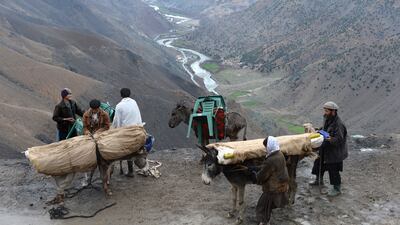
  • Donkeys are loaded with goods in the Panjshir valley. AFP
    Donkeys are loaded with goods in the Panjshir valley. AFP
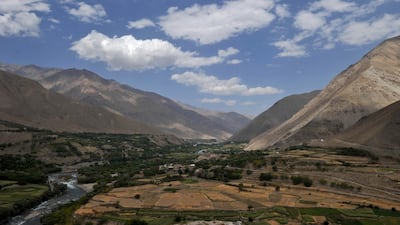
  • A general view of the valley as seen from Ahmad Shah Massoud's grave. The warlord was nicknamed the Lion of Panjshir for his exploits in resisting Soviet forces. AP Photos
    A general view of the valley as seen from Ahmad Shah Massoud's grave. The warlord was nicknamed the Lion of Panjshir for his exploits in resisting Soviet forces. AP Photos
  • Panjshir is surrounded by mountains and is hard to reach. Reuters
    Panjshir is surrounded by mountains and is hard to reach. Reuters
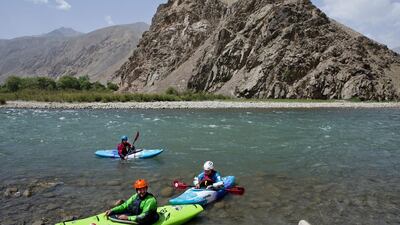
  • Foreign tourists kayak along the Panjshir River, north of the Afghan capital, Kabul. They are unlikely to be in Afghanistan now. AP Photos
    Foreign tourists kayak along the Panjshir River, north of the Afghan capital, Kabul. They are unlikely to be in Afghanistan now. AP Photos
  • Abandoned Soviet artillery in Panjshir, left behind after the occupation from 1979 to 1989 and the subsequent fallout. Reuters
    Abandoned Soviet artillery in Panjshir, left behind after the occupation from 1979 to 1989 and the subsequent fallout. Reuters
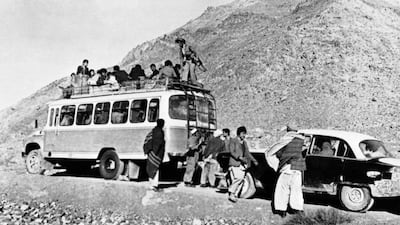
  • Afghan insurgents search for pro-Soviet regime and party officials among bus passengers in the Panjshir valley, the scene of fierce fighting in January 1981. AP Photo
    Afghan insurgents search for pro-Soviet regime and party officials among bus passengers in the Panjshir valley, the scene of fierce fighting in January 1981. AP Photo
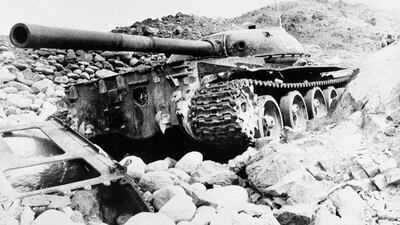
  • This 1981 picture by an Iranian freelance photographer shows a Russian T-62 Commando tank destroyed in Panjshir valley. Afghan Mujahideen rebels said it was hit by a mine. AP Photo
    This 1981 picture by an Iranian freelance photographer shows a Russian T-62 Commando tank destroyed in Panjshir valley. Afghan Mujahideen rebels said it was hit by a mine. AP Photo

On Tuesday, Mr Saleh invoked the Afghan constitution to declare himself President, in the wake of former president Ashraf Ghani’s unexpected departure from Kabul.

Mr Saleh’s claim, which has not yet been publicly recognised by Mr Massoud, may be a “possible negotiating tactic” designed to strengthen Mr Saleh’s hand in any future talks with the Taliban, Mr Housaini suggests.

But Mr Housaini insists that Mr Massoud and Mr Saleh form a united front.

It is unclear how Taliban officials have reacted to Mr Massoud’s proposal, though Mr Housaini indicated that they have reached out with a proposal of their own, the details of which remain confidential.

According to Mr Housaini, Mr Massoud is prepared to resist the Taliban militarily, but would prefer a diplomatic solution to the present stand-off. He has not ruled out joining a Taliban-led government, under the conditions of his proposal.

“He is willing to forgive the assassination of his father if the Taliban are sincere and want peace,” Mr Housaini said. Mr Massoud’s father, Ahmad Shah Massoud, was a famed Afghan resistance commander during the Afghan-Soviet war in the 1980s. He was assassinated in 2001 at the hands of Taliban-allied Al Qaeda operatives posing as television journalists.

The Panjshir Valley, which is home to a population of 200,000 people, hosts more than 20 small “military bases”. There, sources say, Mr Massoud’s commanders are training young men from the province for any future combat.

The Panjshiris are confident that the Taliban will refrain from any attempts to take the valley militarily, but Mr Massoud has not ruled out the possibility.

There is talk among the province’s leaders about how to secure vulnerable segments of the population, should fighting break out. Among the options is a plan to evacuate women and children to areas outside the province, even if they are under Taliban control.

.
.

At the same time, Panjshir is taking in refugees from elsewhere in Afghanistan, including members of the ethnic Hazara population, who were previously persecuted by the Taliban, provided they are able to reach the province via the valley's main road or the few mountain passes that are traversable by foot.

Refugees, Mr Housaini says, have already arrived via roads on which the Taliban has not yet set up checkpoints, and are currently being sheltered by Panjshiri families in their homes. He emphasises, however, that the humanitarian situation is fragile, and will need outside support in order to be sustainable.

The Taliban is currently outmaneuvering the Panjshiris on the public relations front. National news channels, which are now regulated by the Taliban, have made little reference to the ongoing resistance in the valley.

The Taliban is also at an advanced stage in its efforts to establish diplomatic relations with neighbouring states, some of whom had supported the Panjshiris financially and militarily in past anti-Taliban resistance efforts.

Mr Housaini says that the Panjshiris have established their own lines of communication with foreign powers, including Central Asian countries, in part for the purpose of ensuring that aerial supply lines remain open, but that they are aware that foreign support is not as assured as it has been in the past.

Virtually every household in the province is armed, and Mr Massoud’s men are braced to defend the valley indefinitely, should talks between Mr Massoud and the Talban fail. Nonetheless, Mr Housaini says, “we need all the help we can get”.


Company%20profile
%3Cp%3E%3Cstrong%3ECompany%20name%3A%3C%2Fstrong%3E%20Fasset%0D%3Cbr%3E%3Cstrong%3EStarted%3A%20%3C%2Fstrong%3E2019%0D%3Cbr%3E%3Cstrong%3EFounders%3A%3C%2Fstrong%3E%20Mohammad%20Raafi%20Hossain%2C%20Daniel%20Ahmed%0D%3Cbr%3E%3Cstrong%3EBased%3A%3C%2Fstrong%3E%20Dubai%0D%3Cbr%3E%3Cstrong%3ESector%3A%20%3C%2Fstrong%3EFinTech%0D%3Cbr%3E%3Cstrong%3EInitial%20investment%3A%3C%2Fstrong%3E%20%242.45%20million%0D%3Cbr%3E%3Cstrong%3ECurrent%20number%20of%20staff%3A%3C%2Fstrong%3E%2086%0D%3Cbr%3E%3Cstrong%3EInvestment%20stage%3A%3C%2Fstrong%3E%20Pre-series%20B%0D%3Cbr%3E%3Cstrong%3EInvestors%3A%3C%2Fstrong%3E%20Investcorp%2C%20Liberty%20City%20Ventures%2C%20Fatima%20Gobi%20Ventures%2C%20Primal%20Capital%2C%20Wealthwell%20Ventures%2C%20FHS%20Capital%2C%20VN2%20Capital%2C%20local%20family%20offices%3C%2Fp%3E%0A
Labour dispute

The insured employee may still file an ILOE claim even if a labour dispute is ongoing post termination, but the insurer may suspend or reject payment, until the courts resolve the dispute, especially if the reason for termination is contested. The outcome of the labour court proceedings can directly affect eligibility.


- Abdullah Ishnaneh, Partner, BSA Law 

The Vile

Starring: Bdoor Mohammad, Jasem Alkharraz, Iman Tarik, Sarah Taibah

Director: Majid Al Ansari

Rating: 4/5

Avatar: Fire and Ash

Director: James Cameron

Starring: Sam Worthington, Sigourney Weaver, Zoe Saldana

Rating: 4.5/5

In numbers: PKK’s money network in Europe

Germany: PKK collectors typically bring in $18 million in cash a year – amount has trebled since 2010

Revolutionary tax: Investigators say about $2 million a year raised from ‘tax collection’ around Marseille

Extortion: Gunman convicted in 2023 of demanding $10,000 from Kurdish businessman in Stockholm

Drug trade: PKK income claimed by Turkish anti-drugs force in 2024 to be as high as $500 million a year

Denmark: PKK one of two terrorist groups along with Iranian separatists ASMLA to raise “two-digit million amounts”

Contributions: Hundreds of euros expected from typical Kurdish families and thousands from business owners

TV channel: Kurdish Roj TV accounts frozen and went bankrupt after Denmark fined it more than $1 million over PKK links in 2013 

THE APPRENTICE

Director: Ali Abbasi

Starring: Sebastian Stan, Maria Bakalova, Jeremy Strong

Rating: 3/5

Jetour T1 specs

Engine: 2-litre turbocharged

Power: 254hp

Torque: 390Nm

Price: From Dh126,000

Available: Now

The five pillars of Islam

1. Fasting 

2. Prayer 

3. Hajj 

4. Shahada 

5. Zakat 

BULKWHIZ PROFILE

Date started: February 2017

Founders: Amira Rashad (CEO), Yusuf Saber (CTO), Mahmoud Sayedahmed (adviser), Reda Bouraoui (adviser)

Based: Dubai, UAE

Sector: E-commerce 

Size: 50 employees

Funding: approximately $6m

Investors: Beco Capital, Enabling Future and Wain in the UAE; China's MSA Capital; 500 Startups; Faith Capital and Savour Ventures in Kuwait

Mercer, the investment consulting arm of US services company Marsh & McLennan, expects its wealth division to at least double its assets under management (AUM) in the Middle East as wealth in the region continues to grow despite economic headwinds, a company official said.

Mercer Wealth, which globally has $160 billion in AUM, plans to boost its AUM in the region to $2-$3bn in the next 2-3 years from the present $1bn, said Yasir AbuShaban, a Dubai-based principal with Mercer Wealth.

Within the next two to three years, we are looking at reaching $2 to $3 billion as a conservative estimate and we do see an opportunity to do so,” said Mr AbuShaban.

Mercer does not directly make investments, but allocates clients’ money they have discretion to, to professional asset managers. They also provide advice to clients.

“We have buying power. We can negotiate on their (client’s) behalf with asset managers to provide them lower fees than they otherwise would have to get on their own,” he added.

Mercer Wealth’s clients include sovereign wealth funds, family offices, and insurance companies among others.

From its office in Dubai, Mercer also looks after Africa, India and Turkey, where they also see opportunity for growth.

Wealth creation in Middle East and Africa (MEA) grew 8.5 per cent to $8.1 trillion last year from $7.5tn in 2015, higher than last year’s global average of 6 per cent and the second-highest growth in a region after Asia-Pacific which grew 9.9 per cent, according to consultancy Boston Consulting Group (BCG). In the region, where wealth grew just 1.9 per cent in 2015 compared with 2014, a pickup in oil prices has helped in wealth generation.

BCG is forecasting MEA wealth will rise to $12tn by 2021, growing at an annual average of 8 per cent.

Drivers of wealth generation in the region will be split evenly between new wealth creation and growth of performance of existing assets, according to BCG.

Another general trend in the region is clients’ looking for a comprehensive approach to investing, according to Mr AbuShaban.

“Institutional investors or some of the families are seeing a slowdown in the available capital they have to invest and in that sense they are looking at optimizing the way they manage their portfolios and making sure they are not investing haphazardly and different parts of their investment are working together,” said Mr AbuShaban.

Some clients also have a higher appetite for risk, given the low interest-rate environment that does not provide enough yield for some institutional investors. These clients are keen to invest in illiquid assets, such as private equity and infrastructure.

“What we have seen is a desire for higher returns in what has been a low-return environment specifically in various fixed income or bonds,” he said.

“In this environment, we have seen a de facto increase in the risk that clients are taking in things like illiquid investments, private equity investments, infrastructure and private debt, those kind of investments were higher illiquidity results in incrementally higher returns.”

The Abu Dhabi Investment Authority, one of the largest sovereign wealth funds, said in its 2016 report that has gradually increased its exposure in direct private equity and private credit transactions, mainly in Asian markets and especially in China and India. The authority’s private equity department focused on structured equities owing to “their defensive characteristics.”

Benefits of first-time home buyers' scheme
  • Priority access to new homes from participating developers
  • Discounts on sales price of off-plan units
  • Flexible payment plans from developers
  • Mortgages with better interest rates, faster approval times and reduced fees
  • DLD registration fee can be paid through banks or credit cards at zero interest rates
Email sent to Uber team from chief executive Dara Khosrowshahi

From: Dara

To: Team@

Date: March 25, 2019 at 11:45pm PT

Subj: Accelerating in the Middle East

Five years ago, Uber launched in the Middle East. It was the start of an incredible journey, with millions of riders and drivers finding new ways to move and work in a dynamic region that’s become so important to Uber. Now Pakistan is one of our fastest-growing markets in the world, women are driving with Uber across Saudi Arabia, and we chose Cairo to launch our first Uber Bus product late last year.

Today we are taking the next step in this journey—well, it’s more like a leap, and a big one: in a few minutes, we’ll announce that we’ve agreed to acquire Careem. Importantly, we intend to operate Careem independently, under the leadership of co-founder and current CEO Mudassir Sheikha. I’ve gotten to know both co-founders, Mudassir and Magnus Olsson, and what they have built is truly extraordinary. They are first-class entrepreneurs who share our platform vision and, like us, have launched a wide range of products—from digital payments to food delivery—to serve consumers.

I expect many of you will ask how we arrived at this structure, meaning allowing Careem to maintain an independent brand and operate separately. After careful consideration, we decided that this framework has the advantage of letting us build new products and try new ideas across not one, but two, strong brands, with strong operators within each. Over time, by integrating parts of our networks, we can operate more efficiently, achieve even lower wait times, expand new products like high-capacity vehicles and payments, and quicken the already remarkable pace of innovation in the region.

This acquisition is subject to regulatory approval in various countries, which we don’t expect before Q1 2020. Until then, nothing changes. And since both companies will continue to largely operate separately after the acquisition, very little will change in either teams’ day-to-day operations post-close. Today’s news is a testament to the incredible business our team has worked so hard to build.

It’s a great day for the Middle East, for the region’s thriving tech sector, for Careem, and for Uber.

Uber on,

Dara

Real estate tokenisation project

Dubai launched the pilot phase of its real estate tokenisation project last month.

The initiative focuses on converting real estate assets into digital tokens recorded on blockchain technology and helps in streamlining the process of buying, selling and investing, the Dubai Land Department said.

Dubai’s real estate tokenisation market is projected to reach Dh60 billion ($16.33 billion) by 2033, representing 7 per cent of the emirate’s total property transactions, according to the DLD.

Schedule:

Pakistan v Sri Lanka:
28 Sep-2 Oct, 1st Test, Abu Dhabi
6-10 Oct, 2nd Test (day-night), Dubai
13 Oct, 1st ODI, Dubai
16 Oct, 2nd ODI, Abu Dhabi
18 Oct, 3rd ODI, Abu Dhabi
20 Oct, 4th ODI, Sharjah
23 Oct, 5th ODI, Sharjah
26 Oct, 1st T20I, Abu Dhabi
27 Oct, 2nd T20I, Abu Dhabi
29 Oct, 3rd T20I, Lahore

Classification of skills

A worker is categorised as skilled by the MOHRE based on nine levels given in the International Standard Classification of Occupations (ISCO) issued by the International Labour Organisation. 

A skilled worker would be someone at a professional level (levels 1 – 5) which includes managers, professionals, technicians and associate professionals, clerical support workers, and service and sales workers.

The worker must also have an attested educational certificate higher than secondary or an equivalent certification, and earn a monthly salary of at least Dh4,000. 

How to apply for a drone permit
  • Individuals must register on UAE Drone app or website using their UAE Pass
  • Add all their personal details, including name, nationality, passport number, Emiratis ID, email and phone number
  • Upload the training certificate from a centre accredited by the GCAA
  • Submit their request
What are the regulations?
  • Fly it within visual line of sight
  • Never over populated areas
  • Ensure maximum flying height of 400 feet (122 metres) above ground level is not crossed
  • Users must avoid flying over restricted areas listed on the UAE Drone app
  • Only fly the drone during the day, and never at night
  • Should have a live feed of the drone flight
  • Drones must weigh 5 kg or less
RACECARD
%3Cp%3E%0D%3Cstrong%3E6pm%3A%3C%2Fstrong%3E%20Abu%20Dhabi%20Land%20Forces%20-%20Maiden%20(TB)%20Dh82%2C500%20(Dirt)%201%2C200m%0D%3Cbr%3E%3Cstrong%3E6.35pm%3A%20%3C%2Fstrong%3EDubai%20Naval%20Forces%20-%20Maiden%20(TB)%20Dh82%2C500%20(D)%201%2C400m%0D%3Cbr%3E%3Cstrong%3E7.10pm%3A%3C%2Fstrong%3E%20Sharjah%20Air%20Force%20-%20Maiden%20(TB)%20Dh82%2C500%20(D)%201%2C200m%0D%3Cbr%3E%3Cstrong%3E7.45pm%3A%20%3C%2Fstrong%3EAjman%20Presidential%20Guard%20-%20Handicap%20(TB)%20Dh95%2C000%20(D)%201%2C200m%0D%3Cbr%3E%3Cstrong%3E8.20pm%3A%3C%2Fstrong%3E%20Dubai%20Creek%20Mile%20%E2%80%93%20Listed%20(TB)%20Dh132%2C500%20(D)%201%2C600m%0D%3Cbr%3E%3Cstrong%3E8.55pm%3A%20%3C%2Fstrong%3EUmm%20Al%20Quwain%20and%20Ras%20Al%20Khaimah%20Joint%20Aviation%20-%20Rated%20Conditions%20(TB)%20Dh95%2C000%20(D)%201%2C600m%0D%3Cbr%3E%3Cstrong%3E9.30pm%3A%3C%2Fstrong%3E%20Fujairah%20National%20Service%20and%20Reserve%20-%20Handicap%20(TB)%20Dh82%2C500%20(D)%201%2C400m%3C%2Fp%3E%0A
The specs

Engine: 6.2-litre supercharged V8

Power: 712hp at 6,100rpm

Torque: 881Nm at 4,800rpm

Transmission: 8-speed auto

Fuel consumption: 19.6 l/100km

Price: Dh380,000

On sale: now 

UAE currency: the story behind the money in your pockets
The specs

Engine: Turbocharged four-cylinder 2.7-litre

Power: 325hp

Torque: 500Nm

Transmission: 10-speed automatic

Price: From Dh189,700

On sale: now

Updated: August 19, 2021, 6:53 AM