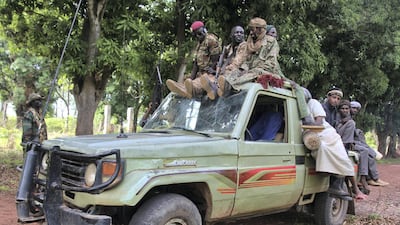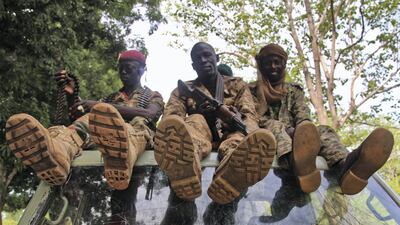
Three rebel soldiers sit atop their vehicle on the road between Kaga Bandor oand N'Dele, two rebel-held towns

From Beirut to Bangui: inside Iran’s plan to take proxy wars to Africa


  • English
  • Arabic

The Assaha Hotel is a tall, traditional Lebanese stone building with a large swimming pool and tables for al fresco dining at the back.

The rooms are painted gold and the beds have satin sheets. While the booking websites list these amenities, they do not mention that the south Beirut hotel was owned, in part, by a man with family ties at the top of Hezbollah.

The mid-market, $60-a-night hotel also hosted a prominent rebel from the Central African Republic on the payroll of Iran’s Islamic Revolutionary Guard Corps Quds Force.

Ismael Djidah, a patron of the Assaha Hotel, is central to a plot that ties the Quds Force, the IRGC's overseas arm, with efforts to build proxy forces in Africa to launch attacks on US and Western diplomatic outposts, military bases and officials.

At the time Mr Djidah stayed at the hotel in February 2018, its operating company, Lebanese Arab Company for Touristic Services, was still part-owned by Hamza Safieddine.

Information on Mr Safieddine’s ID tallies with a funeral notice for his mother that lists his brothers as Hashem, the head of Hezbollah’s executive council, and Abdallah, the organisation’s envoy to Iran.

Beyond his role in Tehran, the US Drug Enforcement Agency in 2016 accused Abdallah Safieddine of controlling the business affairs of Hezbollah’s clandestine External Security Organisation. The shadowy arm is accused of operating the internationally designated terror group’s overseas operations in South America, the Middle East and across Africa.

The Safieddine brothers have further ties to the pinnacle of power in Hezbollah – they are maternal cousins of Hassan Nasrallah, the organisation’s secretary general.

Mr Djidah’s stay at the hotel – on at least one of his numerous visits to the Lebanese capital – was confirmed by a bill included in a UN report in December 2019.

Djidah standing in front of Beirut’s famous Pigeon Rocks at Raouche. Sept 2017

The road from the Central African Republic to Tehran

For those in the market for mercenaries, the Central African Republic’s Route National 8 is a fine road to take.

Barely more than a dirt track, this dusty highway runs for hundreds of kilometres through the rebel-held north towards Darfur in neighbouring Sudan. Along the way, it passes sleepy villages, checkpoints manned by militants and occasional displacement camps filled with civilians sheltering from the latest eruption of violence.

The journey would highlight the decades of neglect by the Christian-majority government that has transformed this mainly Muslim region into a hotbed of grievance and insurgency.

This is central Africa’s “autonomous zone”, says Yale University anthropologist Louisa Lombard, where a legacy of sultans, slave-raiding and sectarian division means that towns here “never lost their militarised-mercantile nature”.

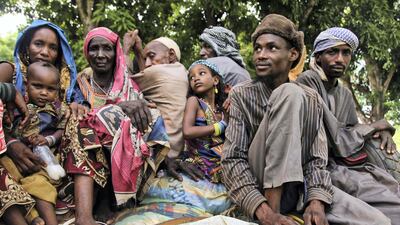
  • Civilians sit in the back of a pick-up truck driven by rerbel soldiers on the road between Kaga Bandor oand N'Dele, two rebel-held towns
    Civilians sit in the back of a pick-up truck driven by rerbel soldiers on the road between Kaga Bandor oand N'Dele, two rebel-held towns
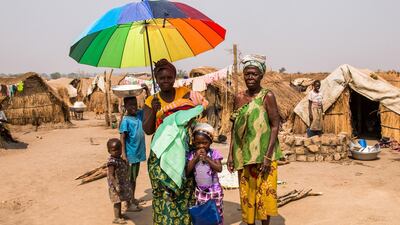
  • A family shelter from the midday sun beneath a parasol in a sprawling camp for thousands of families displaced by civil war in Kaga Bandoro, the Central African Republic
    A family shelter from the midday sun beneath a parasol in a sprawling camp for thousands of families displaced by civil war in Kaga Bandoro, the Central African Republic
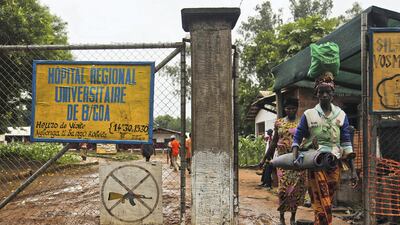
  • A woman exits the hospital in Bossangoa next to a sign that prohibits people from bringing in weapons
    A woman exits the hospital in Bossangoa next to a sign that prohibits people from bringing in weapons
  • Rebel soldiers and civilians board their vehicle on the road between rebel-held Kaga Bandor oand N'Dele
    Rebel soldiers and civilians board their vehicle on the road between rebel-held Kaga Bandor oand N'Dele
  • A man smokes a cigarette inside a camp for displaced people in Kaga Bandoro, the Central African Republic
    A man smokes a cigarette inside a camp for displaced people in Kaga Bandoro, the Central African Republic
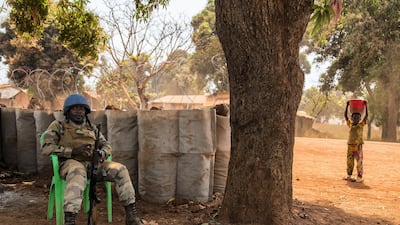
  • A Gabonese UN peacekeeper rests at a fortified position on the road to a camp for displaced people in Bria, a rebel-held town in CAR
    A Gabonese UN peacekeeper rests at a fortified position on the road to a camp for displaced people in Bria, a rebel-held town in CAR
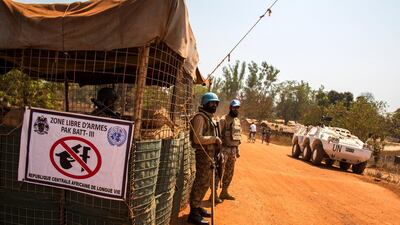
  • U.N. peacekeepers from the Pakistan Army guard the entrance to a 'weapons-free zone' in Kaga Bandoro, the Central African Republic, where thousands of displaced families shelter in a camp from rival rebel groups
    U.N. peacekeepers from the Pakistan Army guard the entrance to a 'weapons-free zone' in Kaga Bandoro, the Central African Republic, where thousands of displaced families shelter in a camp from rival rebel groups

Such militant and entrepreneurial flair caught the eye of Iran as a new front in its ongoing proxy war with the West, according to a UN investigation. The report laid out how Tehran cultivated a network of terrorist cells under the Quds Force, of which Mr Djidah was a critical part.

The Quds Force has operated, funded, trained and directed proxy militias across the Middle East and beyond for decades – its most successful project to date is Hezbollah. Its central role in Iran’s regional operations was highlighted when the US killed Quds Force head Qassem Suleimani in January.

As the influence of former colonial powers in central Africa has waned and Washington has reduced its foothold in the region, China and Russia have invested heavily. But Iran’s dealings around the Sahel states have remained shrouded in secrecy.

The Zahraa Brigade

Three rebel soldiers sit atop their vehicle on the road between Kaga Bandor oand N'Dele, two rebel-held towns

Mr Djidah, who the UN established is most likely a Chadian national, had made a name for himself as a well-connected intermediary able to make introductions to warlords across the Chadian, Sudanese and Central African borderlands. Sources close to Mr Djidah portray him as a veritable LinkedIn of rebel contacts.

He also acted as a presidential adviser to a CAR rebel named Michel Djotodia, who ran the country for ten months after seizing power and triggering a civil war in the former French colony.

After Mr Djotodia was forced to resign amid spiralling violence, the pair fled to Benin in 2014. Here, it appears, Mr Djidah came on to the radar of the Quds Force.

Suleiman Abossa, right, a rebel soldier with the FPRC armed group, stands at a checkpoint on the main road from N’Dele, in the same region where Djidah recruited his militants

One of his first meetings with Iranian operatives was in December, 2016, on Kish Island, an Iranian resort in the Arabian Gulf that he visited for one day, the UN found.

The next year, Mr Djidah made at least four trips to Lebanon. At least two more came in 2018, as did a trip to Iraq, according to visas, hotel bills and airline companies turned up by the UN investigation, which confirmed his travels to and from Rafic Hariri International Airport in Beirut. Besides his CAR diplomatic passport, Mr Djidah is believed to have also used a fake Nigerian document.

The UN began investigating Mr Djidah after he was arrested in Chad last year and an excerpt of his interrogation was aired on TV.

Djidah gives testimony 'in Chadian prison' first leaked and broadcast by a news channel in 2019

In a longer version of the video obtained by UN investigators, Mr Djidah said he aimed to form an armed group called Saraya Zahraa with the support of the Quds Force “to carry out violent actions against Western, Israeli and Saudi interests in Africa”.

In his questioning, Mr Djidah claimed to have recruited between 30 and 40 militants from CAR rebel groups who went on to travel to Lebanon, Iraq and Syria in 2017 and 2018 for training and firearms instruction at Iran-run camps.

UN investigators were able to find evidence that confirmed at least 12 members of Saraya Zahraa had travelled to Lebanon and Iraq. These members planned to establish a group comprising between 200 and 300 militants who would co-ordinate their activities with other Chadian and Sudanese cells.

Mr Djidah said that the Quds Force had given him between $12,000 (Dh44,076) and $20,000 on each trip to Iran, Lebanon and Iraq  a confession corroborated by the UN's diplomatic sources.

The entire plan is understood to have been organised by Unit 400, a highly specialised section of the Quds Force run by a senior officer named Ali Parhoon.

The operation fits closely with Iran’s previous support for militants and proxies to fight the US at arm’s length.

“The strategy has always been aimed at expanding its regional influence and to complicate US and allied forces’ efforts around the Middle East,” said Dr Vladimir Rauta, a lecturer in politics and international relations at the University of Reading who has written extensively on proxy warfare.

Iran's operations in Africa

The newly-appointed commander of the Quds Force of the Islamic Revolutionary Guard Corps Esmail Qaani. AFP

Iranian endeavours in the region are nothing new. 

The Quds Force's new commander, Esmail Qaani, has been a critical point of contact for Tehran on the continent and was sanctioned by the US in 2012 for funding “terrorist groups” and Quds Force “elements in Africa”. The US Treasury Department blamed the Quds Force for a 2010 shipment of grenades, mortars and rockets bound for Gambia but intercepted in Nigeria. Qaani’s history in Africa and recent promotion has prompted speculation that Tehran may expand its African activities.

But Dr Rauta cautioned against assuming that partnering with Iran reflected an anti-Western agenda among Saraya Zahraa and others. Such dealings have as much to do with local competition, pragmatism and resources.

“One of the big misconceptions about proxy relationships is that proxies are totally subservient to whoever funds them,” said Dr Rauta. “They might simply be marriages of convenience, where one side needs the material support that is provided by countries like Iran. There is a lot of sense in seeing this as opportunistic and not necessarily aligned along the lines of hatred towards the US.”

While Djidah claimed his growing force of militants were drawn from armed groups that earlier comprised the CAR-based coalition of mostly Muslim rebels, observers say there is every possibility that these were merely bored, regular young men with limited opportunities, picked up from displacement camps and the region’s impoverished villages. When they’re not fighting, many of the region’s “rebels” hold down ordinary jobs as mechanics, traders and bike taxi drivers.

A Blue Helmet soldier guards the outer perimter of the UN peacekeeping base in Bria

Mr Djidah also alleged that his former boss, Mr Djotodia, was involved in the plot. Although the former CAR leader strongly denies the claim, he admits visiting Kish Island in April 2016, describing this as a trip organised by Iranian business partners.

Mr Djotodia’s lawyer described Mr Djidah as a “totally unreliable witness who was trying to extort money from the Iranian regime”.

In comments made to the UN, Iran denied the allegations and, the report said, “underlined that it neither interfered in the internal affairs of any country nor supported any violent act”.

But Iran and its proxies – chief among them Hezbollah at the top of its regional network – have played crucial roles in forming, training and assisting rebel and militia networks across the Middle East. That the Assaha Hotel was a key location in the murky conspiracy between Mr Djidah, Hezbollah and Iran is just the latest such revelation.

Hezbollah and the hotel business

Hezbollah members during a parade in the group's southern suburb stronghold in Beirut on May 31, 2019. AFP

The operators of the Assaha Hotel, the Lebanese Arab Company for Touristic Services, was co-founded by Hamza Safieddine, the Mabarrat Charity Association (established by late grand ayatollah Mohammed Hussein Fadlallah, whose son Ali now oversees the charity), Ali Fadlallah and two others.

The grand ayatollah died in 2010 and while he has been described as an early spiritual mentor to Hezbollah, he always denied the claim.

The company is part of the Assaha International Group, a conglomerate of companies in Lebanon, Qatar, Sudan, the United Kingdom and Kuwait, according to a website for the brand. The group operates a series of restaurants and hotels, including one near London’s Hyde Park. Hamza Safieddine entered into another business with the Mabarrat Charity Association.

In 2016, Ali Fadlallah said their network of schools, hospitals and other institutions had been unfairly caught up in US sanctions against Hezbollah. Ali Fadlallah’s father was sanctioned by the US in 1995, but the charity he founded was never put on a blacklist by Washington.

For now, the whereabouts of Mr Djidah is unknown – but this former customer of the Assaha Hotel is unlikely to make a reservation there any time soon.

%3Cp%3E%3Cstrong%3EEngine%3A%20%3C%2Fstrong%3E4-litre%20twin-turbo%20V8%0D%3Cbr%3E%3Cstrong%3ETransmission%3A%3C%2Fstrong%3E%208-speed%20auto%0D%3Cbr%3E%3Cstrong%3EPower%3A%20%3C%2Fstrong%3E470hp%2C%20338kW%0D%3Cbr%3E%3Cstrong%3ETorque%3A%3C%2Fstrong%3E%20620Nm%0D%3Cbr%3E%3Cstrong%3EPrice%3A%3C%2Fstrong%3E%20From%20Dh491%2C500%20(estimate)%0D%3Cbr%3E%3Cstrong%3EOn%20sale%3A%20%3C%2Fstrong%3Enow%3C%2Fp%3E%0A
Living in...

This article is part of a guide on where to live in the UAE. Our reporters will profile some of the country’s most desirable districts, provide an estimate of rental prices and introduce you to some of the residents who call each area home.

What is dialysis?

Dialysis is a way of cleaning your blood when your kidneys fail and can no longer do the job.

It gets rid of your body's wastes, extra salt and water, and helps to control your blood pressure. The main cause of kidney failure is diabetes and hypertension.

There are two kinds of dialysis — haemodialysis and peritoneal.

In haemodialysis, blood is pumped out of your body to an artificial kidney machine that filter your blood and returns it to your body by tubes.

In peritoneal dialysis, the inside lining of your own belly acts as a natural filter. Wastes are taken out by means of a cleansing fluid which is washed in and out of your belly in cycles.

It isn’t an option for everyone but if eligible, can be done at home by the patient or caregiver. This, as opposed to home haemodialysis, is covered by insurance in the UAE.

Tu%20Jhoothi%20Main%20Makkaar%20
%3Cp%3E%3Cstrong%3EDirector%3A%20%3C%2Fstrong%3ELuv%20Ranjan%26nbsp%3B%3C%2Fp%3E%0A%3Cp%3E%3Cstrong%3EStars%3A%20%3C%2Fstrong%3ERanbir%20Kapoor%2C%20Shraddha%20Kapoor%2C%20Anubhav%20Singh%20Bassi%20and%20Dimple%20Kapadia%3C%2Fp%3E%0A%3Cp%3E%3Cstrong%3ERating%3A%3C%2Fstrong%3E%203%2F5%3C%2Fp%3E%0A
Dubai Bling season three

Cast: Loujain Adada, Zeina Khoury, Farhana Bodi, Ebraheem Al Samadi, Mona Kattan, and couples Safa & Fahad Siddiqui and DJ Bliss & Danya Mohammed 

Rating: 1/5

What can victims do?

Always use only regulated platforms

Stop all transactions and communication on suspicion

Save all evidence (screenshots, chat logs, transaction IDs)

Report to local authorities

Warn others to prevent further harm

Courtesy: Crystal Intelligence

Wonka
%3Cp%3E%3Cstrong%3EDirector%3A%3C%2Fstrong%3E%C2%A0Paul%20King%3C%2Fp%3E%0A%3Cp%3E%3Cstrong%3EStarring%3A%C2%A0%3C%2Fstrong%3ETimothee%20Chalamet%2C%20Olivia%20Colman%2C%20Hugh%20Grant%3C%2Fp%3E%0A%3Cp%3E%3Cstrong%3ERating%3A%3C%2Fstrong%3E%202%2F5%3C%2Fp%3E%0A
$1,000 award for 1,000 days on madrasa portal

Daily cash awards of $1,000 dollars will sweeten the Madrasa e-learning project by tempting more pupils to an education portal to deepen their understanding of math and sciences.

School children are required to watch an educational video each day and answer a question related to it. They then enter into a raffle draw for the $1,000 prize.

“We are targeting everyone who wants to learn. This will be $1,000 for 1,000 days so there will be a winner every day for 1,000 days,” said Sara Al Nuaimi, project manager of the Madrasa e-learning platform that was launched on Tuesday by the Vice President and Ruler of Dubai, to reach Arab pupils from kindergarten to grade 12 with educational videos.  

“The objective of the Madrasa is to become the number one reference for all Arab students in the world. The 5,000 videos we have online is just the beginning, we have big ambitions. Today in the Arab world there are 50 million students. We want to reach everyone who is willing to learn.”

A general guide to how active you are:

Less than 5,000 steps - sedentary

5,000 - 9,999 steps - lightly active

10,000  - 12,500 steps - active

12,500 - highly active

Benefits of first-time home buyers' scheme
  • Priority access to new homes from participating developers
  • Discounts on sales price of off-plan units
  • Flexible payment plans from developers
  • Mortgages with better interest rates, faster approval times and reduced fees
  • DLD registration fee can be paid through banks or credit cards at zero interest rates
How to help

Send “thenational” to the following numbers or call the hotline on: 0502955999
2289 – Dh10
2252 – Dh 50
6025 – Dh20
6027 – Dh 100
6026 – Dh 200

Jetour T1 specs

Engine: 2-litre turbocharged

Power: 254hp

Torque: 390Nm

Price: From Dh126,000

Available: Now

Fixtures

Tuesday - 5.15pm: Team Lebanon v Alger Corsaires; 8.30pm: Abu Dhabi Storms v Pharaohs

Wednesday - 5.15pm: Pharaohs v Carthage Eagles; 8.30pm: Alger Corsaires v Abu Dhabi Storms

Thursday - 4.30pm: Team Lebanon v Pharaohs; 7.30pm: Abu Dhabi Storms v Carthage Eagles

Friday - 4.30pm: Pharaohs v Alger Corsaires; 7.30pm: Carthage Eagles v Team Lebanon

Saturday - 4.30pm: Carthage Eagles v Alger Corsaires; 7.30pm: Abu Dhabi Storms v Team Lebanon

Stage results

1. Julian Alaphilippe (FRA) Deceuninck-QuickStep  4:39:05

2. Michael Matthews (AUS) Team BikeExchange 0:00:08

3. Primoz Roglic (SLV) Jumbo-Visma same time 

4. Jack Haig (AUS) Bahrain Victorious s.t  

5. Wilco Kelderman (NED) Bora-Hansgrohe s.t  

6. Tadej Pogacar (SLV) UAE Team Emirates s.t 

7. David Gaudu (FRA) Groupama-FDJ s.t

8. Sergio Higuita Garcia (COL) EF Education-Nippo s.t     

9. Bauke Mollema (NED) Trek-Segafredo  s.t

10. Geraint Thomas (GBR) Ineos Grenadiers s.t

%20Ramez%20Gab%20Min%20El%20Akher
%3Cp%3E%3Cstrong%3ECreator%3A%3C%2Fstrong%3E%20Ramez%20Galal%3C%2Fp%3E%0A%3Cp%3E%3Cstrong%3EStarring%3A%3C%2Fstrong%3E%20Ramez%20Galal%3C%2Fp%3E%0A%3Cp%3E%3Cstrong%3EStreaming%20on%3A%20%3C%2Fstrong%3EMBC%20Shahid%3C%2Fp%3E%0A%3Cp%3E%3Cstrong%3ERating%3A%20%3C%2Fstrong%3E2.5%2F5%3C%2Fp%3E%0A
The%20specs
%3Cp%3E%3Cstrong%3EPowertrain%3A%20%3C%2Fstrong%3ESingle%20electric%20motor%0D%3Cbr%3E%3Cstrong%3EPower%3A%20%3C%2Fstrong%3E201hp%0D%3Cbr%3E%3Cstrong%3ETorque%3A%20%3C%2Fstrong%3E310Nm%0D%3Cbr%3E%3Cstrong%3ETransmission%3A%20%3C%2Fstrong%3ESingle-speed%20auto%0D%3Cbr%3E%3Cstrong%3EBattery%3A%20%3C%2Fstrong%3E53kWh%20lithium-ion%20battery%20pack%20(GS%20base%20model)%3B%2070kWh%20battery%20pack%20(GF)%0D%3Cbr%3E%3Cstrong%3ETouring%20range%3A%20%3C%2Fstrong%3E350km%20(GS)%3B%20480km%20(GF)%0D%3Cbr%3E%3Cstrong%3EPrice%3A%20%3C%2Fstrong%3EFrom%20Dh129%2C900%20(GS)%3B%20Dh149%2C000%20(GF)%0D%3Cbr%3E%3Cstrong%3EOn%20sale%3A%3C%2Fstrong%3E%20Now%3C%2Fp%3E%0A
The specs

Engine: 1.6-litre 4-cyl turbo

Power: 217hp at 5,750rpm

Torque: 300Nm at 1,900rpm

Transmission: eight-speed auto

Price: from Dh130,000

On sale: now

Children who witnessed blood bath want to help others

Aged just 11, Khulood Al Najjar’s daughter, Nora, bravely attempted to fight off Philip Spence. Her finger was injured when she put her hand in between the claw hammer and her mother’s head.

As a vital witness, she was forced to relive the ordeal by police who needed to identify the attacker and ensure he was found guilty.

Now aged 16, Nora has decided she wants to dedicate her career to helping other victims of crime.

“It was very horrible for her. She saw her mum, dying, just next to her eyes. But now she just wants to go forward,” said Khulood, speaking about how her eldest daughter was dealing with the trauma of the incident five years ago. “She is saying, 'mama, I want to be a lawyer, I want to help people achieve justice'.”

Khulood’s youngest daughter, Fatima, was seven at the time of the attack and attempted to help paramedics responding to the incident.

“Now she wants to be a maxillofacial doctor,” Khulood said. “She said to me ‘it is because a maxillofacial doctor returned your face, mama’. Now she wants to help people see themselves in the mirror again.”

Khulood’s son, Saeed, was nine in 2014 and slept through the attack. While he did not witness the trauma, this made it more difficult for him to understand what had happened. He has ambitions to become an engineer.

Dengue%20fever%20symptoms
%3Cul%3E%0A%3Cli%3EHigh%20fever%3C%2Fli%3E%0A%3Cli%3EIntense%20pain%20behind%20your%20eyes%3C%2Fli%3E%0A%3Cli%3ESevere%20headache%3C%2Fli%3E%0A%3Cli%3EMuscle%20and%20joint%20pains%3C%2Fli%3E%0A%3Cli%3ENausea%3C%2Fli%3E%0A%3Cli%3EVomiting%3C%2Fli%3E%0A%3Cli%3ESwollen%20glands%3C%2Fli%3E%0A%3Cli%3ERash%3C%2Fli%3E%0A%3C%2Ful%3E%0A%3Cp%3EIf%20symptoms%20occur%2C%20they%20usually%20last%20for%20two-seven%20days%3C%2Fp%3E%0A
Indoor cricket in a nutshell

Indoor Cricket World Cup - Sep 16-20, Insportz, Dubai

16 Indoor cricket matches are 16 overs per side

8 There are eight players per team

There have been nine Indoor Cricket World Cups for men. Australia have won every one.

5 Five runs are deducted from the score when a wickets falls

Batsmen bat in pairs, facing four overs per partnership

Scoring In indoor cricket, runs are scored by way of both physical and bonus runs. Physical runs are scored by both batsmen completing a run from one crease to the other. Bonus runs are scored when the ball hits a net in different zones, but only when at least one physical run is score.

Zones

A Front net, behind the striker and wicketkeeper: 0 runs

B Side nets, between the striker and halfway down the pitch: 1 run

Side nets between halfway and the bowlers end: 2 runs

Back net: 4 runs on the bounce, 6 runs on the full

What is graphene?

Graphene is extracted from graphite and is made up of pure carbon.

It is 200 times more resistant than steel and five times lighter than aluminum.

It conducts electricity better than any other material at room temperature.

It is thought that graphene could boost the useful life of batteries by 10 per cent.

Graphene can also detect cancer cells in the early stages of the disease.

The material was first discovered when Andre Geim and Konstantin Novoselov were 'playing' with graphite at the University of Manchester in 2004.

Avatar: Fire and Ash

Director: James Cameron

Starring: Sam Worthington, Sigourney Weaver, Zoe Saldana

Rating: 4.5/5

Ferrari
%3Cp%3E%3Cstrong%3EDirector%3A%3C%2Fstrong%3E%20Michael%20Mann%26nbsp%3B%3C%2Fp%3E%0A%3Cp%3E%3Cstrong%3EStarring%3A%3C%2Fstrong%3E%20Adam%20Driver%2C%20Penelope%20Cruz%2C%20Shailene%20Woodley%2C%20Patrick%20Dempsey%3C%2Fp%3E%0A%3Cp%3E%3Cstrong%3ERating%3A%3C%2Fstrong%3E%203%2F5%3C%2Fp%3E%0A
Married Malala

Malala Yousafzai is enjoying married life, her father said.

The 24-year-old married Pakistan cricket executive Asser Malik last year in a small ceremony in the UK.

Ziauddin Yousafzai told The National his daughter was ‘very happy’ with her husband.