The Alpine resort city of Davos before the 54th annual meeting of the World Economic Forum. AFP

Rising Middle East tensions dominate Davos, with solutions to conflict unclear


Mina Al-Oraibi
  • English
  • Arabic

This week was meant to be a week when Iraq, and especially the Kurdistan region of Iraq, showcased the economic opportunities in the region and country at the World Economic Forum.

For the first time in years, Iraq has a strong showing at Davos, and the Kurdistan region even has “Kurdish House” on the main street. Yet, on the eve of the annual meeting, many of those plans were up in the air when ballistics missiles launched from Iran struck Erbil, the Kurdistan regional capital, on Monday night.

Yesterday, Prime Minister of the Kurdistan region Masrour Barzani said Erbil was “not party to the conflict” in the region but was being pulled in. The difficult case for investing in Iraq just got harder. The military role of Iran not only in Iraq, Lebanon and Yemen but also in the provision of drones to Russia was raised during sessions yesterday.

That will be one of the issues expected to be raised to Iranian Foreign Minister Hossein Amirabdollahian when he takes the stage today. The wars in Gaza and Ukraine dominated geopolitical discussions.

Prince Faisal bin Farhan, Foreign Minister of Saudi Arabia, stressed the need for an immediate ceasefire in a packed session called “Securing an Insecure World”.

Responding to questions on the Red Sea attacks, the main concern raised in economic circles, he said: “We are incredibly concerned for regional security in general – priority needs to be de-escalation not only in the Red Sea but in the entire region.”

It was a sentiment echoed throughout the day.

The 2024 World Economic Forum in Davos - in pictures

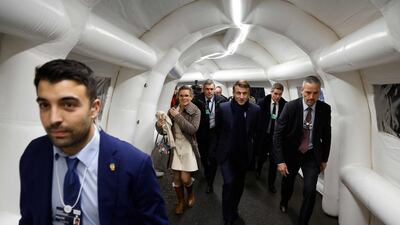
  • French President Emmanuel Macron (centre), flanked by delegation members, walks through an inflatable tunnel connecting venues at Davos. AFP
    French President Emmanuel Macron (centre), flanked by delegation members, walks through an inflatable tunnel connecting venues at Davos. AFP
  • Argentina's President Javier Milei. Reuters
    Argentina's President Javier Milei. Reuters
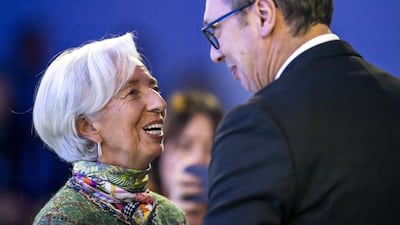
  • European Central Bank chief Christine Lagarde with Serbia's President Vucic. EPA
    European Central Bank chief Christine Lagarde with Serbia's President Vucic. EPA
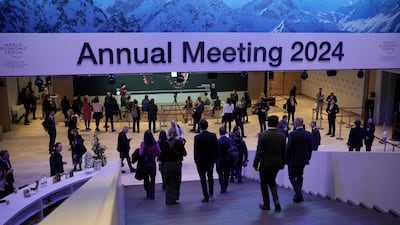
  • WEF participants gather at Davos Congress Centre. AP Photo
    WEF participants gather at Davos Congress Centre. AP Photo
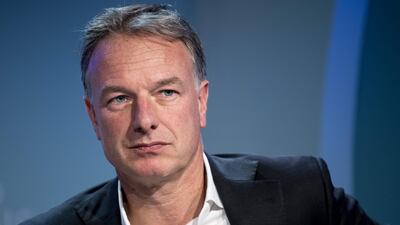
  • ING Group chief executive Steven van Rijswijk at the World Economic Forum gathering in Davos. AFP
    ING Group chief executive Steven van Rijswijk at the World Economic Forum gathering in Davos. AFP
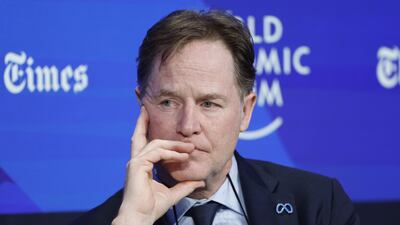
  • Nick Clegg, president of global affairs and communications with Meta at the WEF. Bloomberg
    Nick Clegg, president of global affairs and communications with Meta at the WEF. Bloomberg
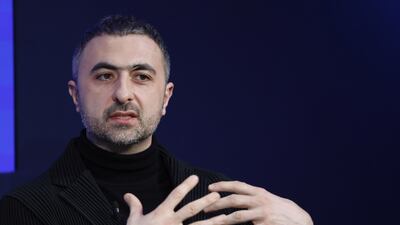
  • Mustafa Suleyman, co-founder and chief executive officer of Inflection AI, speaking at the event. Bloomberg
    Mustafa Suleyman, co-founder and chief executive officer of Inflection AI, speaking at the event. Bloomberg
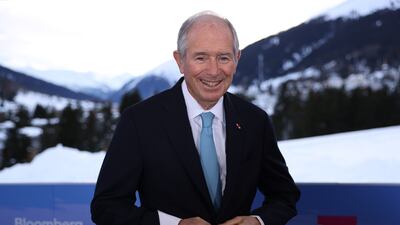
  • Steve Schwarzman, co-founder and chief executive officer of Blackstone Group, at the Swiss alpine resort. Bloomberg
    Steve Schwarzman, co-founder and chief executive officer of Blackstone Group, at the Swiss alpine resort. Bloomberg
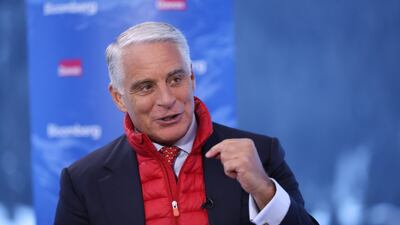
  • Andrea Orcel, group chief executive of Unicredit, speaking during an interview at the World Economic Forum in Davos, Switzerland. Bloomberg
    Andrea Orcel, group chief executive of Unicredit, speaking during an interview at the World Economic Forum in Davos, Switzerland. Bloomberg
  • Mike Brown, chief executive of Nedbank Group Ltd. Bloomberg
    Mike Brown, chief executive of Nedbank Group Ltd. Bloomberg
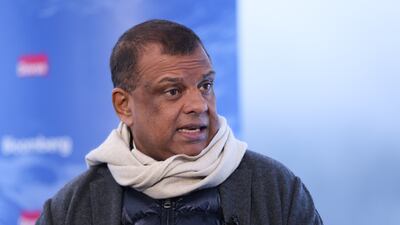
  • Tony Fernandes, chief executive Capital A Berhad. Bloomberg
    Tony Fernandes, chief executive Capital A Berhad. Bloomberg
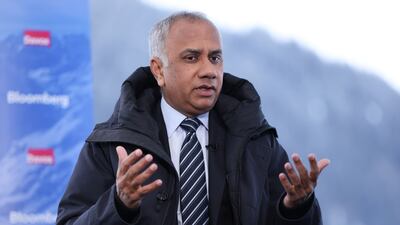
  • Salil Parekh, chief executive officer of Infosys. Bloomberg
    Salil Parekh, chief executive officer of Infosys. Bloomberg
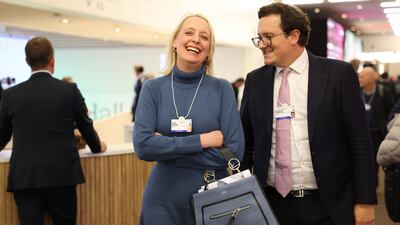
  • Julie Sweet, chief executive of Accenture, and Ludovic Subran, chief economist at Allianz SE. Bloomberg
    Julie Sweet, chief executive of Accenture, and Ludovic Subran, chief economist at Allianz SE. Bloomberg
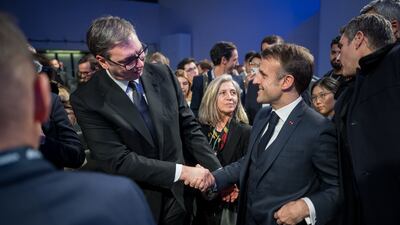
  • France's President Macron (right) shakes hand with Serbia's President Aleksandar Vucic after his speech. AFP
    France's President Macron (right) shakes hand with Serbia's President Aleksandar Vucic after his speech. AFP
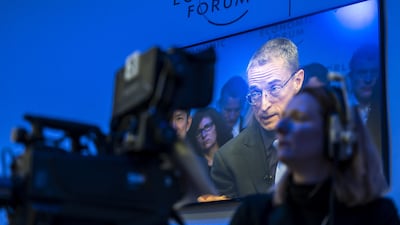
  • Pat Gelsinger, chief executive of Intel. EPA
    Pat Gelsinger, chief executive of Intel. EPA
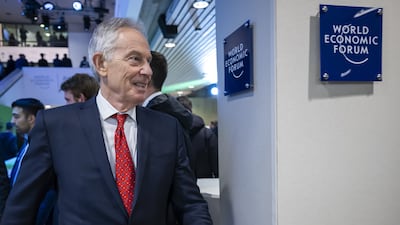
  • Former British prime minister Tony Blair. EPA
    Former British prime minister Tony Blair. EPA
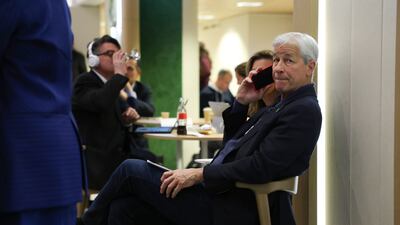
  • Jamie Dimon, chief executive of JP Morgan Chase. Bloomberg
    Jamie Dimon, chief executive of JP Morgan Chase. Bloomberg
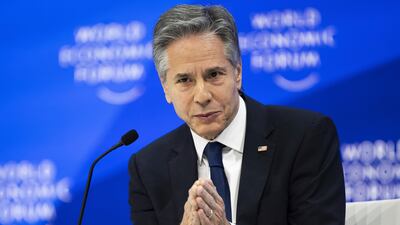
  • US Secretary of State Antony Blinken. AP
    US Secretary of State Antony Blinken. AP
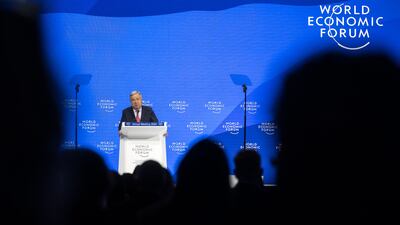
  • Antonio Guterres, UN Secretary General, addresses the assembly. AFP
    Antonio Guterres, UN Secretary General, addresses the assembly. AFP
  • Former US vice president Al Gore speaks. Reuters
    Former US vice president Al Gore speaks. Reuters

Prince Faisal said that while the attacks were “clearly connected to war in Gaza – we need to focus on the war in Gaza not because of the Red Sea but because of war itself and the situation there with close to 30,000 civilians killed”.

“I frankly don’t see any strategic objectives Israel has claimed is coming any closer,” he said.

“We need a ceasefire immediately – continuing as we are now will lead to continuing cycles of escalation.”

He added: “Our emphasis is finding a path of de-escalation.”

The German Foreign Minister, Annalena Baerbock, called for a “sustainable ceasefire”, highlighting the division in views, yet she acknowledged “this is a total disaster, for Israel, for civilians in Gaza, for the whole world”.

“A spark can burn the whole region [and] not just the region. We feel the consequences in Ukraine [with] Russian attacks highest since the invasion,” she said.

The packed hall had illustrious attendees, including the king and queen of Belgium, UN envoys to Syria and Yemen and leading global chief executives – all of whom were looking for answers.

While the session addressed the war in detail, it was short in solutions. Ms Baerbock’s statement that “we are stuck in a vicious cycle” rang strongest.

Jordanian Prime Minister Bisher Khasawneh held a separate session and warned that some actions by Israel could be war crimes.

However, he stressed: “Comprehensive peace remains [the] strategic objective. [We] are firmly committed to the peace accords.”

How the peace can be reached remained unclear.

Kamindu Mendis bio

Full name: Pasqual Handi Kamindu Dilanka Mendis

Born: September 30, 1998

Age: 20 years and 26 days

Nationality: Sri Lankan

Major teams Sri Lanka's Under 19 team

Batting style: Left-hander

Bowling style: Right-arm off-spin and slow left-arm orthodox (that's right!)

Scoreline:

Everton 4

Richarlison 13'), Sigurdsson 28', ​​​​​​​Digne 56', Walcott 64'

Manchester United 0

Man of the match: Gylfi Sigurdsson (Everton)

'I Want You Back'

Director:Jason Orley

Stars:Jenny Slate, Charlie Day

Rating:4/5

Other IPL batting records

Most sixes: 292 – Chris Gayle

Most fours: 491 – Gautam Gambhir

Highest individual score: 175 not out – Chris Gayle (for Royal Challengers Bangalore against Pune Warriors in 2013)

Highest strike-rate: 177.29 – Andre Russell

Highest strike-rate in an innings: 422.22 – Chris Morris (for Delhi Daredevils against Rising Pune Supergiant in 2017)

Highest average: 52.16 – Vijay Shankar

Most centuries: 6 – Chris Gayle

Most fifties: 36 – Gautam Gambhir

Fastest hundred (balls faced): 30 – Chris Gayle (for Royal Challengers Bangalore against Pune Warriors in 2013)

Fastest fifty (balls faced): 14 – Lokesh Rahul (for Kings XI Punjab against Delhi Daredevils in 2018)


SPEC%20SHEET%3A%20SAMSUNG%20GALAXY%20S23%20ULTRA
%3Cp%3E%3Cstrong%3EDisplay%3A%3C%2Fstrong%3E%206.8%22%20edge%20quad-HD%2B%20dynamic%20Amoled%202X%2C%20Infinity-O%2C%203088%20x%201440%2C%20500ppi%2C%20HDR10%2B%2C%20120Hz%3C%2Fp%3E%0A%3Cp%3E%3Cstrong%3EProcessor%3A%3C%2Fstrong%3E%204nm%20Qualcomm%20Snapdragon%208%20Gen%202%2C%2064-bit%20octa-core%3C%2Fp%3E%0A%3Cp%3E%3Cstrong%3EMemory%3A%3C%2Fstrong%3E%208%2F12GB%20RAM%3C%2Fp%3E%0A%3Cp%3E%3Cstrong%3EStorage%3A%3C%2Fstrong%3E%20128%2F256%2F512GB%2F1TB%20(only%20128GB%20has%20an%208GB%20RAM%20option)%3C%2Fp%3E%0A%3Cp%3E%3Cstrong%3EPlatform%3A%3C%2Fstrong%3E%20Android%2013%3C%2Fp%3E%0A%3Cp%3E%3Cstrong%3EMain%20camera%3A%3C%2Fstrong%3E%20quad%2012MP%20ultra-wide%20f%2F2.2%20%2B%20200MP%20wide%20f%2F1.7%20%2B%2010MP%20telephoto%20f%2F4.9%20%2B%2010MP%20telephoto%202.4%3B%203x%2F10x%20optical%20zoom%2C%20Space%20Zoom%20up%20to%20100x%3B%20auto%20HDR%2C%20expert%20RAW%3C%2Fp%3E%0A%3Cp%3E%3Cstrong%3EVideo%3A%3C%2Fstrong%3E%208K%4024%2F30fps%2C%204K%4060fps%2C%20full-HD%4060fps%2C%20HD%4030fps%2C%20full-HD%20super%20slo-mo%40960fps%3C%2Fp%3E%0A%3Cp%3E%3Cstrong%3EFront%20camera%3A%3C%2Fstrong%3E%2012MP%20f%2F2.2%3C%2Fp%3E%0A%3Cp%3E%3Cstrong%3EBattery%3A%3C%2Fstrong%3E%205000mAh%2C%20fast%20wireless%20charging%202.0%2C%20Wireless%20PowerShare%3C%2Fp%3E%0A%3Cp%3E%3Cstrong%3EConnectivity%3A%3C%2Fstrong%3E%205G%2C%20Wi-Fi%2C%20Bluetooth%205.2%2C%20NFC%3C%2Fp%3E%0A%3Cp%3E%3Cstrong%3EI%2FO%3A%3C%2Fstrong%3E%20USB-C%3B%20built-in%20Galaxy%20S%20Pen%3C%2Fp%3E%0A%3Cp%3E%3Cstrong%3ESIM%3A%3C%2Fstrong%3E%20single%20nano%20%2F%20nano%20%2B%20eSIM%20%2F%20nano%20%2B%20nano%20%2B%20eSIM%20%2F%20nano%20%2B%20nano%3C%2Fp%3E%0A%3Cp%3E%3Cstrong%3EColours%3A%3C%2Fstrong%3E%20cream%2C%20green%2C%20lavender%2C%20phantom%20black%3B%20online%20exclusives%3A%20graphite%2C%20lime%2C%20red%2C%20sky%20blue%3C%2Fp%3E%0A%3Cp%3E%3Cstrong%3EPrice%3A%3C%2Fstrong%3E%20Dh4%2C949%20for%20256GB%2C%20Dh5%2C449%20for%20512GB%2C%20Dh6%2C449%20for%201TB%3B%20128GB%20unavailable%20in%20the%20UAE%3C%2Fp%3E%0A
COMPANY%20PROFILE
%3Cp%3E%3Cstrong%3EName%3A%3C%2Fstrong%3E%20Carzaty%2C%20now%20Kavak%3Cbr%3E%3Cstrong%3EBased%3A%3C%2Fstrong%3E%20Dubai%3Cbr%3E%3Cstrong%3ELaunch%20year%3A%20%3C%2Fstrong%3ECarzaty%20launched%20in%202018%2C%20Kavak%20in%20the%20GCC%20launched%20in%202022%3Cbr%3E%3Cstrong%3ENumber%20of%20employees%3A%3C%2Fstrong%3E%20140%3Cbr%3E%3Cstrong%3ESector%3A%3C%2Fstrong%3E%20Automotive%3Cbr%3E%3Cstrong%3EFunding%3A%20%3C%2Fstrong%3ECarzaty%20raised%20%246m%20in%20equity%20and%20%244m%20in%20debt%3B%20Kavak%20plans%20%24130m%20investment%20in%20the%20GCC%3C%2Fp%3E%0A
RESULT

Bournemouth 0 Southampton 3 (Djenepo (37', Redmond 45' 1, 59')

Man of the match Nathan Redmond (Southampton)

Iran's dirty tricks to dodge sanctions

There’s increased scrutiny on the tricks being used to keep commodities flowing to and from blacklisted countries. Here’s a description of how some work.

1 Going Dark

A common method to transport Iranian oil with stealth is to turn off the Automatic Identification System, an electronic device that pinpoints a ship’s location. Known as going dark, a vessel flicks the switch before berthing and typically reappears days later, masking the location of its load or discharge port.

2. Ship-to-Ship Transfers

A first vessel will take its clandestine cargo away from the country in question before transferring it to a waiting ship, all of this happening out of sight. The vessels will then sail in different directions. For about a third of Iranian exports, more than one tanker typically handles a load before it’s delivered to its final destination, analysts say.

3. Fake Destinations

Signaling the wrong destination to load or unload is another technique. Ships that intend to take cargo from Iran may indicate their loading ports in sanction-free places like Iraq. Ships can keep changing their destinations and end up not berthing at any of them.

4. Rebranded Barrels

Iranian barrels can also be rebranded as oil from a nation free from sanctions such as Iraq. The countries share fields along their border and the crude has similar characteristics. Oil from these deposits can be trucked out to another port and documents forged to hide Iran as the origin.

* Bloomberg

Updated: January 17, 2024, 5:17 AM