

Israeli Prime Minister Benjamin Netanyahu has been criticised by former heads of the secret service over his government's judicial reforms that would strip power from Israel's Supreme Court and transfer them to Parliament.
Mr Netanyahu will have a pacemaker fitted after doctors said his heart rate was unusually slow, ahead of a crucial new vote on his controversial judicial reforms on Monday.
There has been mounting criticism of the overhaul from retired former heads of the secret service agencies Mossad and Shin Bet, the country's internal security services.
Monday’s vote in the Knesset is on draft legislation for Mr Netanyahu’s judicial reform plan, which critics say amounts to a coup.
If successful, his opponents say it will concentrate power in the hands of the government for supreme court appointments.
Mass protests were set to continue. Thousands of people took to the streets across Israel on Sunday, once again blocking key highways, after thousands marched into Jerusalem on Saturday night and camped out near the Knesset, or parliament, ahead of Monday's vote.
-

Mass protests continue across Israel against the government's justice system reform plan. EPA -

Anti-government protesters march towards the Israeli Knesset in Jerusalem. EPA -

Protesters blocked roads across Israel, hours after parliament adopted a key clause of the government's judicial overhaul package, which opponents say threatens democracy. AFP -

A demonstrator in a dinosaur suit marches at Ben Gurion Airport near Lod. AFP -
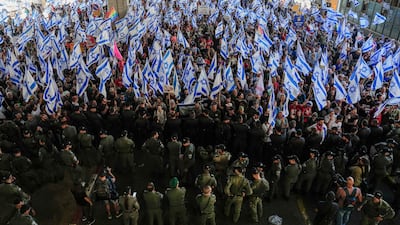
Israelis wave flags during a protest against plans by Prime Minister Benjamin Netanyahu's government to overhaul the judicial system. AP -

Israelis have taken to the streets en masse to protest against the government’s plans to weaken the power of judges. Bloomberg -

Mass protests continue across the country against the government's justice system reform plan. EPA -
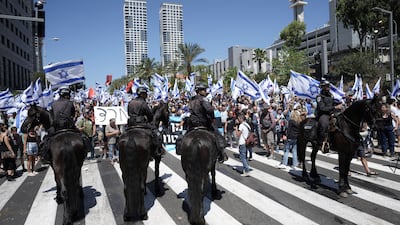
Mounted police in Tel Aviv, Israel, control protesters demonstrating against plans to overhaul the judicial system. AP -

Police and protesters clash on the 'Day of Disruption' opposing the judicial overhaul, in Tel Aviv. Reuters -
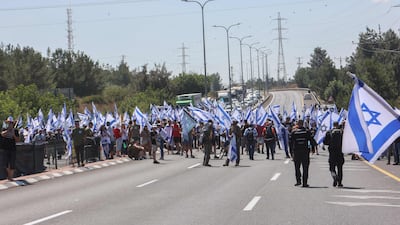
Israeli demonstrators wave flags as they block Highway 443 between Jerusalem and Tel Aviv, near Modiin. AFP -
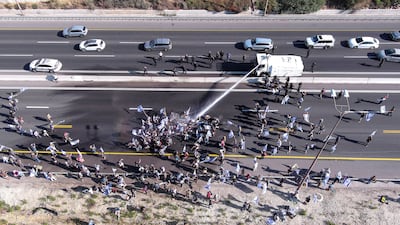
Israeli police use a water cannon against demonstrators at the Ein Hemed junction towards Jerusalem. Reuters -
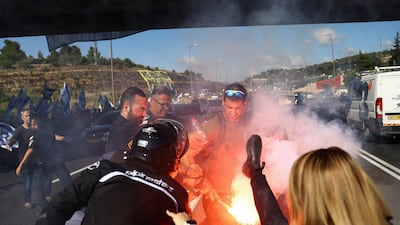
Protesters set off a flare near Jerusalem as they oppose a bill to curb the Israeli Supreme Court's power to void government decisions. Reuters -

A confrontation in Tel Aviv, Israel, during protests against the move by Prime Minister Benjamin Netanyahu's coalition. Reuters -
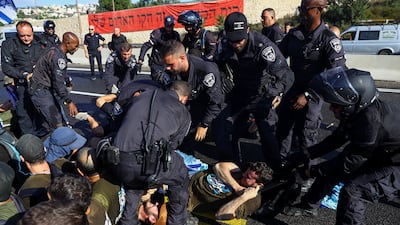
Members of the Israeli security forces remove demonstrators blocking a highway to Jerusalem. Reuters -
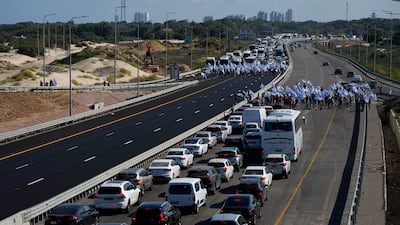
Israeli protesters block the Tel Aviv to Haifa highway near Beit Yanai, Israel. AP -
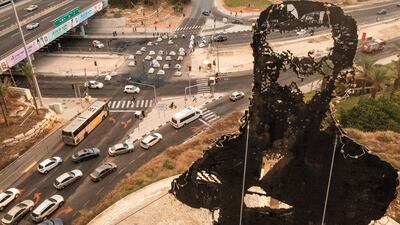
Demonstrators block a road with tents at the entrance to Herzliya, north of Tel Aviv, Israel. Reuters -

Israeli anti-government protesters block the entrance to Jerusalem, where some demonstrators entered the Knesset building. EPA


The reforms have triggered seven months of intensifying protests, the largest in Israel’s history and have caused military reservists to withhold their service.
Opposition within the armed forces is intensifying, as a growing number of former secret service heads have publicly called for a halt to the judicial overhaul.
Thousands of reservist soldiers, elite commandos and air force pilots have signed letters saying they will not serve if the reforms go through, including 1,100 reservist pilots last week alone.
Over 100 retired security chiefs publicly supported the growing ranks of military reservists who plan to stop reporting for duty.
“These are dangerous cracks,” military chief Lieutenant General Herzi Halevi wrote in a letter to soldiers on Sunday meant to address the tensions. “If we will not be a strong and cohesive military if the best do not serve in the IDF, we will no longer be able to exist as a country in the region,” he said.
Ex-Mossad objection
Former Mossad head Yossi Cohen will write in Israel’s Yedioth Ahronoth news outlet, where he will call for a halt to the reforms in favour of continuing dialogue, the paper said on Sunday.
Mr Netanyahu's government says that while compromise is possible, the reforms are essential.
Last week, another former Mossad chief, Tamir Pardo, said at a press conference that Israel would become “a former democracy” if the draft legislation is approved.
On Thursday, former head of Israel’s internal security force Shin Bet, Nadav Argaman called the reforms a “coup”, and said that military personnel withholding their service in protest was justified.
While all security officials quoted are no longer serving, their remarks come amid a large number of Israeli reservists across all branches of the armed forces who say they will not return to serve if called up.
Supporters of the reforms say the current process is undemocratic and puts political powers in the hands of unelected officials.
Mr Netanyahu said on Sunday he would be well enough to attend Monday’s vote, which is expected to trigger another round of nationwide protests if it passes.
“The doctors tell me that I will be free and I will be released from the hospital tomorrow afternoon and will be able to go to the Knesset to vote,” the prime minister said.
The final vote Monday will be on the “reasonability” clause through which judges can strike down government decisions.
Lawmakers began their debate despite Mr Netanyahu's health problems. In a speech launching the session, Simcha Rothman, a main driver of the overhaul, denounced the courts, saying they damaged Israel's democratic fundamentals by arbitrarily striking down government decisions.
“This small clause is meant to restore democracy to the state of Israel,” Mr Rothman said. “I call on Knesset members to approve the bill.”
Speaking in parliament, opposition leader Yair Lapid called for Netanyahu to resume compromise talks and lauded the protesters for standing up to the government.
“The government of Israel launched a war of attrition against the citizens of Israel and discovered the people can’t be broken. We won’t give up on our children’s future,” he said.

