

The James Webb Space Telescope has detected ‘smoke signals’ from a galaxy more than 12 billion light-years away.
An international team of astronomers discovered complex organic molecules, which are also found on Earth in smoke, soot and smog, in a distant galaxy.
Studying the molecules could help scientists understand the chemistry of when new stars are born, even if it was in the earliest period of the history of the universe.
The study, published in the Nature science journal, was conducted by researchers at Texas A&M University and other higher education institutions.
“Discoveries like this are precisely what Webb was built to do: understand the earliest stages of the universe in new and exciting ways,” said Kedar Phadke, a University of Illinois Urbana-Champaign graduate student, who led the technical development of the team’s Webb observations.

“It’s amazing that we can identify molecules billions of light-years away that we’re familiar with here on Earth, even if they show up in ways we don’t like, like smog and smoke.
“It’s also a powerful statement about the amazing capabilities of Webb that we’ve never had before,” he said.
Molecules are common in space with previous theories suggesting that their presence meant new stars were forming.
However, the latest observations by the Webb telescope suggest that might not always be the case.
“Astronomers used to think they were a good sign that new stars were forming.
“Anywhere you saw these molecules, baby stars were also right there blazing away,” said Justin Spilker, an astronomer at Texas A&M University.

“Thanks to the high-definition images from Webb, we found a lot of regions with smoke but no star formation and others with new stars forming but no smoke.”
The discovery was possible because of gravitational lensing – a warp in the fabric of space and time.
It is when two galaxies are almost perfectly aligned from the point of view on Earth, and the light from the background galaxy is stretched and magnified by the foreground galaxy into a ringlike shape, also known as the Einstein Ring.
“By combining Webb’s amazing capabilities with a natural ‘cosmic magnifying glass,’ we were able to see even more detail than we otherwise could,” said Mr Spilker.
“That level of magnification is actually what made us interested in looking at this galaxy with Webb in the first place. It really lets us see all the rich details of what makes up a galaxy in the early universe that we could never do otherwise.”
The James Webb Space Telescope launched into space on Christmas Day, 2021, to help scientists understand the universe and how it was formed.
Astronomers have used the space observatory to see into the early universe and study our solar system like never before.
Largest image by James Webb space telescopes – in pictures
-
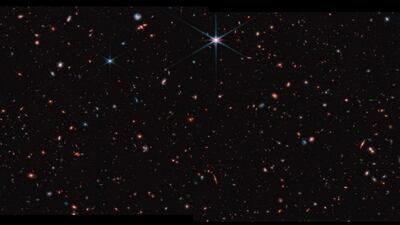
An enormous colour mosaic made up of images captured by the James Webb Space Telescope has been released. This image shows only a small part of the mosiac. All photos: Nasa -
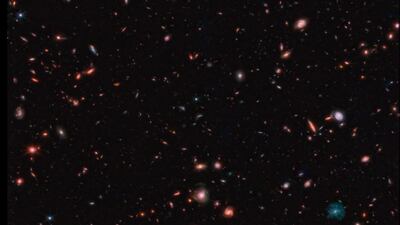
The mosaic is made up 690 individual frames taken with the telescope’s near infrared camera – an instrument that captures radiant energy from objects invisible to the human eye. -

Collectively known as Epoch 1, the image is the largest one yet made using data from the world’s largest space observatory. -
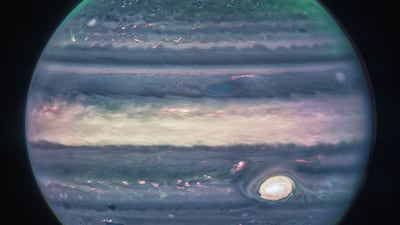
Jupiter as seen by the James Webb telescope. -
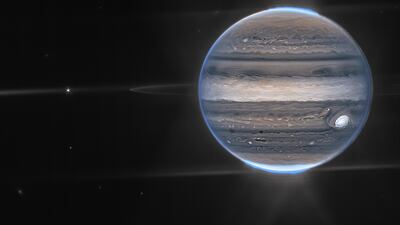
The James Webb telescope captures Jupiter.



