Current climate policies will expose more than a fifth of humans to dangerously hot temperatures by 2100, a study says.
Despite the Paris Agreement pledge to keep global warming at 1.5°C above pre-industrial levels, projections are that current policies will result in 2.7°C warming by the end of the century.
Scientists from the Global Systems Institute of the University of Exeter, associated with the Earth Commission and Nanjing University, say that about 60 million people are already exposed to an average temperature of 29°C or higher, which is classed as dangerous heat.
Two billion – 22 per cent of the projected end-of-century population – would be exposed to this at 2.7°C of global warming.
“The costs of global warming are often expressed in financial terms, but our study highlights the phenomenal human cost of failing to tackle the climate emergency,” said Prof Tim Lenton, director of the Global Systems Institute at the University of Exeter.

The paper, 'Quantifying the Human Cost of Global Warming', highlights the “huge potential” for decisive climate policy to limit the human cost of climate change. It says rapid action to cut greenhouse gas emissions can prevent most of the damage.
“Limiting global warming to 1.5°C rather than 2.7°C would mean five times fewer people in 2100 being exposed to dangerous heat,” said Prof Lenton.
The research, was published in the journal Nature Sustainability, defines the concept of a human “niche”.
It says that human population density peaks in places with an average temperature of about 13°C, with a secondary peak at about 27°C, especially in South Asia.
-
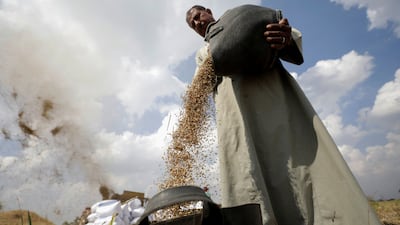
Farmer Ezzat Mostafa, 62, winnows rice in a field in Qaha, north of Cairo, Egypt. All photos: Reuters -
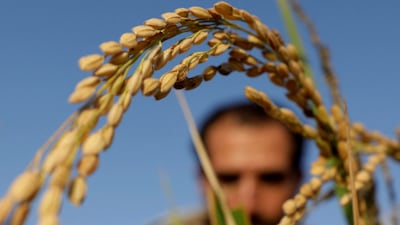
Mr Mostafa says this season has been difficult because of water shortages and severe heat. -

Qaha is located in the rich farmland of the southern part of the Nile Delta. -
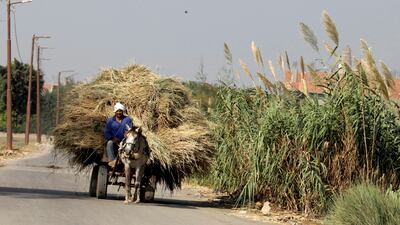
As Egypt hosts the UN's Cop27 climate talks, the country’s leaders have said the changing conditions the Delta, known for millennia for its fertile soil, are a major concern. -

Saltwater intrusion, caused by rising seas, is the most challenging threat to the Delta, experts say. -
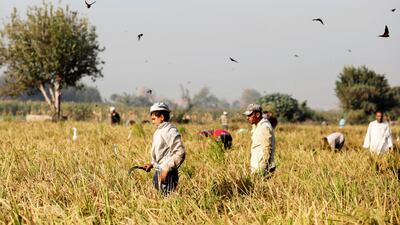
The Nile Delta is home to about 40 per cent of Egypt’s 104 million people and accounts for half of the country’s economy, according to the UN food agency. -

The government is introducing measures, including barriers and run-off systems, to protect the Delta's people from the effects of climate change.


Although less than 1 per cent of humans currently live in places of dangerous heat exposure, the study shows that climate change has already put 9 per cent of the global population – more than 600 million people- outside the niche.
“Most of these people lived near the cooler 13°C peak of the niche and are now in the ‘middle ground’ between the two peaks. While not dangerously hot, these conditions tend to be much drier and have not historically supported dense human populations,” said Prof Chi Xu, of Nanjing University.
While some cooler places may become more habitable due to climate change, population growth is projected to be highest in places at risk of dangerous heat, especially India and Nigeria, the study found.
Assuming a future population of 9.5 billion people, India would have the greatest population exposed at 2.7°C global warming – more than 600 million.
At 1.5°C, this figure would be far lower, at about 90 million.
Prof Marten Scheffer, of Wageningen University, said the economic costs of carbon emissions “hardly reflects the impact on human well-being”.
“Our calculations now help bridge this gap and should stimulate asking new, unorthodox questions about justice,” he said.
The study found that some countries such as Burkina Faso and Mali would become almost completely dangerously hot with a 2.7°C temperature increase.
Brazil would have the largest land area exposed to dangerous heat.