

Fears that Earth could be wiped out by an asteroid can probably be put to rest after a study concluded that the planet is not likely to be harmed by a killer asteroid for the next millennium.
The study, conducted by researchers at the University of Colorado and Nasa, compiled data from 1,000 near-Earth objects larger than 1km and the impact they might have on the planet in the next millennium.
Researchers said the asteroid with the highest risk of colliding with Earth is named 1994 PC1, which is roughly 1km wide and has a 0.00151 per cent chance of passing within the Moon's orbit in the next 1,000 years.
The study, to be published in The Astronomical Journal, comes nearly 30 years after the US Congress asked Nasa to detect and record 90 per cent of near-Earth objects that were 1km or larger.
Researchers say the catalogue is nearly 95 per cent complete.
While Earth is probably safe from killer asteroids, smaller objects still pose a threat to the planet.
Oscar Fuentes-Munoz, who led the study, told the MIT Technology Review that a Nasa catalogue collecting information on asteroids large enough to destroy a city is nearly 40 per cent complete.
James Webb space images - in pictures
-
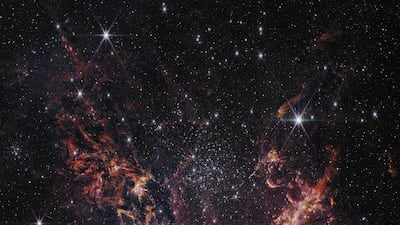
A cluster of stars in the Small Magellanic Cloud in an image taken by the James Webb Space Telescope. PA -
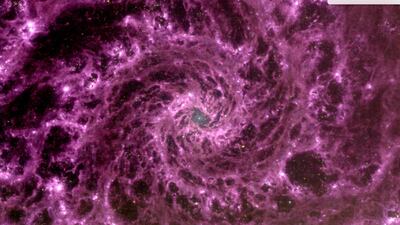
A colour composite image of the Messier 74 galaxy. Photo: Gabriel Brammer (Cosmic Dawn Center, Niels Bohr Institute, University of Copenhagen) / James Webb Space Telescope -
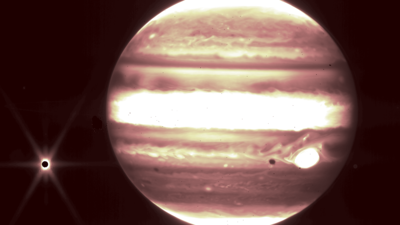
Jupiter and its moon Europa, left, are seen through the James Webb Space Telescope. Photo: Nasa -
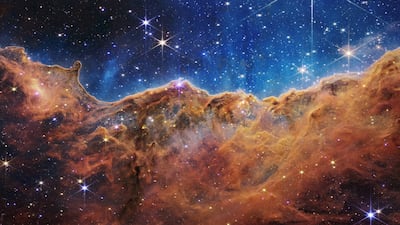
Captured in infrared light by Nasa's new James Webb Space Telescope, this image reveals areas of star birth in Carina Nebula. All photos: James Webb Space Telescope -
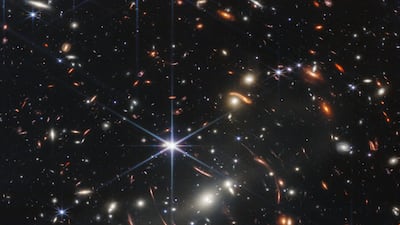
Known as Webb's First Deep Field, the picture showcases a galaxy cluster called SMACS 0723 as it appeared 4.6 billion years ago. The image was revealed by US President Joe Biden on July 11 during an event at the White House. -
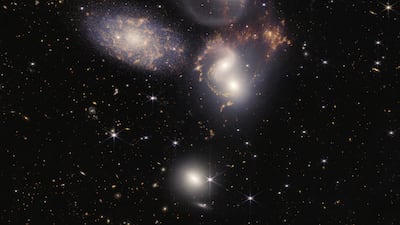
An image of Stephan's Quintet, an area in space with a group of five galaxies. -
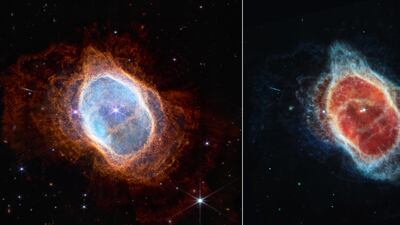
Side-by-side comparison shows observations of the Southern Ring Nebula in near-infrared light (left) and mid-infrared light. -
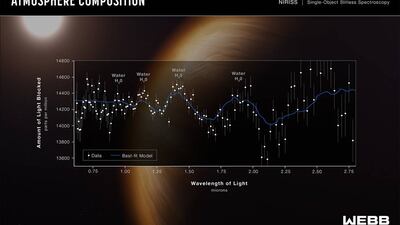
The telescope has captured the distinct signature of water, along with evidence for clouds and haze, in the atmosphere surrounding a hot, puffy gas giant planet orbiting a distant Sun-like star, called WASP-96 b. Photo: James Webb Space Telescope



