Today, more women are breaking glass ceilings and taking on powerful roles.
With women being elected as presidents, ministers and other high-ranking officials in countries around the world, their representation in positions of power has been steadily increasing in recent years.
But, as the world celebrates the International Women's Day, there is still a long way to go to achieve gender equality in global and corporate leadership.
As of January 1, there were 31 countries where 34 women serve as Heads of State or Government, according to the UN Women.
UN Secretary General Antonio Guterres said achieving full gender parity will take 300 years, with “women’s sexual and reproductive rights … being rolled back".
The World Economic Forum revealed that the world will not be able to achieve gender equality by 2030 as 85 per cent of Fortune 500 CEOs are men.
Yet studies predict that if women launched and expanded their firms at the same rate as men, the global economy would benefit by $5–6 trillion.
Women who have reached the top of governments or some of the world’s biggest companies have shared important insights on how the world can fast-forward gender equality.
'Lift up one woman and she’ll lift up others, who lift up more' — Queen Rania
Queen Rania of Jordan has discussed the difficulties Arab women encounter, particularly in moments of unrest and conflict.
Women "fall off national agendas, widening the gap between hardship and hope" when there is substantial unrest she previously said in a speech she gave at a meeting hosted by the UN Women.
Through the Queen Rania Foundation for Education and Development, she has advocated for greater access to education and training opportunities for women in the region, recognising that education is key to unlocking opportunities and empowering women to achieve their full potential.
“Empowerment is contagious – I see it lighting up the faces of our youngest girls,” Queen Rania said.
'Humanity thrives when women thrive' — Reem Al Hashimy
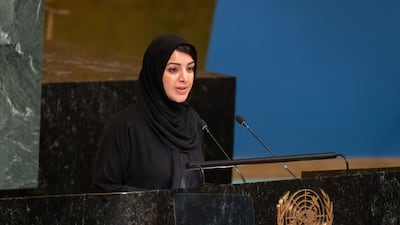
Reem Al Hashimy, the UAE’s Minister of State for International Co-operation, said gender equality needs collective action as the world enters a post-pandemic period.
Ms Al Hashimy has played a crucial role in serving as a pillar and exemplar for enhancing the participation of women in leadership roles within the UAE.
Taking the stage at the 77th UN General Assembly, she became the first woman to deliver a speech for the country. She was also responsible for leading the successful bid to host the first World Expo in the Middle East, Expo 2020, and was subsequently appointed its managing director.
"The road to these achievements was not easy, but with the support of the country’s leadership, Emirati women have managed to overcome their challenges, excel in all areas of work and reach the highest positions,” she said during her leadership in the victorious effort to secure Dubai Expo 2020.
Women in the UAE now occupy more than half of the workforce in the government sector, more than half in all stages of education, and they make up more than a third of the cabinet, said Sheikha Fatima, Mother of the Nation.
“Half of the members of the Federal National Council are women,” she said.
She praised the contribution of Emirati women and the progress of the UAE, which she stated was achieved in record time.
“From inception, there was a firm conviction of the late Sheikh Zayed bin Sultan Al Nahyan, may God rest his soul in peace, in the role of women in society,” she said.
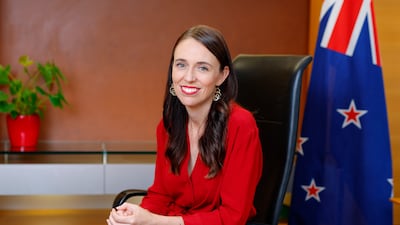
'Having a female prime minister does not mean that you’ve achieved equality' — Jacinda Ardern
Jacinda Ardern, the former New Zealand prime minister, who at the time of her election was New Zealand's youngest, has pushed back against the symbolism of one or two women breaking through barriers meaning the problem of gender equality is solved.
Ms Ardern recently stepped down from her role as prime minister. Her decision to take maternity leave while in office sent a powerful message about the importance of work-life balance and the need for greater support for working mothers.
During Jacinda Ardern's tenure, the government took several steps to support women.
These included initiatives to address the gender pay gap, the extension of paid parental leave to 26 weeks and after her labour party won the elections in 2020, she appointed the most diverse government and parliament in New Zealand’s history with indigenous Maori ministers making up a quarter of its 20-strong members and women taking eight posts.
Her leadership style, characterised by empathy, compassion, and inclusivity, resonated with many.
'We have millions of talented, motivated women eager to contribute' — Princess Reema bint Bandar
Princess Reema bint Bandar is a prominent female leader in the Mena region who has been a vocal advocate for women's empowerment and gender equality.
As Saudi Arabia's first female ambassador to the US, she has been a trailblazer for women in the country, working to promote greater gender equality and women's rights.
She has been a strong supporter of women's entrepreneurship and has advocated for greater access to education and training for women in the region.
As the former head of the Saudi General Sports Authority, she worked to increase women's participation in sports and improve access to sports facilities.
Among the first achievements under Reema's mandate, is the inclusion of physical education for girls in schools.
Princess Reema also founded Alf Khair, a social enterprise aimed at promoting the professional development of Saudi women, in 2013.
One of the organisation's main initiatives was 10KSA, which aimed to raise awareness about holistic health and promote a healthier community in Saudi Arabia.
The campaign lasted for a year and included a World's Largest Human Awareness Ribbon event, which was recognised by the Guinness World Records.
“As a business leader in the kingdom, when the doors to women were just starting to open, I realised that opening the doors wasn’t enough. Women had to be prepared to take advantage of those open doors, and we have to equip them with the skills,” she said.
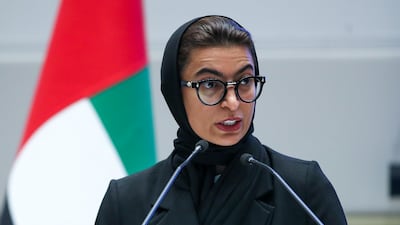
'Excuses for excluding women are no longer acceptable and we must all hold ourselves to the same standards' — Noura Al Kaabi
Despite global advances towards gender equality, women and girls are often still excluded from decision-making, UAE Minister of State Noura Al Kaabi told the UN Security Council.
Taking the centre stage to speak at a ministerial debate on women, peace and security, she said: “The message is clear: Globally, with every one step forward for women and girls, we take two steps back.”
Ms Al Kaabi, who was named one of the 100 most powerful women in the Arab world by Arabian Business several times and Forbes Middle East’s 30 Most Influential Women in Government, has been a vocal advocate for women's rights and empowerment in the UAE and the wider region.
Under her leadership as the Minister of Culture and Youth, she recently said: “We are very proud to have received the honour of being the Best Federal Entity Supporting Gender Balance among the various UAE ministries”.
“We are steadily moving towards strengthening the partnership between men and women in the service of the nation.”

Cinco in numbers
Dh3.7 million
The estimated cost of Victoria Swarovski’s gem-encrusted Michael Cinco wedding gown
46
The number, in kilograms, that Swarovski’s wedding gown weighed.
1,000
The hours it took to create Cinco’s vermillion petal gown, as seen in his atelier [note, is the one he’s playing with in the corner of a room]
50
How many looks Cinco has created in a new collection to celebrate Ballet Philippines’ 50th birthday
3,000
The hours needed to create the butterfly gown worn by Aishwarya Rai to the 2018 Cannes Film Festival.
1.1 million
The number of followers that Michael Cinco’s Instagram account has garnered.
MEDIEVIL%20(1998)
%3Cp%3E%3Cstrong%3EDeveloper%3A%3C%2Fstrong%3E%20SCE%20Studio%20Cambridge%3Cbr%3E%3Cstrong%3EPublisher%3A%3C%2Fstrong%3E%20Sony%20Computer%20Entertainment%3Cbr%3E%3Cstrong%3EConsole%3A%3C%2Fstrong%3E%20PlayStation%2C%20PlayStation%204%20and%205%3Cbr%3E%3Cstrong%3ERating%3A%3C%2Fstrong%3E%203.5%2F5%3C%2Fp%3E%0A
The specs
Engine: 2.0-litre 4cyl turbo
Power: 261hp at 5,500rpm
Torque: 405Nm at 1,750-3,500rpm
Transmission: 9-speed auto
Fuel consumption: 6.9L/100km
On sale: Now
Price: From Dh117,059
Afro%20salons
%3Cp%3E%3Cstrong%3EFor%20women%3A%3C%2Fstrong%3E%3Cbr%3ESisu%20Hair%20Salon%2C%20Jumeirah%201%2C%20Dubai%3Cbr%3EBoho%20Salon%2C%20Al%20Barsha%20South%2C%20Dubai%3Cbr%3EMoonlight%2C%20Al%20Falah%20Street%2C%20Abu%20Dhabi%3Cbr%3E%3Cstrong%3EFor%20men%3A%3C%2Fstrong%3E%3Cbr%3EMK%20Barbershop%2C%20Dar%20Al%20Wasl%20Mall%2C%20Dubai%3Cbr%3ERegency%20Saloon%2C%20Al%20Zahiyah%2C%20Abu%20Dhabi%3Cbr%3EUptown%20Barbershop%2C%20Al%20Nasseriya%2C%20Sharjah%3C%2Fp%3E%0A
Some of Darwish's last words
"They see their tomorrows slipping out of their reach. And though it seems to them that everything outside this reality is heaven, yet they do not want to go to that heaven. They stay, because they are afflicted with hope." - Mahmoud Darwish, to attendees of the Palestine Festival of Literature, 2008
His life in brief: Born in a village near Galilee, he lived in exile for most of his life and started writing poetry after high school. He was arrested several times by Israel for what were deemed to be inciteful poems. Most of his work focused on the love and yearning for his homeland, and he was regarded the Palestinian poet of resistance. Over the course of his life, he published more than 30 poetry collections and books of prose, with his work translated into more than 20 languages. Many of his poems were set to music by Arab composers, most significantly Marcel Khalife. Darwish died on August 9, 2008 after undergoing heart surgery in the United States. He was later buried in Ramallah where a shrine was erected in his honour.
The%20specs
%3Cp%3E%3Cstrong%3EEngine%3A%20%3C%2Fstrong%3E3.5-litre%20twin-turbo%20V6%20%0D%3Cbr%3E%3Cstrong%3EPower%3A%20%3C%2Fstrong%3E456hp%20at%205%2C000rpm%0D%3Cbr%3E%3Cstrong%3ETorque%3A%20%3C%2Fstrong%3E691Nm%20at%203%2C500rpm%0D%3Cbr%3E%3Cstrong%3ETransmission%3A%20%3C%2Fstrong%3E10-speed%20auto%20%0D%3Cbr%3E%3Cstrong%3EFuel%20consumption%3A%20%3C%2Fstrong%3E14.6L%2F100km%0D%3Cbr%3E%3Cstrong%3EPrice%3A%20%3C%2Fstrong%3Efrom%20Dh349%2C545%0D%3Cbr%3E%3Cstrong%3EOn%20sale%3A%20%3C%2Fstrong%3Enow%3C%2Fp%3E%0A
White hydrogen: Naturally occurring hydrogen
Chromite: Hard, metallic mineral containing iron oxide and chromium oxide
Ultramafic rocks: Dark-coloured rocks rich in magnesium or iron with very low silica content
Ophiolite: A section of the earth’s crust, which is oceanic in nature that has since been uplifted and exposed on land
Olivine: A commonly occurring magnesium iron silicate mineral that derives its name for its olive-green yellow-green colour
Who's who in Yemen conflict
Houthis: Iran-backed rebels who occupy Sanaa and run unrecognised government
Yemeni government: Exiled government in Aden led by eight-member Presidential Leadership Council
Southern Transitional Council: Faction in Yemeni government that seeks autonomy for the south
Habrish 'rebels': Tribal-backed forces feuding with STC over control of oil in government territory
Will the pound fall to parity with the dollar?
The idea of pound parity now seems less far-fetched as the risk grows that Britain may split away from the European Union without a deal.
Rupert Harrison, a fund manager at BlackRock, sees the risk of it falling to trade level with the dollar on a no-deal Brexit. The view echoes Morgan Stanley’s recent forecast that the currency can plunge toward $1 (Dh3.67) on such an outcome. That isn’t the majority view yet – a Bloomberg survey this month estimated the pound will slide to $1.10 should the UK exit the bloc without an agreement.
New Prime Minister Boris Johnson has repeatedly said that Britain will leave the EU on the October 31 deadline with or without an agreement, fuelling concern the nation is headed for a disorderly departure and fanning pessimism toward the pound. Sterling has fallen more than 7 per cent in the past three months, the worst performance among major developed-market currencies.
“The pound is at a much lower level now but I still think a no-deal exit would lead to significant volatility and we could be testing parity on a really bad outcome,” said Mr Harrison, who manages more than $10 billion in assets at BlackRock. “We will see this game of chicken continue through August and that’s likely negative for sterling,” he said about the deadlocked Brexit talks.
The pound fell 0.8 per cent to $1.2033 on Friday, its weakest closing level since the 1980s, after a report on the second quarter showed the UK economy shrank for the first time in six years. The data means it is likely the Bank of England will cut interest rates, according to Mizuho Bank.
The BOE said in November that the currency could fall even below $1 in an analysis on possible worst-case Brexit scenarios. Options-based calculations showed around a 6.4 per cent chance of pound-dollar parity in the next one year, markedly higher than 0.2 per cent in early March when prospects of a no-deal outcome were seemingly off the table.
Bloomberg
Under 19 World Cup
Group A: India, Japan, New Zealand, Sri Lanka
Group B: Australia, England, Nigeria, West Indies
Group C: Bangladesh, Pakistan, Scotland, Zimbabwe
Group D: Afghanistan, Canada, South Africa, UAE
UAE fixtures
Saturday, January 18, v Canada
Wednesday, January 22, v Afghanistan
Saturday, January 25, v South Africa
UAE currency: the story behind the money in your pockets
Killing of Qassem Suleimani
More from Neighbourhood Watch
Mercer, the investment consulting arm of US services company Marsh & McLennan, expects its wealth division to at least double its assets under management (AUM) in the Middle East as wealth in the region continues to grow despite economic headwinds, a company official said.
Mercer Wealth, which globally has $160 billion in AUM, plans to boost its AUM in the region to $2-$3bn in the next 2-3 years from the present $1bn, said Yasir AbuShaban, a Dubai-based principal with Mercer Wealth.
“Within the next two to three years, we are looking at reaching $2 to $3 billion as a conservative estimate and we do see an opportunity to do so,” said Mr AbuShaban.
Mercer does not directly make investments, but allocates clients’ money they have discretion to, to professional asset managers. They also provide advice to clients.
“We have buying power. We can negotiate on their (client’s) behalf with asset managers to provide them lower fees than they otherwise would have to get on their own,” he added.
Mercer Wealth’s clients include sovereign wealth funds, family offices, and insurance companies among others.
From its office in Dubai, Mercer also looks after Africa, India and Turkey, where they also see opportunity for growth.
Wealth creation in Middle East and Africa (MEA) grew 8.5 per cent to $8.1 trillion last year from $7.5tn in 2015, higher than last year’s global average of 6 per cent and the second-highest growth in a region after Asia-Pacific which grew 9.9 per cent, according to consultancy Boston Consulting Group (BCG). In the region, where wealth grew just 1.9 per cent in 2015 compared with 2014, a pickup in oil prices has helped in wealth generation.
BCG is forecasting MEA wealth will rise to $12tn by 2021, growing at an annual average of 8 per cent.
Drivers of wealth generation in the region will be split evenly between new wealth creation and growth of performance of existing assets, according to BCG.
Another general trend in the region is clients’ looking for a comprehensive approach to investing, according to Mr AbuShaban.
“Institutional investors or some of the families are seeing a slowdown in the available capital they have to invest and in that sense they are looking at optimizing the way they manage their portfolios and making sure they are not investing haphazardly and different parts of their investment are working together,” said Mr AbuShaban.
Some clients also have a higher appetite for risk, given the low interest-rate environment that does not provide enough yield for some institutional investors. These clients are keen to invest in illiquid assets, such as private equity and infrastructure.
“What we have seen is a desire for higher returns in what has been a low-return environment specifically in various fixed income or bonds,” he said.
“In this environment, we have seen a de facto increase in the risk that clients are taking in things like illiquid investments, private equity investments, infrastructure and private debt, those kind of investments were higher illiquidity results in incrementally higher returns.”
The Abu Dhabi Investment Authority, one of the largest sovereign wealth funds, said in its 2016 report that has gradually increased its exposure in direct private equity and private credit transactions, mainly in Asian markets and especially in China and India. The authority’s private equity department focused on structured equities owing to “their defensive characteristics.”
500 People from Gaza enter France
115 Special programme for artists
25 Evacuation of injured and sick
Infiniti QX80 specs
Engine: twin-turbocharged 3.5-liter V6
Power: 450hp
Torque: 700Nm
Price: From Dh450,000, Autograph model from Dh510,000
Available: Now
Skoda Superb Specs
Engine: 2-litre TSI petrol
Power: 190hp
Torque: 320Nm
Price: From Dh147,000
Available: Now