


China is in a new stage of its fight against Covid-19 as several cities relax restrictions after protests erupted at the weekend, the country's Vice Premier said.
The country "is facing a new situation and new tasks in epidemic control" as the Omicron variant weakens and vaccinations increase, said Sun Chunlan, who oversees China's Covid response, in a meeting of the National Health Commission on Wednesday.
While Beijing will still enforce isolation measures, it will increase immunisations, according to comments shared by Xinhua, the state news agency, echoing an announcement on Tuesday that it would speed up inoculations for the elderly.
China is the world's last major economy to still enforce strict Covid-19 regulations since it was first detected in the city of Wuhan three years ago. President Xi Jinping has stuck to his zero-Covid policy, the ramifications of which sparked protests in several Chinese cities at the weekend.
Demonstrations started after 10 people died in an Urumqi apartment building fire on Saturday. Covid restrictions are being blamed as the reason for their deaths, hindering escape and rescue efforts, a claim officials have denied.
While authorities acted quickly to quash the protests, sending a large number of security forces on Monday, several local authorities have announced an easing of restrictions in hard-hit areas.
Lockdowns have been lifted in several districts in the industrial city of Guangzhou, where protesters clashed with riot police in hazmat suits on Tuesday. In Zhengzhou, businesses have reopened and home quarantine has been slashed for close contacts of Covid-positive cases in other cities, AFP reported.
-
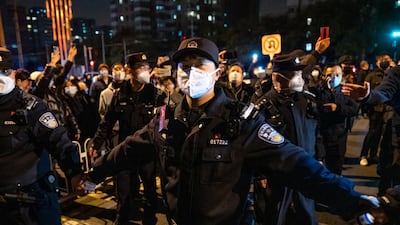
Police stand guard during a protest against Covid-19 restrictions, in China's capital Beijing. Bloomberg -
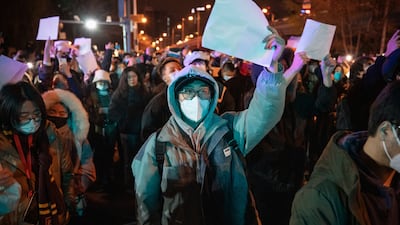
Demonstrators hold blank signs during a protest in Beijing, China. Bloomberg -
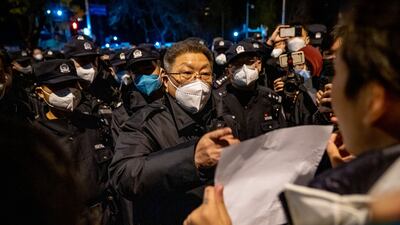
An official speaks with a demonstrator holding a blank sign, during a protest in Beijing. Bloomberg -
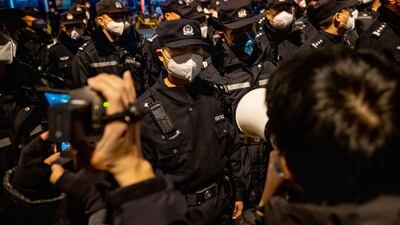
The death of at least 10 people in a fire in Urumqi, north-west China, which is under strict Covid restrictions, has led to protests nationwide. Bloomberg -
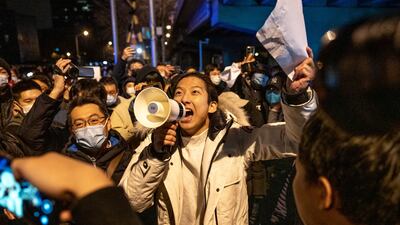
Demonstrators in Beijing. Protesters blame the deaths in Urumqi on strict Covid restrictions on leaving buildings. The authorities deny this. Bloomberg -
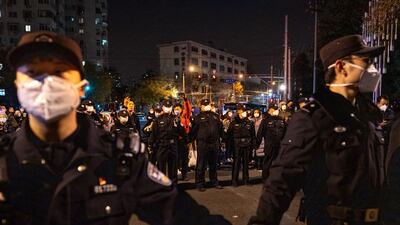
Police form a chain at Beijing protests. Demonstrations have also been reported in cities including, Shanghai, Nanjing, Chengdu, Lanzhou, Guangzhou and Wuhan – where Covid-19 was first reported. Bloomberg -
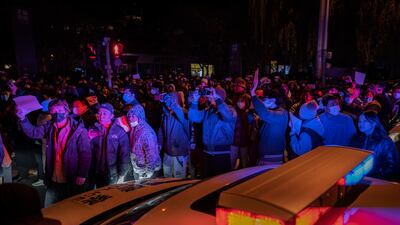
Protesters march past a police vehicle during a demonstration against China's strict zero-Covid measures, in Beijing. Getty -
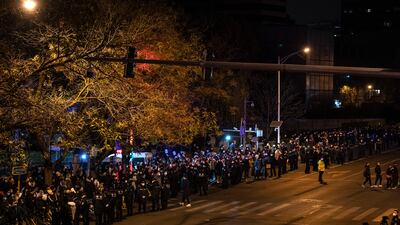
Protesters and police in Beijing. Chinese stocks fell over concerns about the impact of the demonstrations. Getty -

Demonstrators rally in Beijing. China reported more than 40,000 new cases of Covid-19 on Monday. AFP


In the capital, daily testing requirements have also been relaxed, with people who do not leave home frequently — including the elderly and students in online education — now exempt from daily testing. A negative test result within the previous 48 hours will still be required for entry to various public places, however, including shopping malls and restaurants.
China's low number of vaccinations among the elderly was cited as a key reason for its continued lockdowns, often imposed at the last minute and for a relatively low number of cases.
A total of 38,500 domestic cases were recorded on Thursday, a decline from previous days, which saw consecutive records broken as cases reached an all-time high.
Its stringent policies have taken a significant toll on its economy in recent years, which further weakened after demonstrations began at the weekend. Beijing has defended its policies as necessary to "avoid disaster" in a country of more than a billion people.
While mass protests are rare, dissent is regular and "geographically widespread", according to the China Dissent Monitor, run by the US-based Freedom House.
Covid policies were among the grievances behind almost 700 instances of dissent it recorded from June to September, according to an annual report released in mid-November. Hubei province, north of Beijing, recorded the most activity, with 77 instances noted.
It estimated at least 27 demonstrations took place across China from Saturday to Monday, while Australia's ASPI think tank placed the number at 43 across 22 cities.

