

Residents in the southern Chinese city of Guangzhou clashed with riot police on Tuesday night, just hours after the government pledged to tackle “hostile forces” as it faces rare protests over its zero-Covid policy.
Protesters in the city of 15 million people, capital of Guangdong province, threw objects at riot police in hazmat gear, who released tear gas at crowds and handcuffed several individuals, social media footage showed.
-
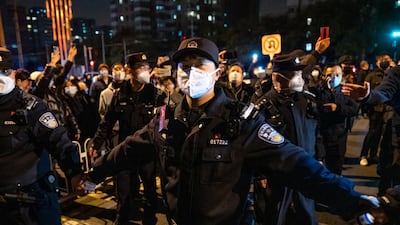
Police stand guard during a protest against Covid-19 restrictions, in China's capital Beijing. Bloomberg -
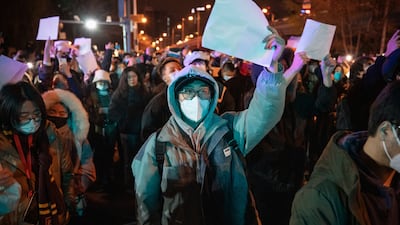
Demonstrators hold blank signs during a protest in Beijing, China. Bloomberg -
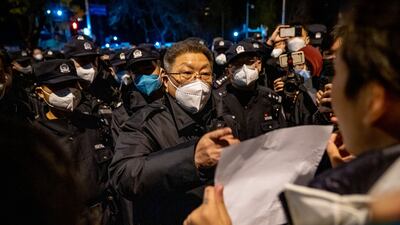
An official speaks with a demonstrator holding a blank sign, during a protest in Beijing. Bloomberg -
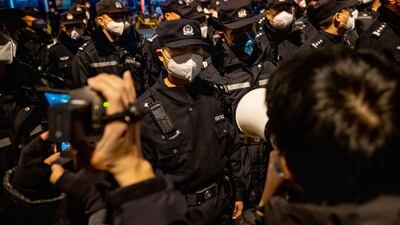
The death of at least 10 people in a fire in Urumqi, north-west China, which is under strict Covid restrictions, has led to protests nationwide. Bloomberg -
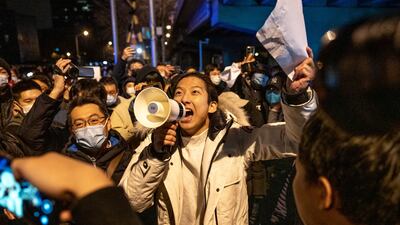
Demonstrators in Beijing. Protesters blame the deaths in Urumqi on strict Covid restrictions on leaving buildings. The authorities deny this. Bloomberg -
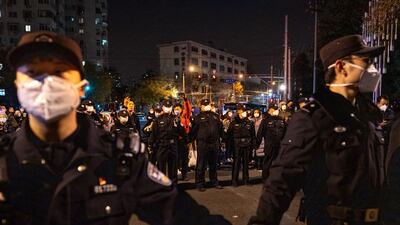
Police form a chain at Beijing protests. Demonstrations have also been reported in cities including, Shanghai, Nanjing, Chengdu, Lanzhou, Guangzhou and Wuhan – where Covid-19 was first reported. Bloomberg -
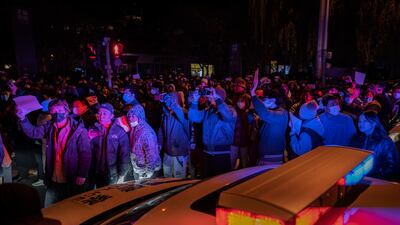
Protesters march past a police vehicle during a demonstration against China's strict zero-Covid measures, in Beijing. Getty -
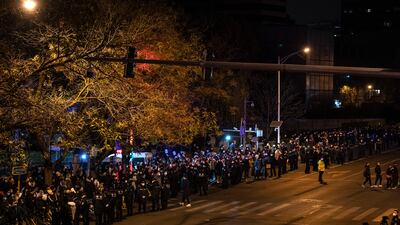
Protesters and police in Beijing. Chinese stocks fell over concerns about the impact of the demonstrations. Getty -

Demonstrators rally in Beijing. China reported more than 40,000 new cases of Covid-19 on Monday. AFP


The city has been hard-hit by a recent wave of infections.
China has the strictest Covid control measures into the world, despite the waning dangers of the less-harmful, globally dominant Omicron strain of the virus.
Experts say the uptake of the Covid-19 vaccine among the very old has been low, raising fears that serious outbreaks could overwhelm hospitals.
This has led to extremely strict and in some cases very long periods of lockdown lasting weeks or even months, as in the case of Shanghai, which ended a two-month lockdown in June.
Many people have complained that extreme Covid control measures have led to food shortages.
The government held its weekly Covid-19 briefing on Tuesday, announcing it would speed up vaccinations for the elderly, amid record case numbers and protests in several cities across the country — a rare act of defiance against the government.
While there has been an ease in some local restrictions, authorities have stood firm to President Xi Jinping's zero-Covid policy and threatened further action against demonstrators.
Beijing must resolutely “crack down on infiltration and sabotage activities by hostile forces,” the Communist Party's central political and legal affairs committee said in a meeting reported by state media on Tuesday.
It did not directly reference the protests.
It said the government would “resolutely crack down on illegal and criminal acts that disrupt social order”.
Demonstrations erupted on Saturday after fury over the death of 10 people in an apartment building in Urumqi, capital of the western region of Xinjiang.
People have claimed Covid-19 restrictions prevented residents escaping the building and hindered rescue efforts. The authorities has denied this.
Police clashed with protesters in the capital Beijing and Shanghai at the weekend, with demonstrations also reported in other cities including the central city of Wuhan — where the virus was first detected in 2019 — and in Hong Kong.
On Tuesday, the UK summoned the Chinese ambassador after a BBC journalist was beaten and detained at a protest in Shanghai.

Large numbers of security forces were deployed to the streets on Monday, stamping out planned protests in Shanghai and Beijing.
The government has stood firm in its stance against the virus, and has made efforts to quash crowd gatherings, with university classes and exams sent online.
In the Tuesday briefing, representatives of the National Health Commission said the coronavirus policy would be “fine-tuned” but played down public anger at the rules, which it attributed to excessive implementation of restrictions.
Police have already started investigating protesters, summoning individuals to police stations and demanding written accounts of their recent activities, according to agency reports.

