


The UN's Human Rights Council voted on Thursday to investigate what it heard was a worsening wave of violence against protesters in Iran.
An urgent session of the council in Geneva backed the creation of a fact-finding mission to report on alleged abuses by the regime.
It heard that dozens of people, including five children, had been killed in Iran in the past week as the crackdown escalates.
UN high commissioner for human rights, Volker Turk, said Iran was in a "full-fledged human rights crisis" after two months of anti-regime protests.
Mr Turk said more than 14,000 people had been arrested and that a "conservative estimate" was that 300 had died, including 40 children.
"It pains me to see what is happening in the country — the images of children killed, of women beaten in the streets, of people sentenced to death," he said.
A resolution passed by the council sets up a new fact-finding mission to collect evidence of abuses and ensure it could be used in court.
It will have a mandate separate from the UN's special rapporteur on Iran, who has been denied access to the country.
The resolution championed by Germany, which with Iceland called the special session, also calls on Iran to take all measures needed to prevent arbitrary arrests and killings.
"The Iranian demonstrators have no seat on the Human Rights Council in Geneva and no voice of their own in the United Nations," said German Foreign Minister Annalena Baerbock.
"Today the UN Human Rights Council can raise its voice for indivisible human rights in Iran."
Protests in Iran — in pictures
-

Iranians protest in Tehran after the death of 22-year-old Mahsa Amini after she was detained by the morality police in September. AP Photo -
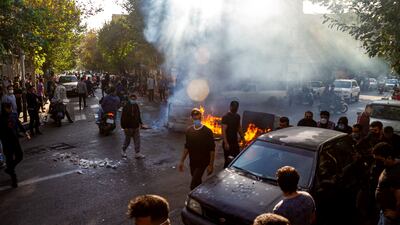
Protests have intensified despite a vicious government crackdown that has left as many as 200 people dead, although estimates of the toll by rights groups vary. AP Photo -
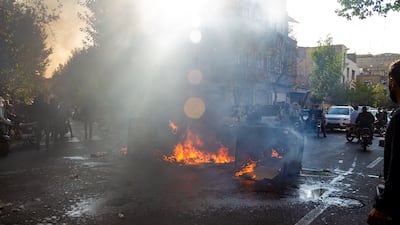
At least eight members of the security forces have also been killed or wounded during the unrest and there are signs that violent resistance could be intensifying. AP Photo -
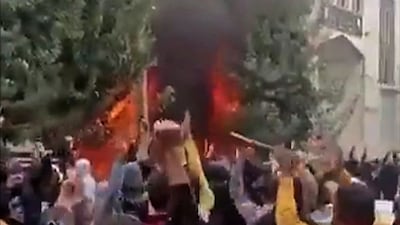
A fire burns at the office of the governor of Mahabad, in the West Azerbaijan province of Iran. AFP -
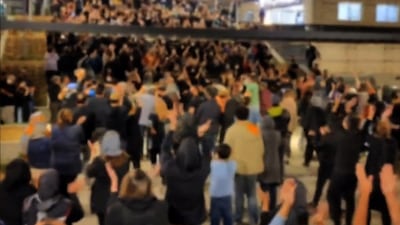
Protesters gather in the a courtyard of Chitgar complex in western Tehran. AFP -

Iranian protesters continue to defy a deadly crackdown by security forces. AFP -

A woman cuts her hair at the grave site of Nika Shahkarami in the city of Khorramabad, during a reported memorial held to mark 40 days since the death of the 16-year-old. AFP -
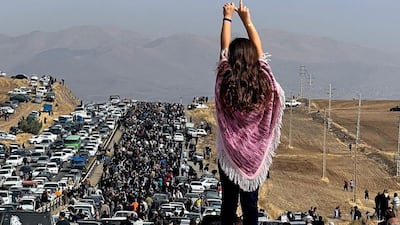
A woman not wearing a headscarf stands on top of a vehicle as thousands make their way towards Saqez, Mahsa Amini's home town, to mark 40 days since her death in police custody. AFP -
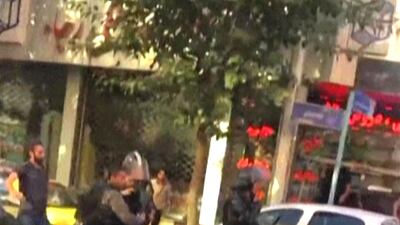
Iranian riot police prepare to confront protesters the capital, Tehran. AFP -
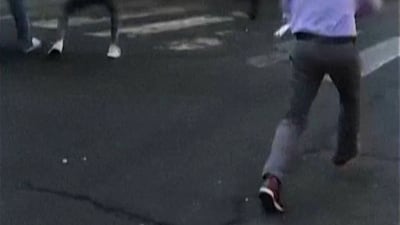
Iranian protesters surge forward amid clashes with riot police in Tehran. AFP -
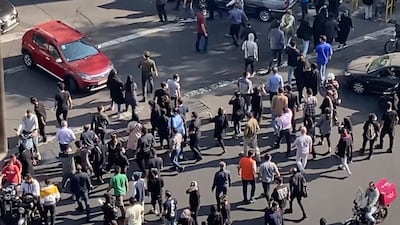
A crowd blocks an intersection during a protest to mark 40 days since Amini's death in custody. AP Photo -
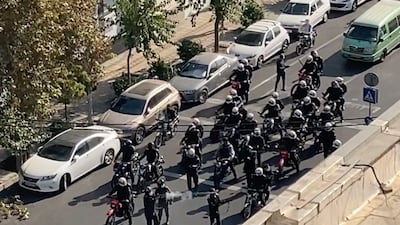
Iranian police arrive to disperse a protest in Tehran. AP Photo -
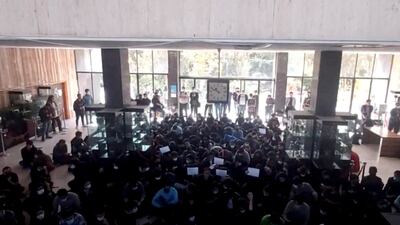
Protesters chant at a vigil for Amini at the Khajeh Nasir Toosi University of Technology in Tehran. Reuters -
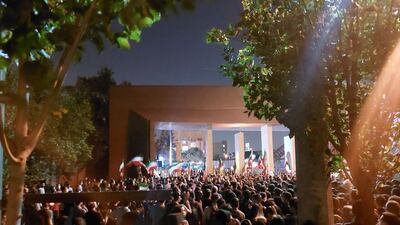
Students at Sharif University of Technology attend a protest. AP Photo -

Police outside Sharif University during a student protest. AP Photo -
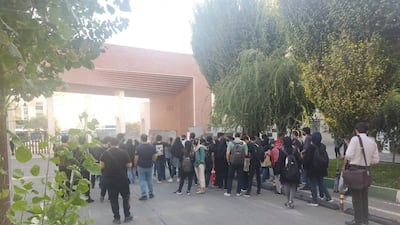
Students at the university protest over the death of Amini, who was in 'morality police' custody for allegedly breaking strict rules on head coverings for women. AP Photo -
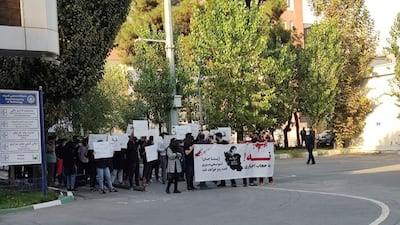
The students' banner says: 'No to mandatory hijab'. AP Photo


The protests were sparked by the death of Mahsa Amini, a 22-year-old woman, in the custody of Iran's morality police.
The UN rapporteur, Javid Rehman, has described indiscriminate use of force against protesters, as well as harassment of women for wearing their hijab incorrectly.
He told the council that top officials in Iran had shown no willingness to engage with demonstrators but instead told security forces to use violence.
Families of children who died have been given government counter-narratives that they fell from a height, took their own lives or were poisoned by mysterious enemy agents, he said.
"Prisons are now bursting with all those who had dreamed of and worked for a better future for Iran," Mr Rehman said.
"In the past seven days alone, crackdown on protests has intensified with at least 60 to 70 persons killed."
Iranian delegate Khadijeh Karimi told the council that western powers were abusing the UN body for political ends.
She described Ms Amini's death as unfortunate but blamed western governments and foreign provocateurs for spurring on violent protests.
The US said a new fact-finding mission was needed because Iran had shown no willingness to hold independent investigations.

Iran's morality police and other security forces have been sanctioned by western powers including the UK, US and European Union because of the protests.
Thursday's special session was the first in the Human Rights Council dedicated to Iran, and the second overall this year after a discussion of the war in Ukraine.
It was focused especially on the plight of Iranian women and children, after the UN reported at least 27 children being killed in the violence.
Some children were killed by live ammunition or beaten to death, while others were arrested in raids on schools for alleged participation in the protests, the council heard.
Germany and Iceland's request for a special meeting was backed by 17 of 47 members of the UN council, including the US, Britain and France.
Some German MPs are urging the government to go further still by tightening sanctions and classifying Iran's Revolutionary Guard as terrorists.

