


The International Space Station has dodged debris left behind by an anti-satellite test carried out by Russia last year.
Thrusters on the orbiting science laboratory this week were fired for five minutes and five seconds to make the manoeuvre.
In November 2021, Russia’s test struck the Cosmos 1408 satellite, creating more than 1,500 pieces of orbital debris, which were expected to generate hundreds of thousands of smaller pieces.
Nasa said in a statement that the recent manoeuvre had no effect on the space station.
“This evening, the International Space Station’s Progress 81 thrusters fired for five minutes, five seconds in a pre-determined debris avoidance manoeuvre to provide the complex an extra measure of distance away from the predicted track of a fragment of Russian Cosmos 1408 debris,” the space agency said.
“Without the manoeuvre, it was predicted that the fragment could have passed within about three miles [4.8 kilometres] of the station.”
Anti-satellite missile, or Asat, tests use military technology to destroy spacecraft.
They are a concern because they create high levels of debris that could endanger astronauts and satellites, and because this technology could be used in an armed conflict.
Days after Russia’s Asat test last year, astronauts aboard the space station had to seek emergency shelter, on account of the debris created by the satellite break-up.
Only a few countries have carried out Asat tests, including India in 2019, China in 2007 and the US in 2008.
The US recently banned these tests and is encouraging other nations to do likewise.
Other countries that have so far joined the ban are New Zealand, Japan, Germany, Canada, the UK and South Korea.
ISS memorable moments – in pictures
-
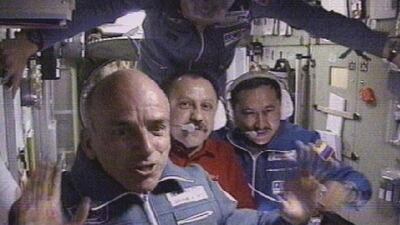
The world's first space tourist Dennis Tito waves in front of the International Space Station crew on April 30, 2001. Courtesy: RTV -
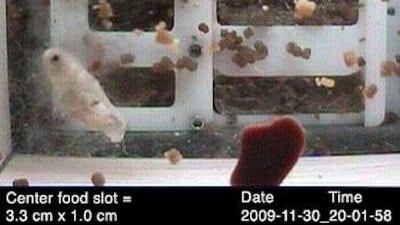
Painted Lady butterflies live in their habitat aboard the International Space Station. Courtesy: Nasa -

Red romaine lettuce was the first vegetable to grow in space in August 2015. Courtesy: Nasa -
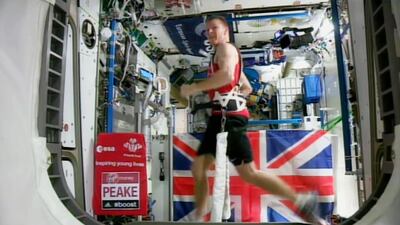
In 2016, British astronaut Tim Peake completed the fastest marathon in space. Courtesy: European Space Agency -
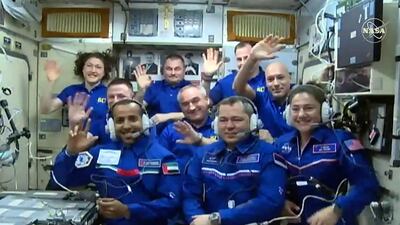
Maj Hazza Al Mansouri meets the rest of the team at the International Space Station shortly after docking. Courtesy: Nasa



