


The UK is considering taking “very strong action” against Iran after a clampdown by Tehran's security forces that included firing live ammunition and bird shot at protesters, the British Parliament was told on Tuesday.
MPs urged the government to impose sanctions on the Islamic Revolutionary Guard Corps and press for a United Nations investigation into alleged human rights abuse.
Iranian security forces were filmed firing teargas during a raid on a girl’s school in Tehran on Monday, with many videos of the incident being posted on social media.
Protests in Iran, in which more than 200 people have been killed, have endured since September 16 with almost nightly demonstrations in cities across the country over the death in morality police custody of Kurdish-Iranian woman Mahsa Amini, 22.
Ministers will also investigate claims that family members of Iran’s leaders are applying for British passports to seek refuge in London.
The UK is looking “at all options to hold Iran to account”, MPs were told, as they held a debate over the protests.
-
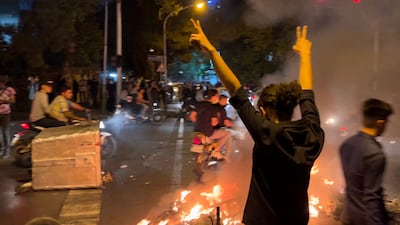
A protest for Mahsa Amini, a woman who died after being arrested by the Islamic republic's 'morality police', in Tehran. AFP -
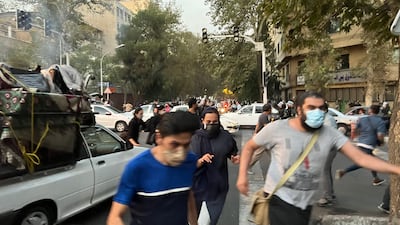
Demonstrators disperse during the protest for Amini, who died in a hospital in the capital Tehran on Friday. AFP -
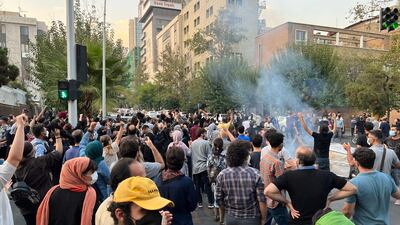
The crowd chanted 'Death to the dictator', meaning Supreme Leader Ayatollah Ali Khamenei, while some women took off their headscarves. AFP -
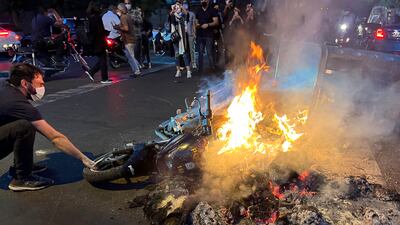
A man pulls out a police motorcycle set on fire during the protest. Amini had been detained for violating the country's conservative dress code. AP -
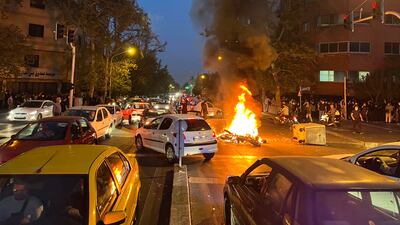
In recent months, rights activists have urged women to remove their veils in public, a gesture that would risk their arrest for defying a dress code as the country's rulers crack down on 'immoral behaviour'. AP -
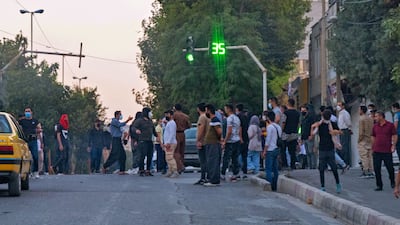
Iranians protest in Sanandaj, the capital of Iran's Kurdistan province, following the Amini's death while in custody. AFP -

Iranian police officers clash with demonstrators in Tehran. Police said Amini fell into a coma as she waited with other detained women at a morality police station, rejecting allegations that she was probably beaten. AFP


“The Iranian regime’s use of live ammunition and bird shot against protesters is barbaric,” Foreign Office minister Gillian Keegan told the Commons, as she accused the regime in Tehran of having a “flagrant disregard for human rights”.
“We condemn the Iranian authorities," she said. "Obviously we’ve taken very strong action.
“We condemn the crackdown on protesters, journalists and internet freedom, and the use of violence in response to the expression of fundamental rights by women or any other members of Iranian society is wholly unjustifiable.
“We will continue to work, including with our international partners, to explore all options for addressing Iran’s human rights violations.
“We will never be able to comment on possible future actions or sanctions or designations.”
Iran imposed sanctions on British institutions and people last week after the UK blacklisted Iran's morality police amid protests over the death of Amini.
Britain's National Cyber Security Centre and the Government Communications Headquarters, known as the GCHQ, were among seven institutions listed.
Conservative MP Bob Stewart said he had heard “substantial rumours” that Iranian elites were attempting to make London “a place of safe refuge” and were applying for British passports.
Ms Keegan said in response: "Obviously we have our own rule of law here in the UK but in relation to the rumours he has heard about passports, I haven’t heard those but I will certainly look into that.”
The opposition Labour Party on Tuesday demanded the country lead calls for the UN Human Rights Council to “urgently establish an international investigative and accountability mechanism”.
“Britain must support all those who stand up for basic freedoms, freedom of conscience and religion and freedom to live one’s life as one chooses,” Labour’s shadow foreign office minister Bambos Charalambous said.
“The UK can and should lead calls for the UN Human Rights Council to urgently establish an international investigative and accountability mechanism to collect, consolidate, preserve and analyse evidence of the most serious crimes in Iran under international law.”
Alicia Kearns, the Conservative chairwoman of the Commons Foreign Affairs Committee, urged the government to “finally act and sanction Iran’s Revolutionary Guard Corps”.
“What we are seeing in Iran is state industrialised femicide," she said. "And abroad we are seeing them being increasingly aggressive in support of terrorist states and terrorist organisations."

