


Huge fires, monsoon rains and deadly landslides have wreaked havoc across the globe during the summer of this year.
Natural disasters have killed thousands of people around the world in just months, injuring countless more and leaving tens of millions without homes.
Experts say climate change has been a major factor in worsening weather events and the UN has called on nations to work together to tackle it.
Here are five recent natural disasters which have sparked calls for urgent action from leaders and scientists.
Flooding in India and Pakistan
A third of Pakistan ended up under water after rainfall levels doubled in September, with more than 1,500 killed and 33 million displaced.
In India, unprecedented rainfall has killed at least 500 people in flooding and landslides since the onset of 2022's monsoon season.
The annual monsoon brings South Asia 70 to 80 per cent of its annual rain, but it also brings death and destruction.
Experts believe the weather system for the Indian subcontinent is being altered by climate change.
A team of scientists has found that global warming was not the chief cause of the disaster in Pakistan — but climate change played “a really important role” in the fatal flooding, according to Friederike Otto, climate scientist at Imperial College of London and the study’s senior author.
Mr Otto said while it would have been a “disastrously high rainfall event” even without climate change, the flooding was “worse because of climate change”, and small changes matter a lot, “especially in this highly vulnerable region”.
The scientists examined records of past rains, which go back to 1961, and used computer simulations to compare what happened last month to what would have happened in a world without heat-trapping gases from the burning of coal, oil and natural gas.
Pakistan’s climate minister Sherry Rehman blamed global warming for the flooding, calling flooding that began in August a “man-made disaster”.
-
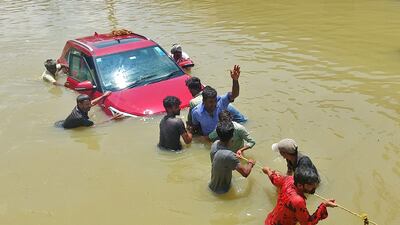
People pull a car on a waterlogged road following torrential rains in Bengaluru, southern India. Torrential rains have lashed the city in Karnataka state since Monday night. Reuters -
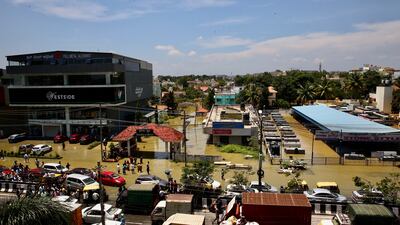
The city suffers floods every year owing to torrential rainfall in the monsoon season and poor infrastructure and drainage systems. EPA -
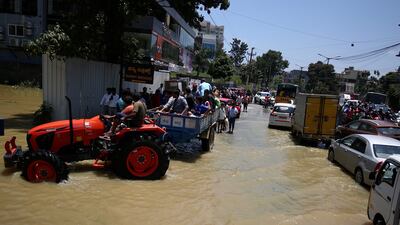
Officer-goers use boats and tractors for transportation as dozens of houses and vehicles remain inundated in low-lying areas. EPA -
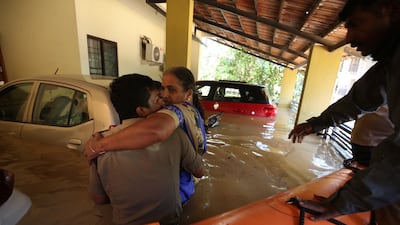
Firefighters rescue people from their houses submerged by water. EPA -

Videos on local television showed vehicles completely submerged in floodwater and in parts distressed people, some carrying children, waded through knee-deep water. EPA -
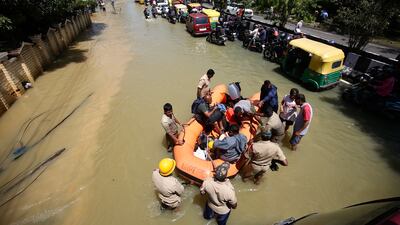
Firefighters use an inflatable boat as they rescue residents. EPA -
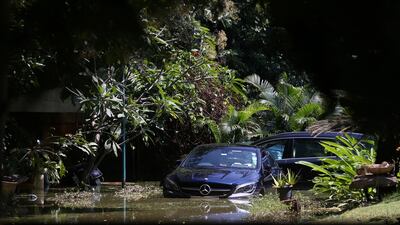
Up to 430 houses have been completely damaged and more than 2,100 have suffered partial damage, the government said. EPA -
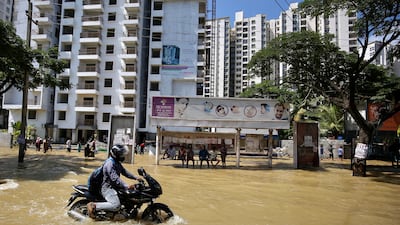
Authorities have closed schools and colleges and advised people to remain at home. EPA -
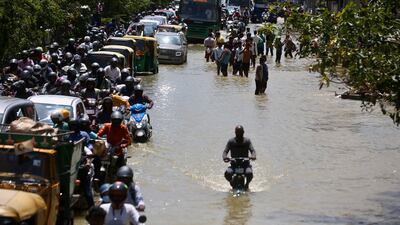
This is the second time in a week that heavy rain has wreaked havoc in the IT hub of the country, bringing life to a standstill. On Sunday, heavy rainfall caused flooding in low-lying residential areas and choked roads. EPA -

Power cuts have occurred and water supply has been severely affected in some localities, with authorities announcing the use of water tankers. EPA -

Chief minister Basavaraj Bommai has announced that three billion rupees ($37.6 million) will be released to tackle the emergency. EPA


Pakistan’s Prime Minister Shahbaz Sharif told his cabinet in September that despite the country producing less than 1 per cent of heat-trapping carbon dioxide, it faced disproportionately more damage from climate-induced floods than other nations.
Earlier in September, Subrahmanyam Jaishankar, India's external affairs minister, said: “We've had a very difficult time in India. And, of course, we are seeing this now [with] these extraordinary floods in Pakistan. So, if people still haven't woken up to it, they should wake up to the enormity of what these climate changes project”.
Typhoon Nanmadol
Typhoon Nanmadol, which killed two people as it brought heavy rain across Japan in September, is one of a trend of wetter storms in a warmer future, according to Michael Wehner, a senior scientist at the Lawrence Berkeley National Laboratory.
The storm injured more than 100, halted traffic and left thousands of homes without power. More damage was reported in southern Japan, where the storm made landfall before weakening as it moved north, AP said.
Two deaths were reported in Miyazaki prefecture on Japan’s southern main island of Kyushu, the Fire and Disaster Management Agency said. A man was found in a submerged car at a flooded farm in Miyakonojo town, and another was found underneath a landslide in Mimata.
“The worst storms will get worse,” Mr Wehner told CBS News.
Hurricane Fiona
Hurricane Fiona was another example of the worrying trend, according to Mr Wehner.
More than 1,000 stranded residents had to be rescued after the hurricane hit the US territory in mid-September, Governor Pedro Pierluisi said. The storm knocked out the island's power supply and caused catastrophic flooding and landslides after landfall, officials said, leading to 30 rescue operations. One man died while operating a generator.
The storm ripped asphalt from roads, swept away a major road bridge, swamped cars, forced airports to close and dumped so much rain that some rivers rose up to six metres in a few hours, witnesses said.
Mr Pierluisi said more than 2,000 people were in more than 100 shelters on the island.
California fires
California's Governor Gavin Newsom signed what he called “some of the nation’s most aggressive climate measures in history” to combat climate change in September.
It comes after the state was hit by a huge blaze — dubbed the “Mosquito Fire” — California's largest of 2022.
Scientists say climate change has made the west warmer and drier over the past three decades and will continue to make weather more extreme and wildfires more frequent and destructive. In the past five years, California has experienced the largest and most destructive fires in its history.
The Mosquito fire, fuelled by dry vegetation, spread over 250 square kilometres soon after it began on September 6. It destroyed more than 70 homes, according to the California Department of Forestry and Fire Protection.
The Fairview Fire, about 120km south-east of Los Angeles, affected 114 square kilometres. Two people were killed attempting to escape the fire, which destroyed at least 35 homes and other structures in the state’s Riverside County.
Wildfires, droughts and storms in Europe
At least 10 people died and four were missing after violent storms lashed Italy’s central Marche region — just days before the country’s general elections on September 25.
About 400 millimetres of rain fell in just two hours, turning main streets into rivers. The flooding followed the worst summer drought in the country for 70 years, draining the Po River, Italy's largest water reservoir.
Wildfires caused by extreme heat caused chaos in Portugal and Spain, with a drought in the latter drying up a reservoir and revealing the “Spanish Stonehenge” — an ancient circle of megalithic stones believed to date back to 5,000 BC. In France and Germany low rivers reduced electricity output and affected the ability of barges to navigate rivers.

The fires and falling rivers are “manifestations of climate change brought about by human activities”, climate scientist Kevin Trenberth, a distinguished scholar at the National Centre of Atmospheric Research in Colorado, told The Conversation.
Dr Trenberth warned that 2022 is likely to produce a third year of a La Niña event, in which cool waters dominate the central and eastern tropical Pacific.
The pattern affects atmospheric circulation, keeping the main rains over southern Asia and the Indonesian region, with record-breaking marine heatwaves in the North and South Pacific, he said.

