


Researchers at Kyoto University in Japan have taught a robot to laugh at jokes in a bid to make it more human.
They are using artificial intelligence to train robots about appropriate laughter – and to differentiate between chuckles and rip-roaring laughs.
They have written about working with a robot called Erica to make conversations more natural.
Their findings have been published in the journal Frontiers in Robotics and AI.
“We think that one of the important functions of conversational AI is empathy,” said lead author Dr Koji Inoue, an assistant professor at Kyoto University in the Department of Intelligence Science and Technology.
“Conversation is, of course, multimodal, not just responding correctly. So we decided that one way a robot can empathise with users is to share their laughter, which you cannot do with a text-based chatbot.”
Portraits of Queen Elizabeth II by robot Ai-Da and other artists - in pictures
-

Ai-Da, the world's first ultra-realistic robot artist, right, has made a new portrait of Queen Elizabeth II, titled 'Algorithm Queen', in celebration of the British monarch’s platinum jubilee. Photo: Midas -
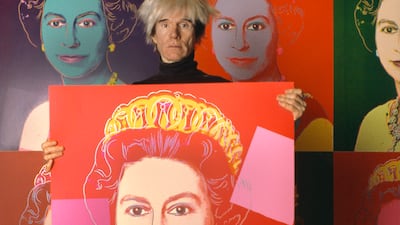
Ai-Da may be the first robot to create a portrait of the monarch, but she certainly isn't the first artist. Here American Pop artist Andy Warhol holds a silkscreen print of Queen Elizabeth in his studio, the Factory, in New York, 1985. Getty Images -
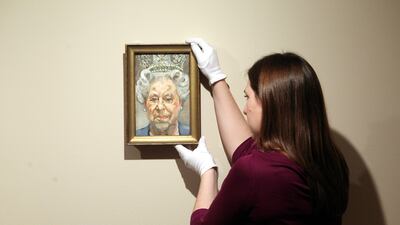
A portrait of Queen Elizabeth by Lucian Freud hangs during an exhibition at Windsor Castle in 2012. Getty Images -

A preliminary sketch of Queen Elizabeth for the first banknote to carry a portrait of the monarch, issued on March 17, 1960, is seen in the Bank of England Museum in 2010. Getty Images -
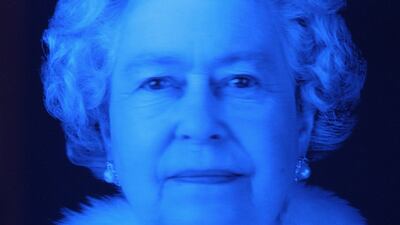
A portrait by artist Chris Levine depicting Queen Elizabeth is displayed at Asprey in London in 2012. The portrait incorporates a diadem, which was created by the jewellers Asprey in conjunction with the artist as part of the diamond jubilee celebrations. Getty Images -

A portrait of the queen by artist Darren Baker is unveiled at Church House, Westminster, in 2011. Getty Images -
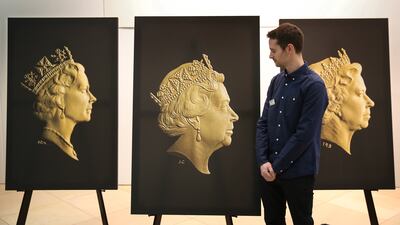
A Royal Mint engraver looks at the new coinage portrait, centre, of Queen Elizabeth at The National Portrait Gallery in London, 2015. Getty Images -

Queen Elizabeth unveils a portrait of herself by artist Colin Davidson at Crosby Hall, London, in 2016. Getty Images -
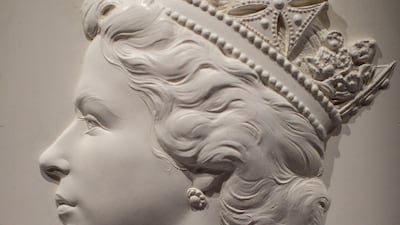
The 1963 plaster cast known as the 'Dressed Head' by Arnold Machin, which provided the portrait of Queen Elizabeth to be used on British stamps from 1967, on display at the Postal Museum, London, in 2017. Getty Images -
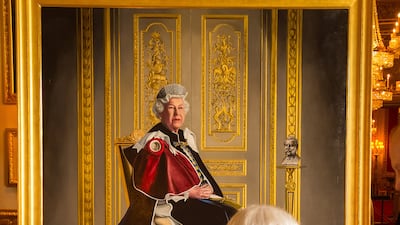
Queen Elizabeth views a portrait of herself by British artist Henry Ward, marking six decades of patronage to the British Red Cross, after it was unveiled at Windsor Castle in 2016. Getty Images -
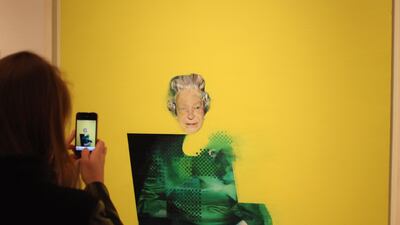
A woman photographs a painting by artist Justin Mortimer, entitled 'The Queen', in the National Portrait Gallery, London, in 2012. Getty Images -
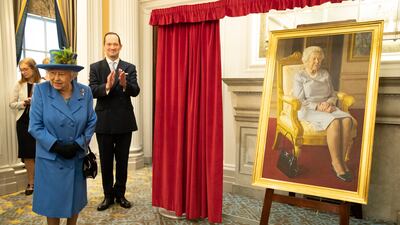
Queen Elizabeth looks at a new painting by BP Portrait Award 2017 winner, Benjamin Sullivan. The portrait was commissioned to celebrate 100 years of the RAF Club, in 2018. Getty Images -
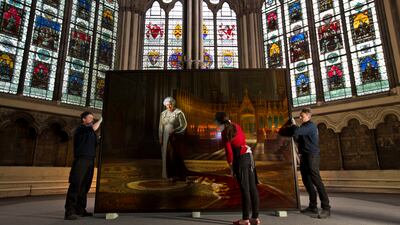
Conservators conduct a condition report on a portrait of the queen before it is placed inside the Chapter House at Westminster Abbey, in 2013. Getty Images -
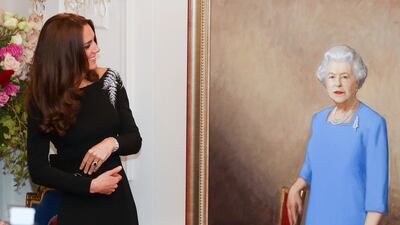
Catherine, Duchess of Cambridge inspects a portrait of Queen Elizabeth painted by New Zealand artist Nick Cuthell and unveiled during a state reception in Wellington, in 2014. Getty Images -

Canadian artist Phil Richards and Canada's then-prime minister, Stephen Harper, stand with Queen Elizabeth as she unveils a portrait of herself in the White Drawing Room at Buckingham Palace, in 2012. Getty Images -
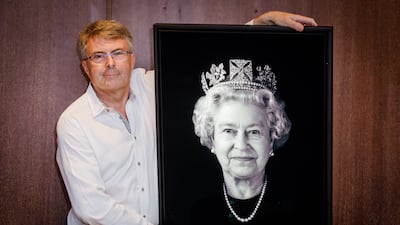
Rob Munday unveils a never seen before portrait of Queen Elizabeth at 45 Park Lane in London in May this year. Getty Images


Creating a “shared laughter” model, the researchers used AI to help detect laughter, to decide whether to laugh and also what kind of laughter would be best.
Four two to three-minute dialogues between real people and Erica were used to test the system, which performed well.
However, the experts said there is more work to do to create truly natural laughter situations.
Business Extra: Takeo Kanade on rise of robots - podcast
“Robots should actually have a distinct character, and we think that they can show this through their conversational behaviours, such as laughing, eye gaze, gestures and speaking style," Dr Inoue said.
“We do not think this is an easy problem at all, and it may well take more than 10 to 20 years before we can finally have a casual chat with a robot like we would with a friend.”

