UN Secretary General Antonio Guterres said 'humanity’s future is in our hands today'. Getty Images

Stop 'nuclear sabre-rattling', UN chief demands


Soraya Ebrahimi
  • English
  • Arabic

The world is at a “maximum moment of danger” and all countries with nuclear weapons must make a commitment to “no first-use”, said UN Secretary General Antonio Guterres on Monday, as he also called for an end to “nuclear sabre-rattling”.

The UN chief called for the same commitment to dialogue and reason that led to the deal that restarted grain and fertiliser shipments from Ukraine and Russia to be applied to “the critical situation” at Europe’s largest nuclear power plant at Zaporizhzhia, where continued shelling and fighting has raised fears of a catastrophe.

“Humanity’s future is in our hands today,” said Mr Guterres as he urged all countries “to recommit to a world free of nuclear weapons and to spare no effort to come to the negotiating table to ease tension and end the nuclear arms race, once and for all”.

The secretary general spoke at a UN Security Council meeting organised by China, which holds the presidency this month, on “promoting common security through dialogue and co-operation”.

Around the world, Mr Guterres said, collective security is being tested as “never before”, pointing to geopolitical divides, conflicts, military coups, invasions, lengthy wars and differences between the world’s great powers, “including at this council”.

He also cited “challenges that were unimaginable to our predecessors — cyberwarfare, terrorism and lethal autonomous weapons”.

“And the nuclear risk has climbed to its highest point in decades,” Mr Guterres said.

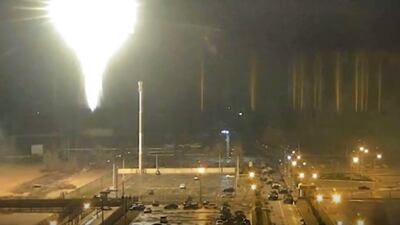
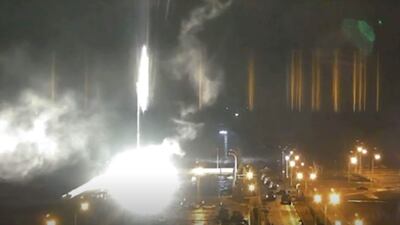
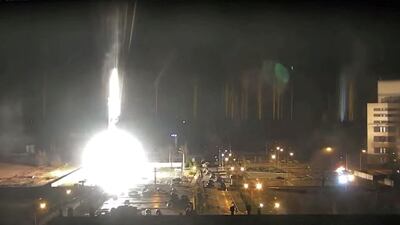
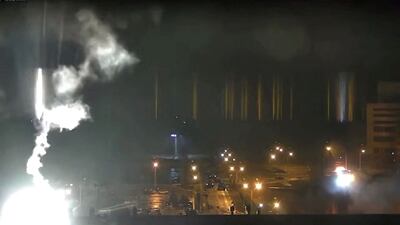
Zaporizhzhia nuclear power plant attacked — in pictures

  • A bright flaring object lands near the nuclear plant in Enerhodar, Ukraine. AP
    A bright flaring object lands near the nuclear plant in Enerhodar, Ukraine. AP
  • Russian forces shelled Europe’s largest nuclear plant early on Friday. AP
    Russian forces shelled Europe’s largest nuclear plant early on Friday. AP
  • Surveillance camera footage shows a flare landing at the Zaporizhzhia nuclear power plant. Reuters
    Surveillance camera footage shows a flare landing at the Zaporizhzhia nuclear power plant. Reuters
  • The flare lands at the plant. Reuters
    The flare lands at the plant. Reuters
  • Multiple blasts at the plant were recorded. AFP
    Multiple blasts at the plant were recorded. AFP
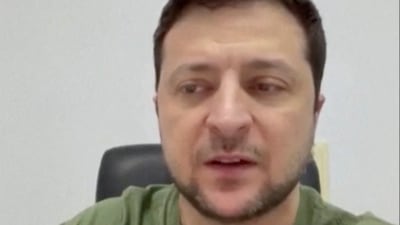
  • Ukrainian President Volodymyr Zelenskiy makes a statement following the attack. Reuters
    Ukrainian President Volodymyr Zelenskiy makes a statement following the attack. Reuters
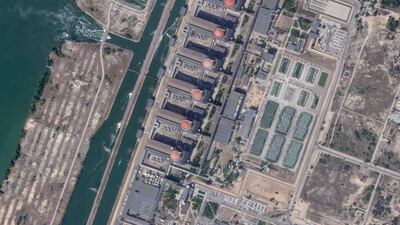
  • The Zaporizhzhia nuclear power plant in Enerhodar, Ukraine, on September 2, 2019. AP
    The Zaporizhzhia nuclear power plant in Enerhodar, Ukraine, on September 2, 2019. AP
  • A power-generating unit at the Zaporizhzhia nuclear power plant. AP Photo
    A power-generating unit at the Zaporizhzhia nuclear power plant. AP Photo

The council meeting took place during the pandemic-delayed conference to review the 50-year-old Treaty on Non-Proliferation of Nuclear Weapons, which is considered the cornerstone of international disarmament efforts.

It is taking place against the backdrop of Russian President Vladimir Putin’s warning after his February 24 invasion of Ukraine that Russia is a “potent” nuclear power and any attempt to interfere would lead to “consequences you have never seen”.

Earlier this year, her announced his decision to put Russia’s nuclear forces on high alert.

Mr Putin has since said that “a nuclear war cannot be won and must never be fought”, a message reiterated by a senior Russian official on the opening day of the conference on August 2.

The treaty sought to prevent the spread of nuclear arms beyond the five original nuclear powers — the US, Russia, China, Britain and France — and eventually achieve a nuclear-free world.

It requires non-nuclear signatory nations not to pursue atomic weapons in exchange for a commitment by the five powers to move towards nuclear disarmament and to guarantee non-nuclear states’ access to peaceful technology for producing energy.

The Chernobyl nuclear disaster 33 years on — in pictures

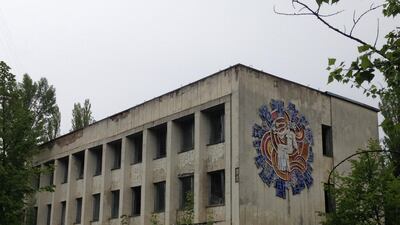
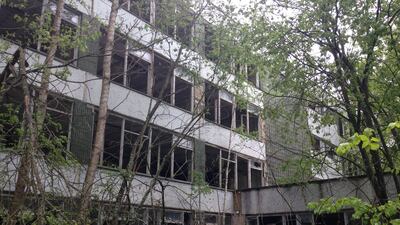
  • Pripyat is still a draw for visitors, not least for its Soviet-era architecture which has been frozen in time. All photos: Declan McVeigh / The National
    Pripyat is still a draw for visitors, not least for its Soviet-era architecture which has been frozen in time. All photos: Declan McVeigh / The National
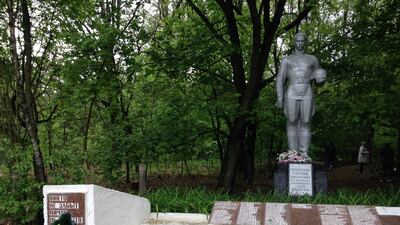
  • Like thousands of other Soviet towns, Pripyat had memorials to the dead of the 1941-1945 Great Patriotic War. This one is close to an abandoned nursery in the 30km 'dead zone' around Chernobyl.
    Like thousands of other Soviet towns, Pripyat had memorials to the dead of the 1941-1945 Great Patriotic War. This one is close to an abandoned nursery in the 30km 'dead zone' around Chernobyl.
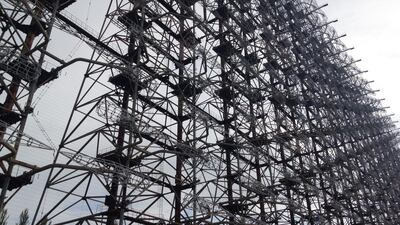
  • This enormous Duga-1 OTH radar array – AKA the 'Russian woodpecker' for the interference it caused on shortwave radio – dominates the skyline of this remote part of northern Ukraine near Chernobyl.
    This enormous Duga-1 OTH radar array – AKA the 'Russian woodpecker' for the interference it caused on shortwave radio – dominates the skyline of this remote part of northern Ukraine near Chernobyl.
  • Pripyat was once home to nearly 50,000 people; the city has been left to rot as Ukraine’s government still forbids people from living there.
    Pripyat was once home to nearly 50,000 people; the city has been left to rot as Ukraine’s government still forbids people from living there.
  • An abandoned funfair in Pripyat.
    An abandoned funfair in Pripyat.
  • Before the disaster more than 15,400 children lived in the city of Pripyat alone.
    Before the disaster more than 15,400 children lived in the city of Pripyat alone.
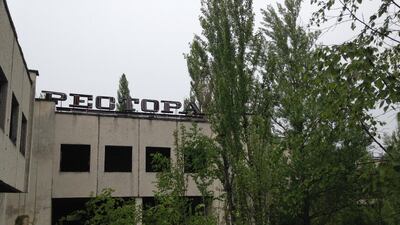
  • One of Pripyat’s 27 restaurants and cafes, left to the elements since 1986.
    One of Pripyat’s 27 restaurants and cafes, left to the elements since 1986.
  • The UN says more than 6,000 cases of thyroid cancer were reported among children from Ukraine, Russia and Belarus up to 2005, 'most likely caused by radiation exposures shortly after the accident'.
    The UN says more than 6,000 cases of thyroid cancer were reported among children from Ukraine, Russia and Belarus up to 2005, 'most likely caused by radiation exposures shortly after the accident'.
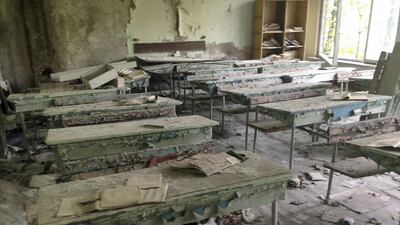
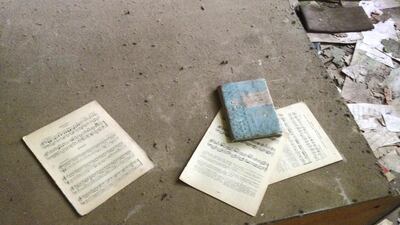
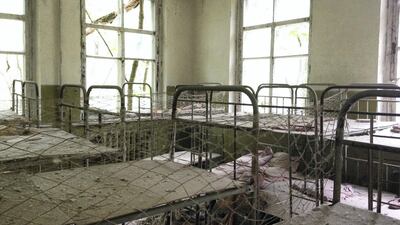
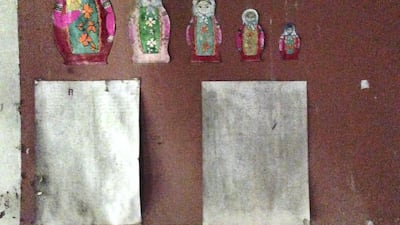
  • Classrooms were abandoned as the Soviet authorities ordered people to leave the Chernobyl area. Residents were told they would be leaving for three days, but officials later decided the area would remain empty.
    Classrooms were abandoned as the Soviet authorities ordered people to leave the Chernobyl area. Residents were told they would be leaving for three days, but officials later decided the area would remain empty.
  • This nursery was one of 15 which educated almost 5,000 young children across the area.
    This nursery was one of 15 which educated almost 5,000 young children across the area.
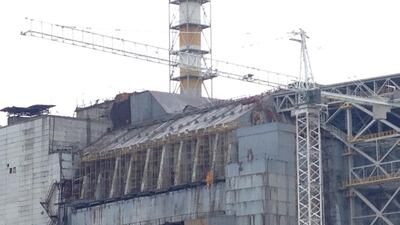
  • The sarcophagus over reactor number four at Chernobyl was designed and built in 1986 to keep in 740,000m3 of radioactive debris and contaminated soil. In November 2016 the sarcophagus itself was covered in the €1.5 billion ($1.49bn) Chernobyl New Safe Confinement project.
    The sarcophagus over reactor number four at Chernobyl was designed and built in 1986 to keep in 740,000m3 of radioactive debris and contaminated soil. In November 2016 the sarcophagus itself was covered in the €1.5 billion ($1.49bn) Chernobyl New Safe Confinement project.
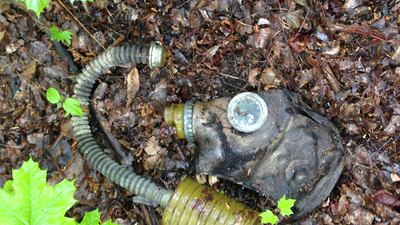
  • A gas mask once worn by one of thousands of Soviet 'liquidators' - a mix of civilian and military workers sent to Chernobyl after the reactor explosion. More than half a million people took part in the clean-up.
    A gas mask once worn by one of thousands of Soviet 'liquidators' - a mix of civilian and military workers sent to Chernobyl after the reactor explosion. More than half a million people took part in the clean-up.
  • The 30km exclusion zone around the site of the blast is dotted with reminders that it was once home to thousands of people. This nursery was abandoned on April 27, 1986.
    The 30km exclusion zone around the site of the blast is dotted with reminders that it was once home to thousands of people. This nursery was abandoned on April 27, 1986.
  • Abandoned buildings in Pripyat remain officially out of bounds, but some people – a mix of former residents, villagers, adventurers and mere loners – have returned to live inside the 30km 'dead zone'.
    Abandoned buildings in Pripyat remain officially out of bounds, but some people – a mix of former residents, villagers, adventurers and mere loners – have returned to live inside the 30km 'dead zone'.

Gustavo Zlauvinen, president of the treaty review conference, told the Security Council without naming any country that since February, “the NPT faces a raft of challenges, the diversity and scope of which are unlike anything that has come before”.

It should be no surprise, he said, that concerns have grown on the need for urgent action on disarmament.

Mr Zlauvinen, an Argentinian Foreign Ministry official, called “the norm” against using nuclear weapons one of the most important achievements of the post-Second World War era, but said that “it is increasingly threatened”.

He also said that the current global security environment revived the belief that nuclear weapons provide “the ultimate security guarantee”, calling this “an extremely damaging narrative and dangerous for non-proliferation”.

Russia’s UN ambassador Vassily Nebenzia told the council “the international security system is experiencing a profound crisis” and trust between key international players at nearly all the institutions it is based on is at “a critically low level”.

For more than 200 years, he said, western countries have blamed Russia for everything.

Mr Nebenzia accused the US and its allies of “acting in the same reckless and provocative manner in Asia and Africa” as they are in Ukraine, and added “the reckless American scheme involving Taiwan is proceeding in the same vein”.

He said Russia had called for an emergency meeting of the Security Council on Tuesday on what he called Ukrainian provocations at the Zaporizhzhia nuclear plant.

He accused western countries supporting Ukraine of “essentially helping Kyiv in its attempts of nuclear blackmail” while ignoring shelling of the facility by Ukrainian armed forces.

Ukraine has accused Russia of using the plant as a military base and shelling it and its surroundings.

UN chief: 'Humanity one miscalculation away from nuclear annihilation' — video

US ambassador to the UN Linda Thomas-Greenfield told the council that one of the greatest threats to maintaining global peace and security is Russia’s full-scale invasion of its neighbour and fellow member of the UN. She listed diplomatic efforts by the US and many other nations to prevent Moscow’s military action.

“Russia, however, rejected dialogue, discarded established views of sovereign equality, discarded the concept of indivisibility of security and launched a horrific war,” she said.

Ms Thomas-Greenfield took after Russia’s repeated saying that the security of one state cannot come at the expense of another, saying: “Russia’s tortured, full-throated messaging on the supposed threats it faces from its neighbours omits the fact that all nations have the right to choose their security alliances.”


New shelling reported at Ukraine nuclear plant — video

Mercer, the investment consulting arm of US services company Marsh & McLennan, expects its wealth division to at least double its assets under management (AUM) in the Middle East as wealth in the region continues to grow despite economic headwinds, a company official said.

Mercer Wealth, which globally has $160 billion in AUM, plans to boost its AUM in the region to $2-$3bn in the next 2-3 years from the present $1bn, said Yasir AbuShaban, a Dubai-based principal with Mercer Wealth.

Within the next two to three years, we are looking at reaching $2 to $3 billion as a conservative estimate and we do see an opportunity to do so,” said Mr AbuShaban.

Mercer does not directly make investments, but allocates clients’ money they have discretion to, to professional asset managers. They also provide advice to clients.

“We have buying power. We can negotiate on their (client’s) behalf with asset managers to provide them lower fees than they otherwise would have to get on their own,” he added.

Mercer Wealth’s clients include sovereign wealth funds, family offices, and insurance companies among others.

From its office in Dubai, Mercer also looks after Africa, India and Turkey, where they also see opportunity for growth.

Wealth creation in Middle East and Africa (MEA) grew 8.5 per cent to $8.1 trillion last year from $7.5tn in 2015, higher than last year’s global average of 6 per cent and the second-highest growth in a region after Asia-Pacific which grew 9.9 per cent, according to consultancy Boston Consulting Group (BCG). In the region, where wealth grew just 1.9 per cent in 2015 compared with 2014, a pickup in oil prices has helped in wealth generation.

BCG is forecasting MEA wealth will rise to $12tn by 2021, growing at an annual average of 8 per cent.

Drivers of wealth generation in the region will be split evenly between new wealth creation and growth of performance of existing assets, according to BCG.

Another general trend in the region is clients’ looking for a comprehensive approach to investing, according to Mr AbuShaban.

“Institutional investors or some of the families are seeing a slowdown in the available capital they have to invest and in that sense they are looking at optimizing the way they manage their portfolios and making sure they are not investing haphazardly and different parts of their investment are working together,” said Mr AbuShaban.

Some clients also have a higher appetite for risk, given the low interest-rate environment that does not provide enough yield for some institutional investors. These clients are keen to invest in illiquid assets, such as private equity and infrastructure.

“What we have seen is a desire for higher returns in what has been a low-return environment specifically in various fixed income or bonds,” he said.

“In this environment, we have seen a de facto increase in the risk that clients are taking in things like illiquid investments, private equity investments, infrastructure and private debt, those kind of investments were higher illiquidity results in incrementally higher returns.”

The Abu Dhabi Investment Authority, one of the largest sovereign wealth funds, said in its 2016 report that has gradually increased its exposure in direct private equity and private credit transactions, mainly in Asian markets and especially in China and India. The authority’s private equity department focused on structured equities owing to “their defensive characteristics.”

Like a Fading Shadow

Antonio Muñoz Molina

Translated from the Spanish by Camilo A. Ramirez

Tuskar Rock Press (pp. 310)

VEZEETA PROFILE

Date started: 2012

Founder: Amir Barsoum

Based: Dubai, UAE

Sector: HealthTech / MedTech

Size: 300 employees

Funding: $22.6 million (as of September 2018)

Investors: Technology Development Fund, Silicon Badia, Beco Capital, Vostok New Ventures, Endeavour Catalyst, Crescent Enterprises’ CE-Ventures, Saudi Technology Ventures and IFC

'Shakuntala Devi'

Starring: Vidya Balan, Sanya Malhotra

Director: Anu Menon

Rating: Three out of five stars

MATCH INFO

UAE Division 1

Abu Dhabi Harlequins 12-24 Abu Dhabi Saracens

Sly%20Cooper%20and%20the%20Thievius%20Raccoonus
%3Cp%3E%3Cstrong%3EDeveloper%3A%3C%2Fstrong%3E%20Sucker%20Punch%20Productions%3Cbr%3E%3Cstrong%3EPublisher%3A%3C%2Fstrong%3E%20Sony%20Computer%20Entertainment%3Cbr%3E%3Cstrong%3EConsole%3A%3C%2Fstrong%3E%20PlayStation%202%20to%205%3Cbr%3E%3Cstrong%3ERating%3A%3C%2Fstrong%3E%205%2F5%3C%2Fp%3E%0A
Key findings of Jenkins report
  • Founder of the Muslim Brotherhood, Hassan al Banna, "accepted the political utility of violence"
  • Views of key Muslim Brotherhood ideologue, Sayyid Qutb, have “consistently been understood” as permitting “the use of extreme violence in the pursuit of the perfect Islamic society” and “never been institutionally disowned” by the movement.
  • Muslim Brotherhood at all levels has repeatedly defended Hamas attacks against Israel, including the use of suicide bombers and the killing of civilians.
  • Laying out the report in the House of Commons, David Cameron told MPs: "The main findings of the review support the conclusion that membership of, association with, or influence by the Muslim Brotherhood should be considered as a possible indicator of extremism."
Will the pound fall to parity with the dollar?

The idea of pound parity now seems less far-fetched as the risk grows that Britain may split away from the European Union without a deal.

Rupert Harrison, a fund manager at BlackRock, sees the risk of it falling to trade level with the dollar on a no-deal Brexit. The view echoes Morgan Stanley’s recent forecast that the currency can plunge toward $1 (Dh3.67) on such an outcome. That isn’t the majority view yet – a Bloomberg survey this month estimated the pound will slide to $1.10 should the UK exit the bloc without an agreement.

New Prime Minister Boris Johnson has repeatedly said that Britain will leave the EU on the October 31 deadline with or without an agreement, fuelling concern the nation is headed for a disorderly departure and fanning pessimism toward the pound. Sterling has fallen more than 7 per cent in the past three months, the worst performance among major developed-market currencies.

“The pound is at a much lower level now but I still think a no-deal exit would lead to significant volatility and we could be testing parity on a really bad outcome,” said Mr Harrison, who manages more than $10 billion in assets at BlackRock. “We will see this game of chicken continue through August and that’s likely negative for sterling,” he said about the deadlocked Brexit talks.

The pound fell 0.8 per cent to $1.2033 on Friday, its weakest closing level since the 1980s, after a report on the second quarter showed the UK economy shrank for the first time in six years. The data means it is likely the Bank of England will cut interest rates, according to Mizuho Bank.

The BOE said in November that the currency could fall even below $1 in an analysis on possible worst-case Brexit scenarios. Options-based calculations showed around a 6.4 per cent chance of pound-dollar parity in the next one year, markedly higher than 0.2 per cent in early March when prospects of a no-deal outcome were seemingly off the table.

Bloomberg

Countries offering golden visas

UK
Innovator Founder Visa is aimed at those who can demonstrate relevant experience in business and sufficient investment funds to set up and scale up a new business in the UK. It offers permanent residence after three years.

Germany
Investing or establishing a business in Germany offers you a residence permit, which eventually leads to citizenship. The investment must meet an economic need and you have to have lived in Germany for five years to become a citizen.

Italy
The scheme is designed for foreign investors committed to making a significant contribution to the economy. Requires a minimum investment of €250,000 which can rise to €2 million.

Switzerland
Residence Programme offers residence to applicants and their families through economic contributions. The applicant must agree to pay an annual lump sum in tax.

Canada
Start-Up Visa Programme allows foreign entrepreneurs the opportunity to create a business in Canada and apply for permanent residence. 

The%20specs
%3Cp%3E%3Cstrong%3EEngine%3A%20%3C%2Fstrong%3E2.3-litre%204cyl%20turbo%0D%3Cbr%3E%3Cstrong%3EPower%3A%20%3C%2Fstrong%3E299hp%20at%205%2C500rpm%0D%3Cbr%3E%3Cstrong%3ETorque%3A%20%3C%2Fstrong%3E420Nm%20at%202%2C750rpm%0D%3Cbr%3E%3Cstrong%3ETransmission%3A%20%3C%2Fstrong%3E10-speed%20auto%0D%3Cbr%3E%3Cstrong%3EFuel%20consumption%3A%20%3C%2Fstrong%3E12.4L%2F100km%0D%3Cbr%3E%3Cstrong%3EOn%20sale%3A%20%3C%2Fstrong%3ENow%0D%3Cbr%3E%3Cstrong%3EPrice%3A%20%3C%2Fstrong%3EFrom%20Dh157%2C395%20(XLS)%3B%20Dh199%2C395%20(Limited)%3C%2Fp%3E%0A
Israel Palestine on Swedish TV 1958-1989

Director: Goran Hugo Olsson

Rating: 5/5

The biog

Prefers vegetables and fish to meat and would choose salad over pizza

Walks daily as part of regular exercise routine 

France is her favourite country to visit

Has written books and manuals on women’s education, first aid and health for the family

Family: Husband, three sons and a daughter

Fathiya Nadhari's instructions to her children was to give back to the country

The children worked as young volunteers in social, education and health campaigns

Her motto is to never stop working for the country

COMPANY%20PROFILE%20
%3Cp%3EName%3A%20DarDoc%3Cbr%3EBased%3A%20Abu%20Dhabi%3Cbr%3EFounders%3A%20Samer%20Masri%2C%20Keswin%20Suresh%3Cbr%3ESector%3A%20HealthTech%3Cbr%3ETotal%20funding%3A%20%24800%2C000%3Cbr%3EInvestors%3A%20Flat6Labs%2C%20angel%20investors%20%2B%20Incubated%20by%20Hub71%2C%20Abu%20Dhabi's%20Department%20of%20Health%3Cbr%3ENumber%20of%20employees%3A%2010%3C%2Fp%3E%0A
Updated: August 23, 2022, 7:35 AM