


The United States will establish a permanent army headquarters in Poland as part of enhanced Nato plans in the face of Russian aggression in Europe, President Joe Biden said on Wednesday.
Nato leaders discussed plans to overhaul and boost the alliance’s defences at the alliance's Madrid summit, including establishing a new force model that would place about 300,000 troops on high alert to deal with any future threats.
As well as the Polish base for the Fifth Army Corps, Mr Biden said his country would also maintain an additional rotational brigade of thousands of troops in Romania and bolster deployments in the Baltic states. The US will send two more F-35 squadrons to the UK and add to air-defence systems in Germany and Italy. That adds to 100,000 American troops already in Europe.
“In a moment where Putin has shattered peace in Europe and attacked the very, very tenets of the rule-based order of the United States and our allies — we’re stepping up,” Mr Biden said at the summit. “The steps we’re taking during this summit are going to further augment our collective strength.” The Russian president is “getting the NATO-ization of Europe," he added.
Nato will be "strengthened in all directions across every domain - land, air and sea," he said. Biden visited Poland in March and told US troops deployed there that they were "in the midst of a fight between democracies and oligarchs."
Poland, which has long sought a permanent US military base on its soil, on Wednesday said the move would send a clear signal to the Russians.
"It is a success which comes from long and consistent negotiations on this matter and, at the same time, a very clear sign that the Americans intend to increase, not decrease, their presence in Poland," said Jakub Kumoch, the Polish president's foreign policy adviser.
-
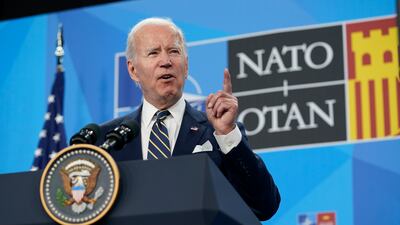
US President Joe Biden speaks at a news conference on the final day of the Nato summit in Madrid. AP -

British Prime Minister Boris Johnson holds a news conference. PA -
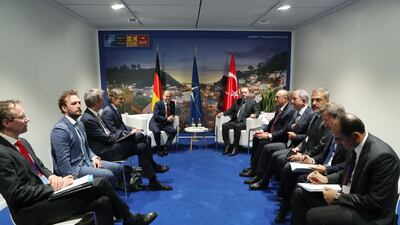
Turkish President Recep Tayyip Erdogan meets German Chancellor Olaf Scholz. AFP -
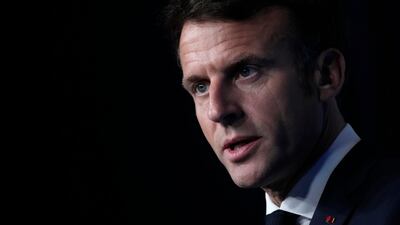
French President Emmanuel Macron speaks during the final day of the Nato summit. AP -
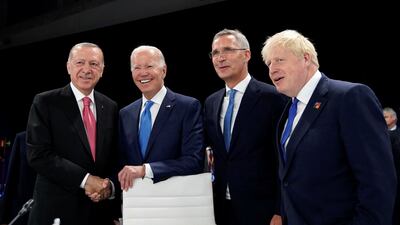
Turkish President Recep Tayyip Erdogan and US President Joe Biden shake hands as Nato secretary general Jens Stoltenberg and British Prime Minister Boris Johnson look on at a Nato summit in Madrid. Reuters -
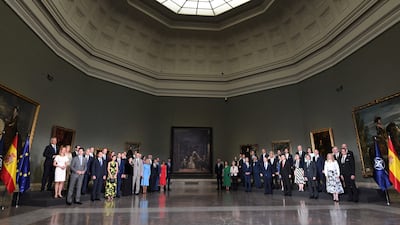
Heads of state of Nato member countries and their spouses pose for a group photo during a visit to the Prado Museum, in Madrid. AFP -
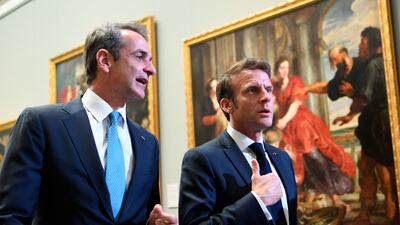
French president Emmanuel Macron, right, and Greek Prime Minister Kyriakos Mitsotakis during the Prado Museum visit. AP -
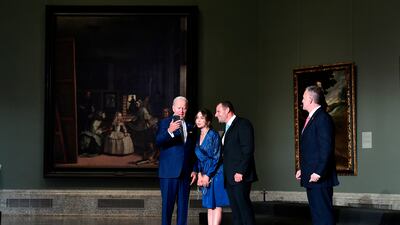
Mr Biden takes a selfie with Maltese Prime Minister Robert Abela and his wife Lydia Abela as they visit the Prado Museum. AP -
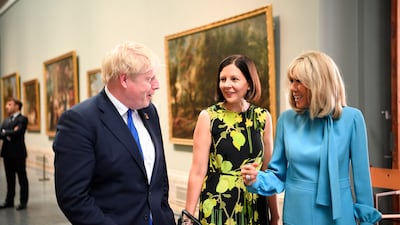
British Prime Minister Boris Johnson, the first lady of France, Brigitte Macron, right, and Belgian Prime Minister Alexander De Croo's wife Annik Penders have a conversation at the museum. AP -
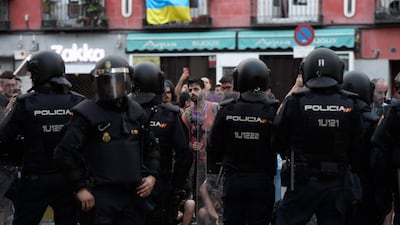
Spanish police stand in front of protesters during an anti-Nato demonstration near Tirso de Molina square in Madrid. AFP -
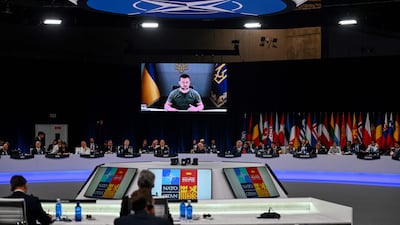
Ukrainian President Volodymyr Zelenskyy appears on a giant screen as he delivers a statement at the start of the first plenary session of the Nato summit. AFP -
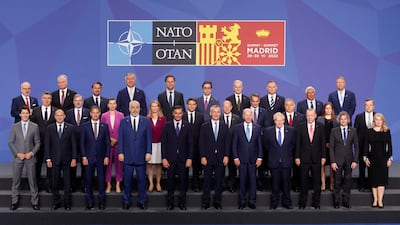
World leaders pose for a photo during the summit. Reuters -
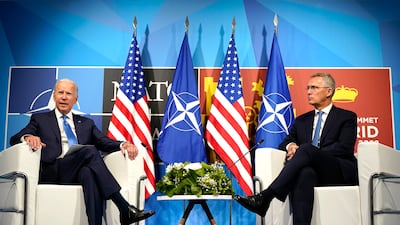
US President Joe Biden, left, and Nato Secretary General Jens Stoltenberg. AP -
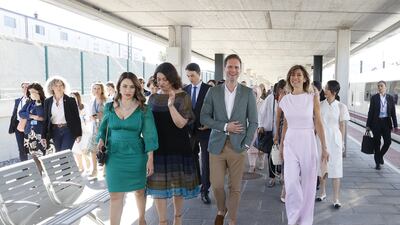
Maria Begona Gomez, wife of Spanish Prime Minister Pedro Sanchez, the first Lady of Lithuania, Diana Nausediene, first lady of Malta, Lydia Abela, and Gauthier Destenay, the husband of Luxembourg's Prime Minister, before a visit to the royal site of San Idelfonso in Segovia. EPA -
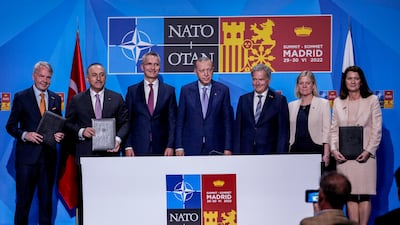
Finnish Foreign Minister Pekka Haavisto, Turkish Foreign Minister Mevlut Cavusoglu, Jens Stoltenberg, Turkish President Recep Tayyip Erdogan, Finland's President Sauli Niinisto, Sweden's Prime Minister Magdalena Andersson and Sweden's Foreign Minister Ann Linde pose for a picture after signing an agreement in Madrid. AP -
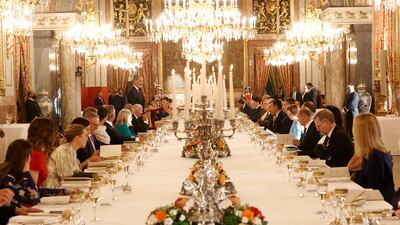
King Felipe VI of Spain addresses leaders during a dinner at the Royal Palace in Madrid. Reuters -
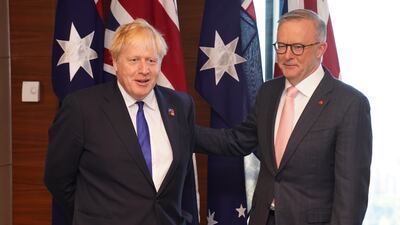
Mr Johnson meets Australian Prime Minister Anthony Albanese. PA -
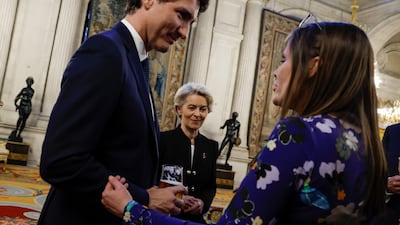
Canada's Prime Minister Justin Trudeau and European Commission President Ursula von der Leyen attend a reception at the Royal Palace in Madrid. AP -
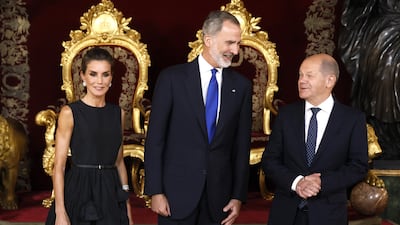
Spain's King Felipe VI and Queen Letizia greet German Chancellor Olaf Scholz, right, during a royal reception for heads of governments and states. EPA -
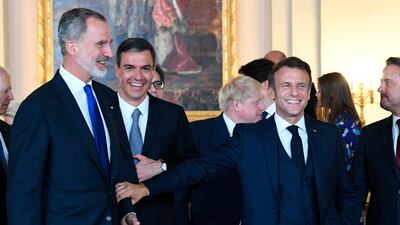
King Felipe VI, left, Mr Sanchez, second left and Mr Macron before the dinner. AP -
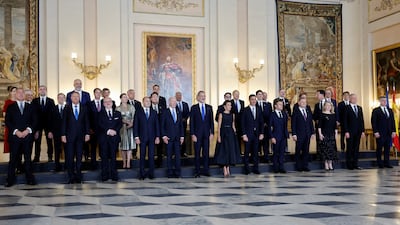
Nato leaders pose for a 'family photo' with King Felipe and Queen Letizia in Madrid. Reuters -
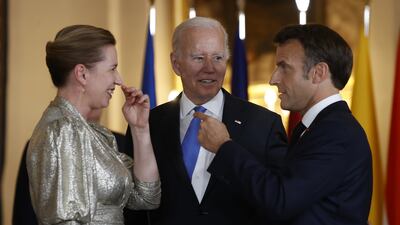
Denmark's Prime Minister Mette Frederiksen, left, with Mr Biden and Mr Macron. EPA -
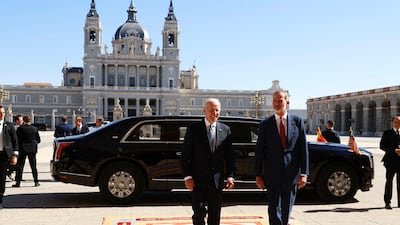
Mr Biden, left, and King Felipe arrive for a meeting at the Royal Palace in Madrid. Reuters -
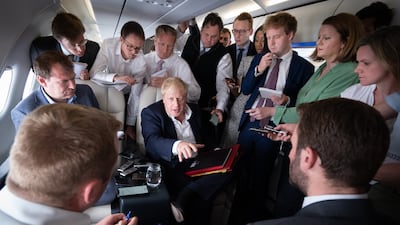
Mr Johnson talks to journalists on his plane during a flight from Germany – where he was attending the G7 summit – to the Nato summit in the Spanish capital. PA -

Mr Erdogan, second left, meets Mr Stoltenberg, Mr Niinisto of Finland and Ms Andersson of Sweden before the summit. Reuters -
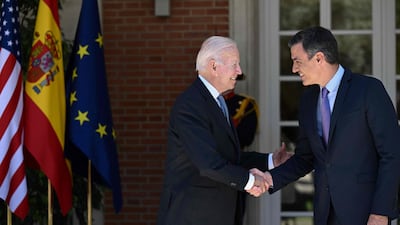
Mr Biden shakes hands with Prime Minister Sanchez of Spain at the Palace of Moncloa, in Madrid. AFP -
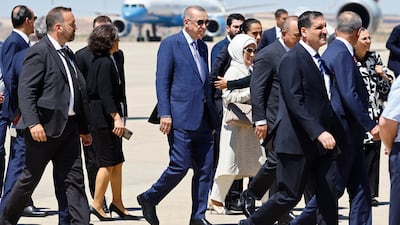
Mr Erdogan, centre, arrives at the Torreon air base in Madrid. AP -
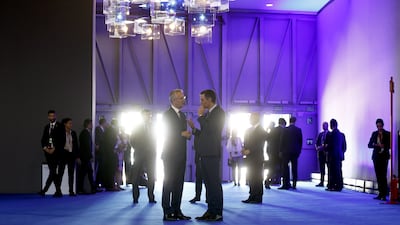
Mr Sanchez, right, speaks with Mr Stoltenberg before the summit. EPA -
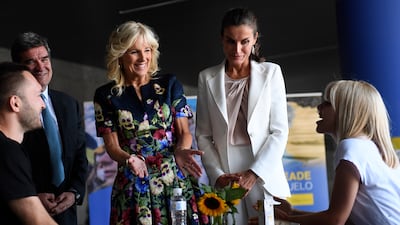
US first lady Jill Biden, centre left, and Spain's Queen Letizia speak with a family during a visit to a reception centre for Ukrainian refugees in Madrid. AP -
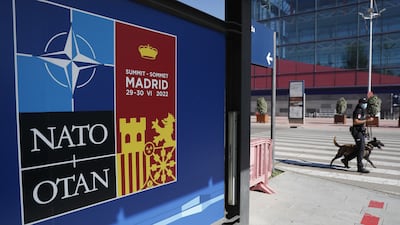
Spanish police patrol outside the Ifema convention centre before the Nato summit in Madrid. EPA -
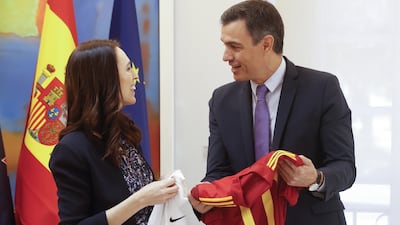
Mr Sanchez and his New Zealand counterpart Jacinda Ardern hold the jerseys of their national football teams during a meeting at Moncloa Palace. EPA -
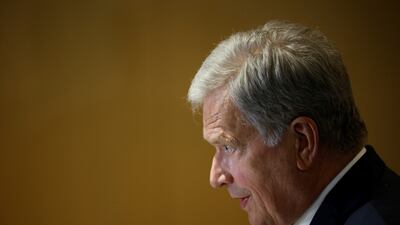
Finland's President Niinisto speaks during a briefing in Madrid before the Nato summit. Reuters -
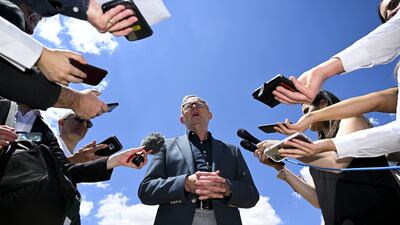
Australian Prime Minister Anthony Albanese speaks to the media after arriving at Torrejon Airbase in Madrid. EPA -
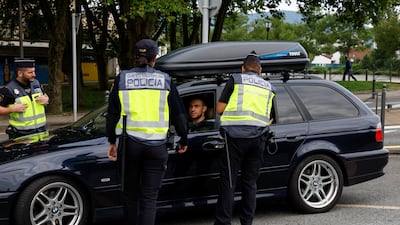
Spanish police officers control traffic on the Spain-France border in Irun. Reuters -

Mr Stoltenberg speaks at a press conference to preview the Nato summit at the alliance's headquarters in Brussels, Belgium. AFP -
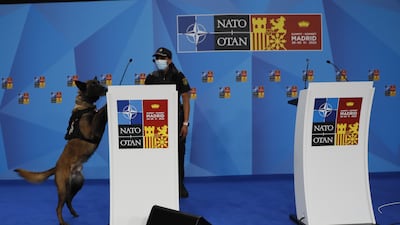
Spanish police use sniffer dogs to check a podium at the Ifema centre in Madrid. EPA -
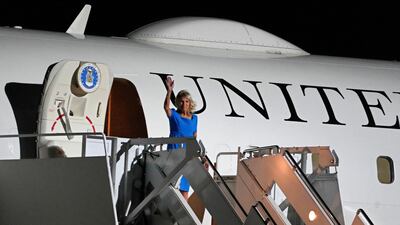
US first lady Jill Biden waves on arrival at Torrejon air base in Madrid. Reuters


"Something that seemed impossible to many is becoming a fact today," Deputy Foreign Minister Marcin Przydacz wrote on Twitter. "We have a PERMANENT U.S. presence in Poland ... It is also a clear signal to Moscow."
Russian forces struck targets in the Mykolaiv region of southern Ukraine on Wednesday and intensified attacks on fronts across the country.
Ukrainian President Volodymyr Zelenskyy told the Nato leaders his country needed more weapons and money to defend itself against Russia, warning that Moscow's ambitions did not stop at Ukraine.
In a video link-up from the capital Kyiv, demanded more weapons from the West and said Ukraine needed $5 billion per month for its defence and protection.
Russia would set its sights on other countries, he warned, saying Moscow wanted to "enslave" NATO-member Lithuania.
"This not a war being waged by Russia against only Ukraine. This is a war for the right to dictate conditions in Europe - for what the future world order will be like," he said.
Russia said Wednesday it would not be intimidated by US military reinforcements in Europe as tensions spiral over Moscow's military intervention in Ukraine.
"I think that those who propose such solutions are under the illusion that they will be able to intimidate Russia, somehow restrain it - they will not succeed," Deputy Foreign Minister Sergei Ryabkov said.
"The security of countries where additional contingents will appear will not be strengthened. The prospect of stabilisation will be distant. Risks will increase," he added.
He said Russia would respond.
Arriving at the summit in Madrid, UK Prime Minister Boris Johnson said Mr Putin was getting "more Nato", not less, as a result of his actions in Ukraine.
On Tuesday, Nato Secretary General Jens Stoltenberg said countries need to significantly increase their defence spending in a “more dangerous and unpredictable world”, where Ukraine is paying the price for freedom.


The alliance had already on Tuesday night moved one step closer to bolstering its eastern front with Russia after Turkey dropped its opposition to Swedish and Finnish bids to join. Once members, the Nordic countries will augment the alliance with their Nato-standard militaries and high level of integration. Both countries are also boosting defence spending.
President Recep Tayyip Erdogan emerged from the meeting declaring victory after securing a 10-point agreement under which the two countries vowed to join Turkey's fight against banned Kurdish militants and to swiftly extradite suspects.
Turkey put the deal to the immediate test by announcing that it would seek the extradition of 12 suspects from Finland and 21 from Sweden.
Nato hopes adding them will shrink the vulnerability of other countries in the Baltic region with the option to quickly reinforce from the north in the event of an attack. The additional 1,343 kilometres of land frontier with Russia would effectively isolate its enclave of Kaliningrad sandwiched between Poland and Lithuania on the Baltic Sea.
Mr Stoltenberg on Wednesday said the alliance would invite the two Nordic countries to join while leaders are still in Madrid.
He called the invitation “a historic decision”, with the alliance’s 30 members then due to ratify membership. “I expect that also to go rather quickly because allies are ready to make that ratification process happen as quickly as possible,” he said.
Turkey agreed to support inviting the two Nordic countries into the military alliance, after receiving pledges from Finland and Sweden addressing its security concerns, including restrictions on Kurdish groups that Turkey considers terrorists, and avoiding arms embargoes.
“The talks were intense and tough, not in mood but in terms of the subject matter, and after four hours, we reached an understanding,” Finnish President Sauli Niinisto said. “Turkey becoming an ally now could impact the considerations” on arms export permits on a case-by-case basis, he said.
Swedish Prime Minister Magdalena Andersson said in a phone interview: “It’s good for Sweden and Finland’s security but in equal measure it is good for Nato as we would contribute to the common security of the alliance. Sweden and Finland were able to explain our work against terrorism and how we have tightened legislation and will continue to strengthen it.”
Nato membership for the two previously neutral countries would mark a significant shift in the European security landscape after Russia’s invasion of Ukraine.
Still, the actual membership process will still take many months, including ratification from Nato members’ parliaments, before Finland and Sweden become members and can benefit from the alliance’s article 5 collective defence commitments.
Mr Stoltenberg said he expected allies to sign the Nordic countries’ accession protocols “immediately” after the summit. All 30 members need to sign off.
A senior US administration official said President Biden’s goal this week was to help propel the deal across the finish line. The US has stressed that bringing Finland and Sweden into the fold could make the alliance more secure.

