


Nasa has shared a stunning image of Saturn taken by the Voyager 2 spacecraft in 1981.
It is a colour representation of the planet, that helps to show its rings and northern hemisphere brightly glowing.
The photo was taken when Voyager 2 was 33.9 million kilometres from the planet. It made its closest approach to the planet a month later.
“It's a combination of three images, taken through ultraviolet, violet and green filters,” Nasa said on Instagram.
Saturn is the second largest planet in the solar system and is known for its seven striking rings that are made up of chunks of ice and rock.
The gas giant is made up mostly of hydrogen and helium, with 82 moons that orbit it.
Nasa research in 2018 showed that the planet is losing its rings, which are being drawn by gravity into Saturn as a dusty rain of ice particles.
“In this new study, the rate of water flow into the planet is estimated to be one Olympic-sized swimming pool every half an hour, meaning Saturn's rings will be gone in under 300 million years,” Nasa said on its website when the study was first released.
“This is short relative to the 4.5 billion-year age of the solar system. The findings suggest that giant planetary ring systems are not built to last for ever.”
Strange Earth-like planets beyond our solar system – in pictures
-
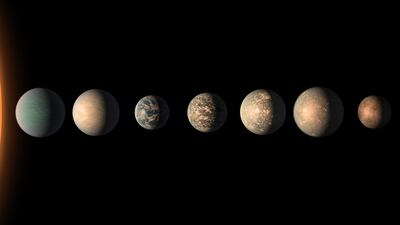
The landmark discovery of Trappist-1 set off a wave of excitement across the space community. It was the first time multiple Earth-sized planets were found in a habitable zone and were orbiting the same star – Trappist-1. Courtesy: Nasa -
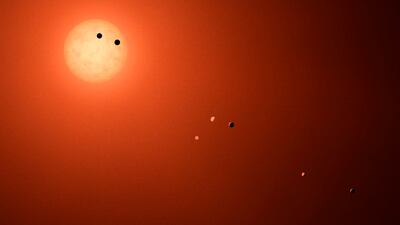
All seven planets orbiting Trappist-1 are believed to be rocky and have potential for water on the surface. Courtesy: Nasa -
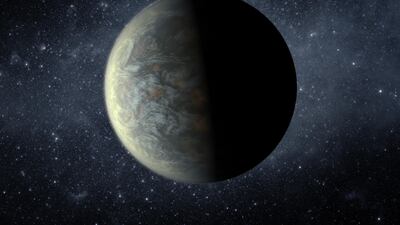
Located in a habitable zone, Kepler-22b was labelled by Nasa as ‘super Earth’. Researchers believe the planet, which is larger than Earth, could be another ocean world. However, because of the planet’s extreme tilt, the north and south poles would experience sunlight and darkness for half a year each. Courtesy: Nasa -
Discovered in 2020, Toi 700 d is only 20 per cent larger than Earth and orbits an M Dwarf star – a cool and stable type of star that do not release killer stellar flares, or radiation. Located 100 million light years away from Earth, one year on the planet is 37.4 days. Courtesy: Nasa -
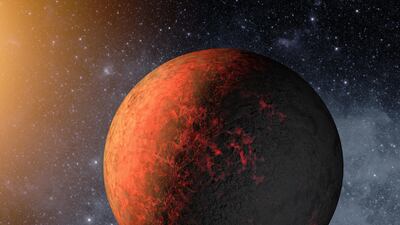
Discovered in 2011, KEPLER-20e is an Earth-size planet that orbits a sun-like star outside of the solar system. It is too close to its star to be in the habitable zone, so it cannot hold liquid water. However, the discovery was still groundbreaking because it was the first time small exoplanets were found to be orbiting around a star that was similar to the Sun. Courtesy: Nasa -

Kepler-20f was discovered along with Kepler-20e. A year on the planet is19.6 days. Courtesy: Nasa



