


Live updates: follow the latest news on Russia-Ukraine
Russia is losing scores of tanks with Ukraine's military developing a range of new tactics that include grenade-dropping drones, military analysts told The National.
An estimated 64 main battle tanks and 37 armoured fighting vehicles have been destroyed by a range of weapons, but in particular British-supplied modern anti-tank weapons.
Military experts are also baffled by the “brazen” Russian tactics in which tank commanders advance without infantry or artillery support, making them highly vulnerable to ambushes.
“The Russians have lost every single type of tank so far bar the T-90M, which is the most modern tank in service,” said Sam Cranny-Evans of Rusi, a defence and security think tank. “From the Russian perspective, that means some of their most capable and elite formations have been caught up in the fighting and suffered losses.”
The huge 64-kilometre armoured column, stalled for over a week outside Kyiv amid food and fuel shortages and attacks by Ukrainian troops, has been seen on the move again. New satellite photos appeared to show the massive Russian convoy outside the Ukrainian capital had fanned out. The purpose of the latest move was unclear, though Russia is widely expected eventually to try to encircle the capital.
Britain’s Ministry of Defense said that after making “limited progress,” Russian forces were trying to “re-set and re-posture” their troops, gearing up for operations against Kyiv.
Ukraine ambush
The Ukrainian army has rapidly evolved its tactics to take out tanks driving along motorways or into towns or villages.
Tank commanders with their hatches battened down have limited visibility, although they do have excellent optical devices supplied by the French. To draw their attention, Ukraine infantry open up with their assault rifles from one side of road. As the tanks swivel towards them, infantry equipped with anti-tank weapons open fire from the other side, usually directly into the vulnerable rear.
It has also been reported – without verification – that the Ukrainians have equipped small drones with hand grenades that they then drop into open turrets, killing tank commanders. This would in part explain why small cages have been built over some hatches to deflect the grenade.
Modern anti-tank weaponry
The British New Light Anti-Tank Weapon (NLAW) is proving critical in the fight against Russian armour and has been described by experts as “revolutionary” in tracking moving vehicles. At least 2,000 have been sent to Ukraine.
It is the only anti-tank missile in the world that has an inbuilt fire-control computer that can track a moving vehicle and remain locked on to it, making a hit highly likely.

The NLAW, like the Javelin missiles, has a top-down attack whereby the missile first flies up then directly down on to a vehicle's thinner upper armour.
Tanks with the tops blown off are usually victims of this attack because the ammunition is stored in the turret area and will “cook off”.
Russian defences
Every Russian tank is festooned with small, box-like explosive reactive armour (ERA), which detonates when struck by a missile, preventing penetration.
But the NLAW and Javelin missiles and, it is understood, the Ukraine-made Skif and Stugna-P anti-tank missiles, have tandem warheads, where the first explosion takes out the ERA and the second penetrates the armour.
To protect the vulnerable turret armour, soldiers have devised a pergola structure in the hope that it will detonate or deflect incoming missiles.
“They have basically mounted what looks like a metal garden pergola designed to reduce the effectiveness of a top-attack weapon,” said retired Brigadier Ben Barry, a former tank commander.

There are also suggestions that the older Russian vehicles, such as the T-64s and T-80s, might have ERA that is out of date, either not being replaced or through corruption.
“When the Ukrainians were losing tanks they found that the ERA was out of shelf life, it was just too old,” said Christopher Foss, an armoured expert formerly at Janes Defence Weekly. “It could be that on some Russian tanks it is simply out of date.”
Worse, none of the Russian armoured personnel carriers – the BDRM or BMP models – are equipped with extra armour for increased protection. This means that they are vulnerable to even heavy 12.7mm machine-gun fire.
Russian tactics
Artillery, in the view of Russian commanders, is the God of War. Their army has huge numbers of tracked and towed guns that, in combined arms warfare, are supposed to support infantry and armour.
But it appears that the strategy now is to surround the major Ukraine cities and use the artillery to bombard them into submission.
This has led to Russian armoured columns driving straight into towns without the proper support.

“The first thing a well-trained British or US battle group would almost certainly not do is brazenly drive through towns, but would put out the infantry to chase away any Ukrainian infantry,” said Brig Barry, of the IISS think tank. “Secondly, when the ambush strikes, what you don't seem to see is the infantry getting out of their armoured vehicles to chase off the Ukrainian infantry. You also don’t see them bringing down mortar artillery fire for support.”
Urban armour
The 60km long armoured column that has been stationary outside Kyiv for more than a week now appears to be finally on the move. It is likely to form the main force used to encircle the capital before an artillery bombardment commences.
But it will certainly be ambushed in the woods, villages and roads as it tries to move into place. If it attempts to move into the urban outskirts of Kyiv it will face difficulties.
While the traditional RPG weapon gives a severe back-blast, rendering it unusable for ambushes from enclosed spaces, such as an apartment, the NLAW does not, making it ideal to shoot straight down on to Russian armour.
It has also been reported that the well-regarded 1st Tank Army were expected to attack Kyiv but have been instead committed around Sumy and Kharkiv in the east. The unit is seen as having the most combat experience and the best equipped.
Fuel
There could well be issues soon over fuel supplies for tanks. Footage seen by The National showed a convoy of fuel tankers in eastern Ukraine with eight vehicles burnt out.
The Russian T-80 tanks run on a form of jet fuel while the T-90s and T-72s need diesel, although the latter possibly have multi-fuel tanks.
-
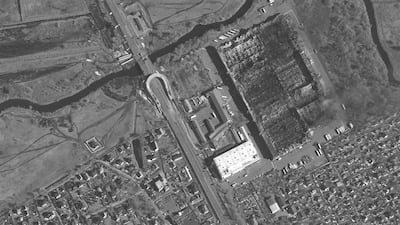
This satellite image provided by Maxar Technologies shows destroyed and burning warehouse buildings in Stoyanka, Ukraine, in the western Kyiv region, during the Russian invasion. AP -
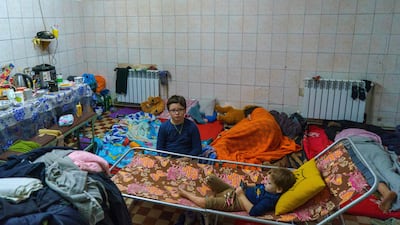
Children shelter in a metro station in Kharkiv. Moscow said on March 10, 2022, that it will open daily humanitarian corridors to allow civilians fleeing fighting in Ukraine to reach Russian territory, despite Kyiv insisting that no evacuation routes should lead to Russia. AFP -
Russian President Vladimir Putin during a videoconference meeting with government members at the Kremlin in Moscow. The meeting focuses on minimising the effects of sanctions on the Russian economy. Russian troops entered Ukraine on February 24, prompting the country's president to declare martial law and triggering a series of severe economic sanctions imposed by western countries. EPA -
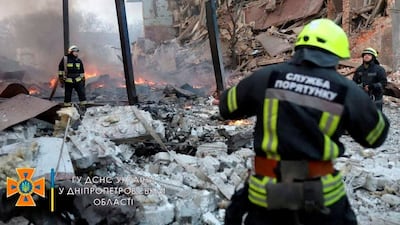
Rescuers work among remains of buildings damaged by an air strike in Dnipro, Ukraine, as Russia's attack on the country continues. Reuters -

Members of the National Guard of Ukraine, Oleksandr and Olena, listen to a priest at their wedding in Ukraine. Reuters -

People fleeing Russia's invasion of Ukraine warm up by a fire near the train station in Lviv, Ukraine. Reuters -
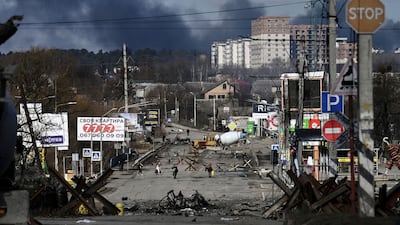
Russian forces rolled their armoured vehicles up to the northeastern edge of Kyiv, edging closer in their attempts to encircle the Ukrainian capital. AFP -
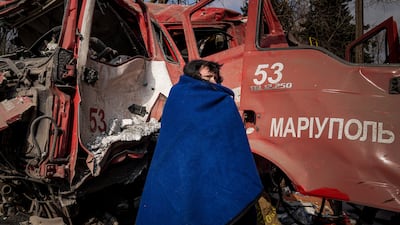
A woman covers herself with a blanket near a damaged fire truck after shelling in Mariupol, Ukraine. AP Photo -

A Ukrainian soldier hides from a helicopter air strike near Demydiv, Ukraine. Reuters -
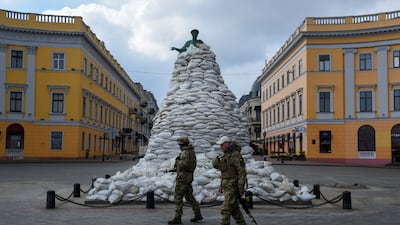
Ukrainian soldiers walk past a monument of the city founder Duke de Richelieu, covered with sand bags for protection, in Odessa, Ukraine. Reuters -
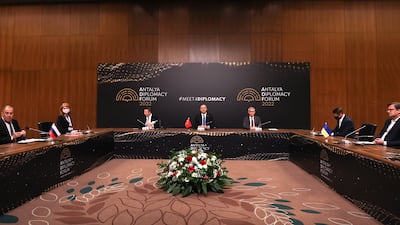
Russian Foreign Minister Sergey Lavrov, left, Turkish Foreign Minister Mevlut Cavusoglu, centre, and Ukranian Foreign Minister Dmytro Kuleba. EPA -
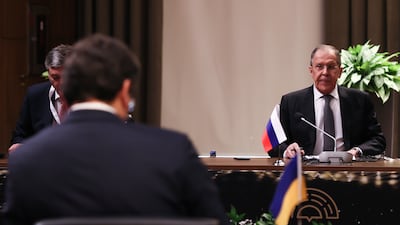
Russian Foreign Minister Sergey Lavrov in talks with Ukrainian counterpart Dmytro Kuleba during a tripartite meeting chaired by Turkish Foreign Minister Mevlut Cavusoglu, in Antalya, Turkey. AP -
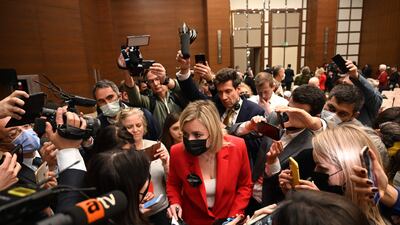
Russian Foreign Ministry spokeswoman Maria Zakharova speaks to the media as the foreign ministers of Ukraine, Russia and Turkey hold talks in Antalya, 15 days after Russia launched a military invasion on Ukraine. AFP -
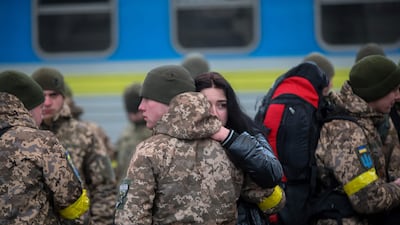
A Ukrainian serviceman says goodbye to his girlfriend before departing in the direction of Kyiv at the central train station in the western Ukrainian city of Lviv. AFP -
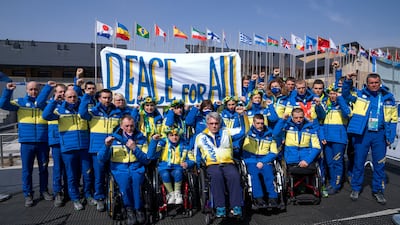
Valerii Sushkevych, president of the Ukraine National Paralympic Committee, and the Ukraine delegation raise their fists and pose with a banner at the Beijing 2022 Winter Paralympic Games. Reuters -

A member of the Ukrainian team cries during a moment of silence at the Zhangjiakou athletes village during the Beijing 2022 Winter Paralympic Games. AFP -
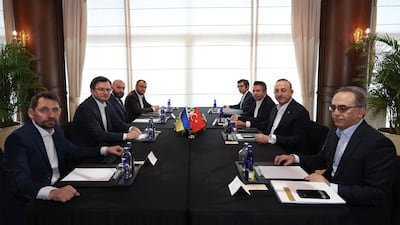
Turkish Foreign Minister Mevlut Cavusoglu, right, and Ukraine Foreign Minister Dmytro Kubela, second left, in Antalya, Turkey. AFP -
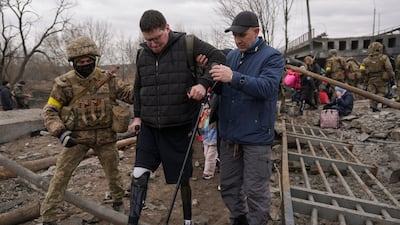
A man is supported after crossing the Irpin river while fleeing the town of Irpin, Ukraine. AP -
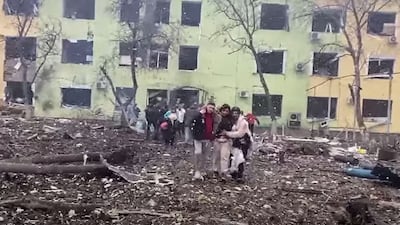
People are helped out of a damaged children's hospital following a Russian air strike in the southeastern city of Mariupol, Ukraine. AFP -

A man rides a bicycle in front of an apartment building that was damaged by shelling in Mariupol. AP -
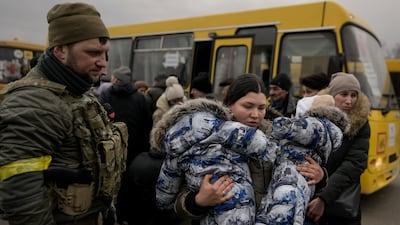
A woman carries two babies after arriving at a triage point in Kyiv, Ukraine. AP -
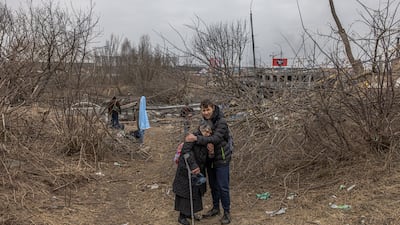
A man hugs an elderly woman after crossing a damaged bridge as they flee from the frontline town of Irpin, near the Ukrainian capital of Kyiv. EPA -
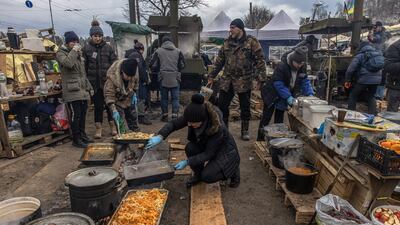
Local residents cook at a makeshift camp next to a checkpoint in Kyiv. EPA -
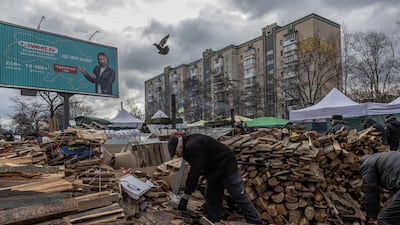
Ukrainian men chop wood at a makeshift camp next to a checkpoint in Kyiv. EPA -

A member of the Territorial Defence Forces learns how to use a Javelin missile during a training session in Kyiv. EPA -
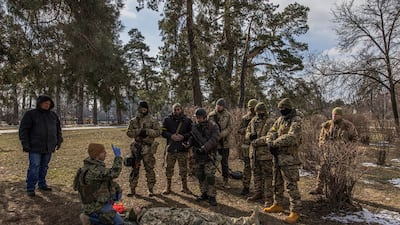
Members of the Territorial Defence Forces learn how to give first aid during the training session. EPA -
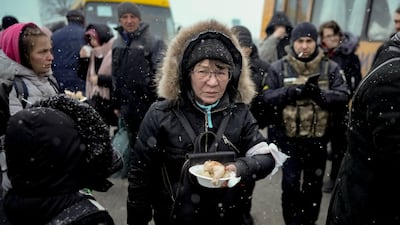
A woman rescued from the outskirts of Kyiv holds a plate of food after arriving at a triage point in the Ukrainian capital. AP -
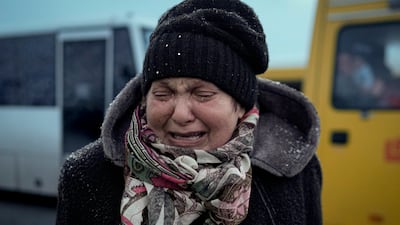
A woman cries after arriving at the triage point in Kyiv. AP -
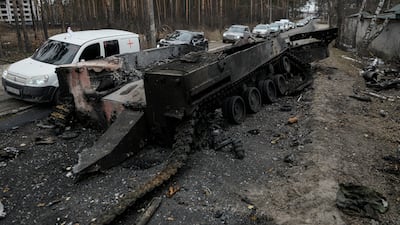
Civilian vehicles drive past a destroyed Russian tank as they leave Irpin. AP -
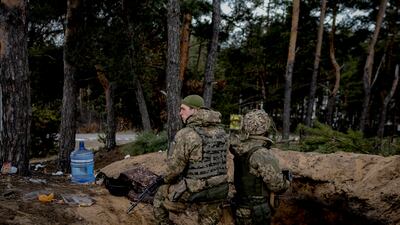
Ukrainian servicemen stand in a foxhole in Irpin. AP -
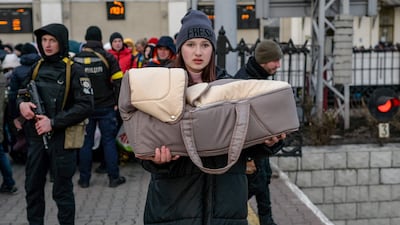
People gather on a platform to board a train leaving Odesa after the US said Russian troops are making preparations to attack the city. AFP -
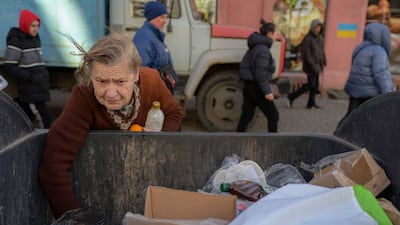
A Ukrainian woman looks for food in a bin in Odesa's city centre. AFP -
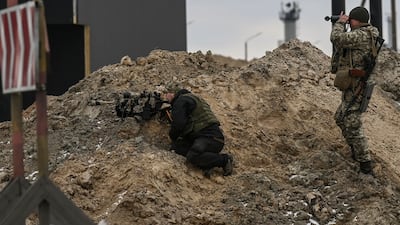
Ukrainian servicemen look towards Russian positions outside the city of Brovary, east of Kyiv. AFP -
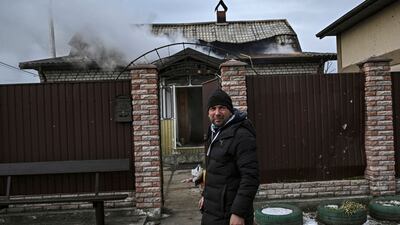
A man walks past a shelled house at the village of Velyka Dymerka, east of Kyiv. AFP -
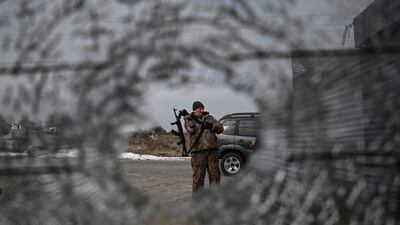
A Ukrainian serviceman stands at a check point in the vilage of Velyka Dymerka east of Kyiv. AFP -
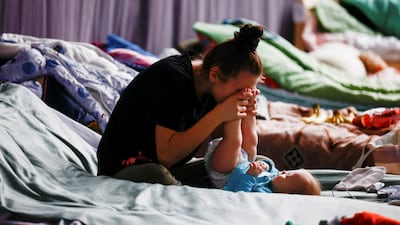
A Ukrainian woman plays with her child in a temporary refugee shelter in Przemysl, Poland. Reuters -

A woman waits outside a maternity and children's hospital damaged by shelling in Mariupol, Ukraine. AP -
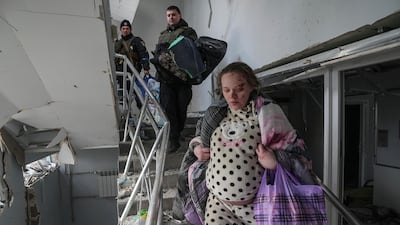
A pregnant woman leaves the hospital after she was wounded when it was bombed. AP -
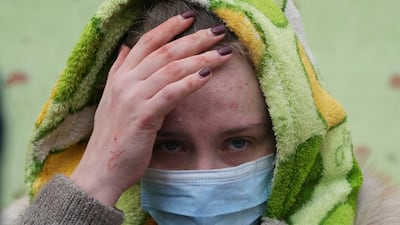
A woman waits outside the damaged hospital in Mariupol. AP -

A man wounded by shelling in Mariupol. AP -
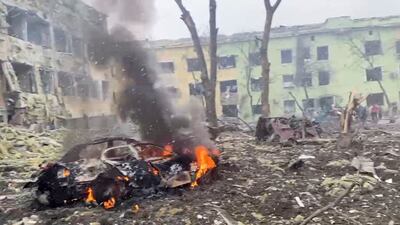
A car burns after the destruction of the children's hospital in Mariupol. Reuters -
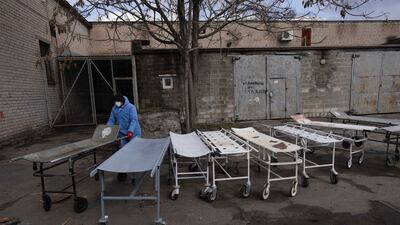
A mortuary worker wheels a stretcher used to move dead bodies before they are buried on the outskirts of Mariupol. AP


But the cold weather also poses a problem, with the Russians running their tanks for warmth and to charge batteries using up fuel as, unlike British or American vehicles, they do not have auxiliary power units.
However, the Russians are likely to forage from Ukraine’s fuel stations or dumps.
Losses
The Russians have lost a significant number of supply vehicles, including dozens of the precious fuel tankers and their crews, who do not have the armoured cab protection that most Nato trucks have.
The Oryx military website puts total Russian vehicle losses at 1,034, with 424 destroyed, 13 damaged, 159 abandoned and 43 captured.
Russia has lost an estimated 173 main battle tanks and 106 armoured fighting vehicles – with some abandoned or captured – but the military has an estimated total of more than 6,000, with many in warehouses across Russia. But there is also the problem of finding experienced tank crews to replace those soldiers killed.

