

Live updates: follow the latest news on Russia-Ukraine
International leaders have resumed efforts to find a way to end the military confrontation between Russia and Ukraine, more than 10 days after Russian President Vladimir Putin decided to invade the former Soviet republic of 43 million people.
Ukraine was gripped by one of the worst humanitarian crises in Europe since the 1990s civil war in the former Yugoslavia, with the largest exodus of people fleeing conflict since WW2, according to UN High Commissioner for Refugees Filippo Grandi.
"More than 1.5 million refugees from Ukraine have crossed into neighbouring countries in 10 days — the fastest growing refugee crisis in Europe since World War II," he tweeted.
On Sunday, Pope Francis joined leaders calling for an immediate end to the violence, saying "negotiation and common sense must prevail. And that international law be respected once again."
On Sunday, ceasefires to allow for the evacuation of at least 200,000 civilians in Mariupol and Volnovakha collapsed amid incessant artillery and rocket attacks, as the International Committee of the Red Cross called for both sides to return to negotiations.
On Saturday, British Prime Minister Boris Johnson said he would seek to rally the international community to make a “renewed and concerted effort” to end the war and pursue diplomatic paths to de-escalation.
Mr Johnson will host Canadian and Dutch leaders Justin Trudeau and Mark Rutte at Downing Street on Monday “for discussions on how to turn these commitments into a concerted campaign of solidarity with Ukraine".
On Tuesday, Mr Johnson will speak with the leaders of the so-called Visegrad (V4) group of Hungary, Poland, the Czech Republic and Slovakia.
Writing in The New York Times, Mr Johnson said diplomatic efforts in the lead-up to Russia’s invasion of Ukraine were doomed to fail and it was now “sinking further into a sordid campaign of war crimes and unthinkable violence against civilians”.
Other world leaders sought to mediate between both sides. Israel’s Prime Minister Naftali Bennett said on Sunday his country would continue to assist in finding a diplomatic solution to the crisis, even if the chances of success were small.
Mr Bennett spoke to his Cabinet hours after he returned from a surprise meeting with Mr Putin in Moscow.
He then travelled to Germany for talks with Chancellor Olaf Scholz.
Mr Bennett revealed no details from his talks with the Russian leader, but called the country’s mediation efforts “our moral duty”.
Earlier, his office said he and Ukrainian President Volodymyr Zelenskyy spoke by phone on Sunday morning, the third such call between the two leaders over the past day.
Israel has good relations with both Russia and Ukraine.
On Sunday, Turkish President Recep Tayyip Erdogan urged Mr Putin to declare a ceasefire, open humanitarian corridors and sign a peace agreement, his office said.
In a statement after a one-hour phone call, the Turkish presidency said Mr Erdogan told Mr Putin that Turkey was ready to contribute to a peaceful resolution of the conflict and that a ceasefire would ease concerns over the humanitarian situation.
-
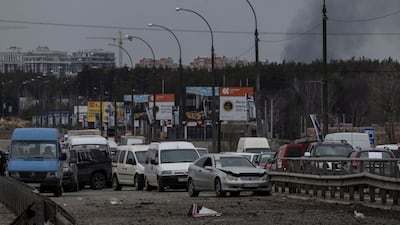
Cars are left abandoned on a road as residents flee the town of Irpin, Ukraine after days of heavy shelling. Reuters -
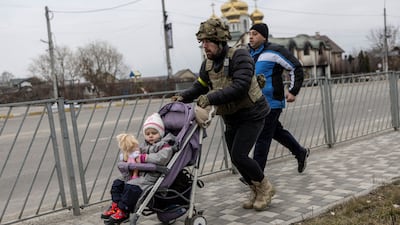
A Ukrainian soldier helps a family fleeing from Irpin. Reuters -

A bus passes the Duke of Wellington statue, which has a traffic cone in the colours of the flag of Ukraine placed on top of it, in Glasgow, Scotland. AP -
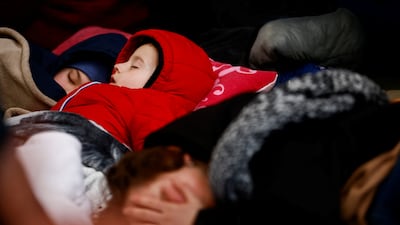
Ukrainian children sleep at the reception point at the train station in Przemysl, Poland. Reuters -
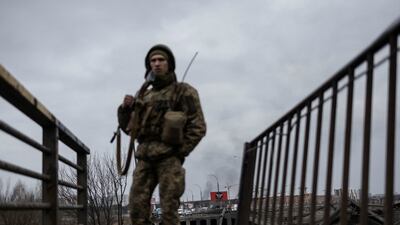
Smoke rises as a Ukrainian soldier stands by the only escape route used by locals to flee from the town of Irpin. Reuters -
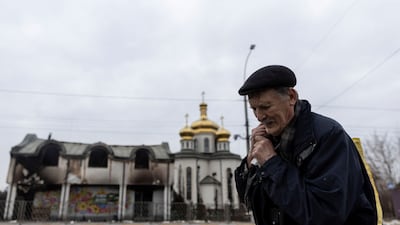
A man flees from Irpin. Reuters -
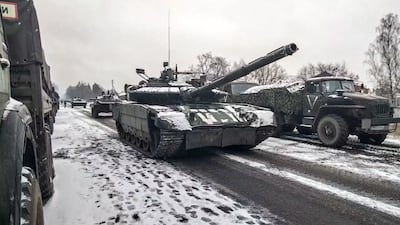
A screengrab from footage released by the Russian Defence Ministry shows a purported Russian tank unit advancement in the Kyiv region. AFP -
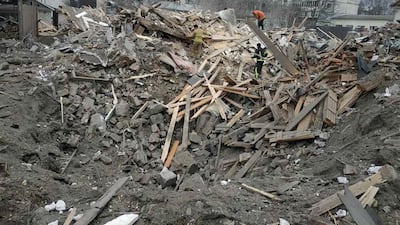
People walk on debris of residential buildings damaged by shelling in the Zhytomyr region. Reuters -

A damaged residential building after Russian multiple rocket launchers shelled the area in the southern city of Mykolaiv. AFP -
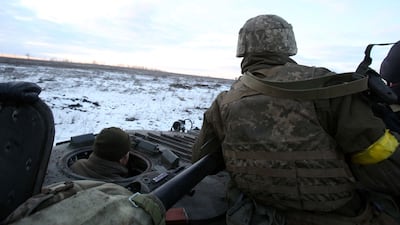
Ukrainian soldiers sit in their armoured vehicle after fighting against Russian troops and Russia-backed separatists near Zolote village, Luhansk region. AFP -
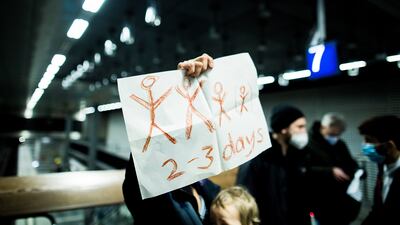
A woman offers accommodation for people fleeing Ukraine at the main railway station in Berlin, Germany. Getty Images -
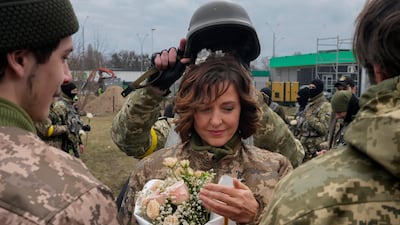
A soldier holds a helmet as a wedding crown during the ceremony for members of the Ukrainian Territorial Defence Forces Lesia Ivashchenko and Valerii Fylymonov, at a checkpoint in Kyiv. AP -
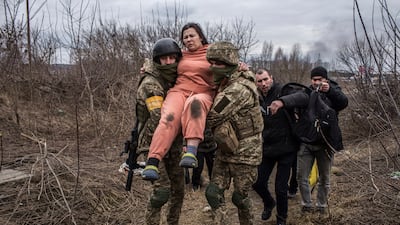
Ukrainian soldiers carry a woman fleeing the town of Irpin. AP -
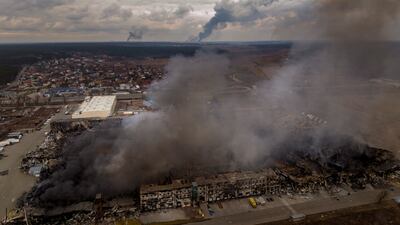
A factory and warehouse burn after being bombarded in Irpin. AP -
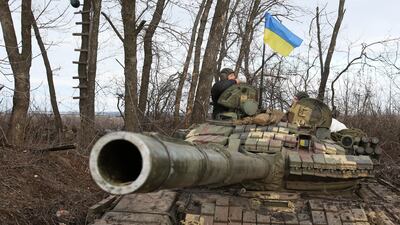
Ukrainian soldiers near Zolote. AFP -
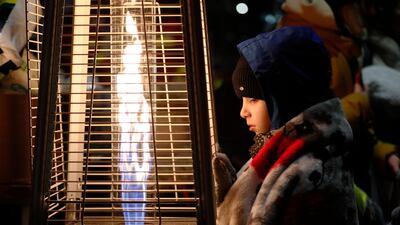
A Ukrainian refugee boy, wearing a blanket on his shoulders, warms his hands with a gas heater shortly after crossing the Siret border into northern Romania. EPA -

People demonstrate against the Russian military operation in Ukraine in Buenos Aires, Argentina. EPA -
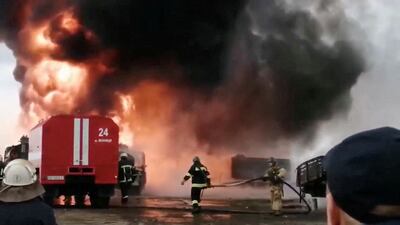
First responders work at the scene after a missile hit a building at Havryshivka Vinnytsia International Airport in Vinnytsia, Ukraine. Reuters -
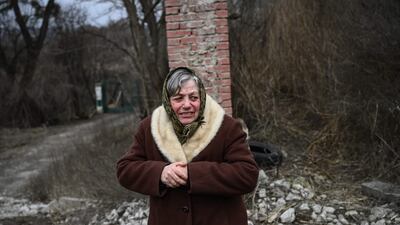
A woman at a checkpoint on the road to Kyiv after her evacuation from a nearby town. AFP -
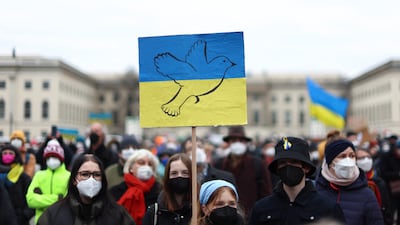
A placard in the Ukrainian colours is held up at an anti-war demonstration the Bebelplatz square in Berlin, Germany. Reuters -
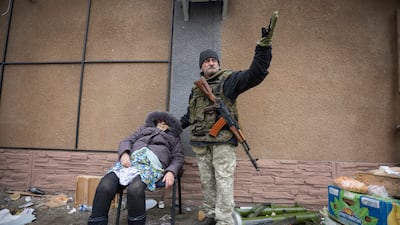
A Ukrainian serviceman helps an elderly woman in Irpin, 20 kilometres north-west of the capital Kyiv. AP Photo -
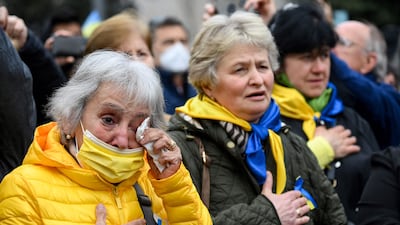
Protesters cry during a demonstration in support of Ukraine at the Plaza Catalunya square in Barcelona. AFP -
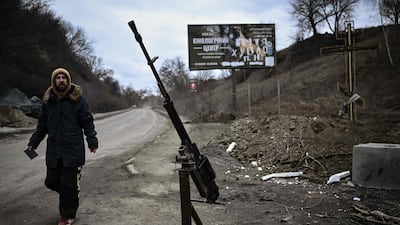
A man walks past a machine gun at a checkpoint next to the last bridge on the road that connects the town of Stoyanka to the outskirts of Ukraine's capital Kyiv. AFP -
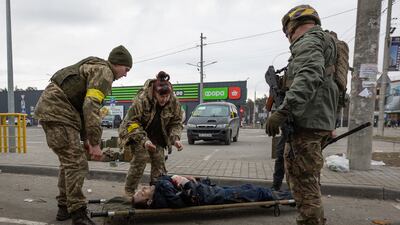
Ukrainian servicemen put a wounded man on a stretcher in Irpin. AP Photo -

People board a train to return to Ukraine after getting supplies in Zahony, Hungary. AP Photo -
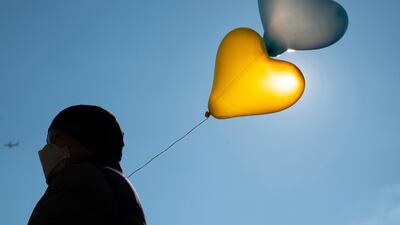
Balloons in the colors of Ukraine during a demonstration against the Russian attack on Ukraine, in Mainz, Germany. AP -
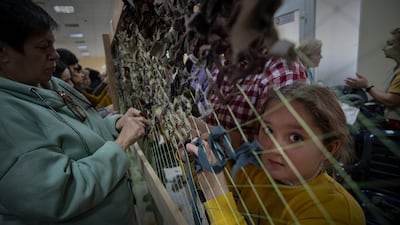
A Ukrainian girl helps to weave a camouflage net for the Ukrainian army, in Odesa. EPA -
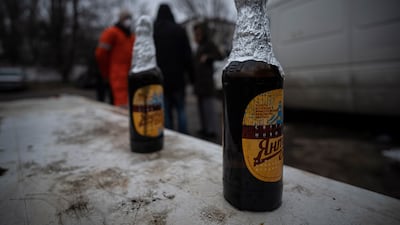
Molotov cocktails prepared by a group of volunteers in Odesa. Hundreds are made every day. EPA -

Ukrainian servicemen assist people fleeing the town of Irpin after crossing the Irpin River on an improvised path under a bridge that was destroyed by a Russian air strike. AP Photo -
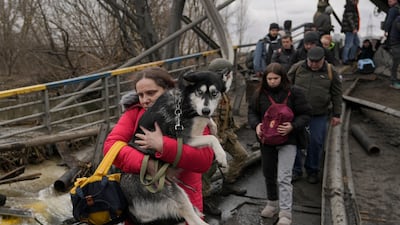
A woman holds a dog while crossing the Irpin River on an improvised path under a bridge that was destroyed by a Russian airstrike, while assisting people fleeing the town of Irpin, Ukraine. AP Photo -
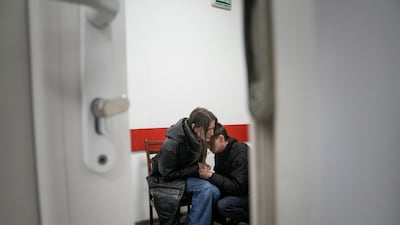
Marina Yatsko and her boyfriend Fedor comfort each other at a hospital in Mariupol after her 18-month-old son Kirill was killed by shelling. AP Photo -
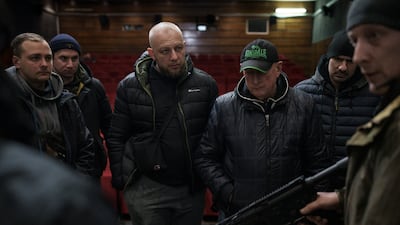
Ukrainian civilians receive weapons training in a cinema in Lviv, western Ukraine. AP Photo -
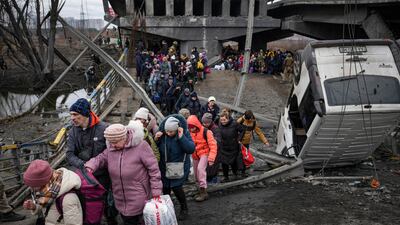
Residents flee the town of Irpin, near Kyiv, Ukraine. AP Photo -
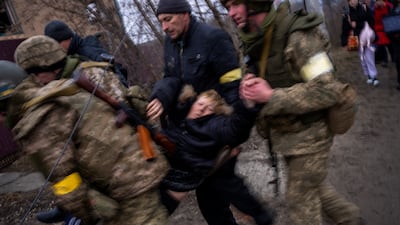
Ukrainian soldiers carry a sick woman as civilians flee Irpin, on the outskirts of Kyiv, after Russian attacks. AP Photo -

Captured Russian soldiers at a press conference in the Interfax news agency in Kyiv, Ukraine. AP Photo -
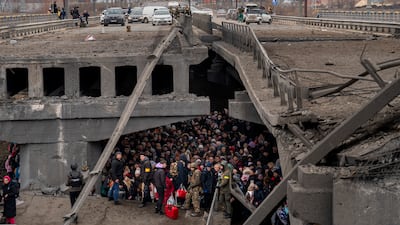
Ukrainians beneath a destroyed bridge in Irpin. AP Photo -

A woman fleeing Ukraine on a bus near the border crossing in Korczowa, Poland. AP Photo -
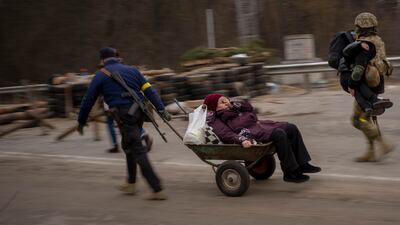
A Ukrainian soldier and a militia man help a fleeing family on the outskirts of Kyiv, Ukraine, on March 5, 2022. AP Photo -
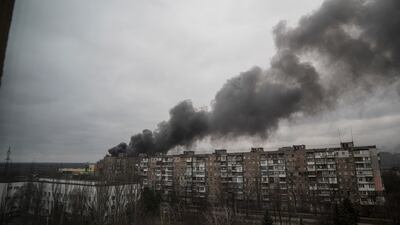
Smoke rises after shelling by Russian forces in Mariupol. AP Photo -
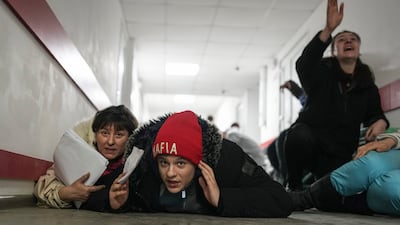
People at a hospital during shelling by Russian forces in Mariupol. AP Photo -
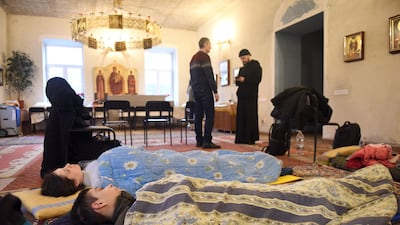
Displaced Ukrainians at the Resurrection New Athos Monastery in the western Ukrainian city of Lviv. AFP


Third round of talks
Ukrainian negotiators said a third round of talks with Russia on a ceasefire would go ahead on Monday, although Moscow was less definitive.
In a televised address on Saturday night, Mr Zelenskyy called on people in areas occupied by Russian troops to fight.
“We must go outside and drive this evil out of our cities,” he said, vowing to rebuild his nation.
Mr Putin repeated that he wanted a neutral Ukraine that had been “demilitarised” and “denazified,” and likened Western sanctions “to a declaration of war”.
Also on Saturday, Mr Zelenskyy held talks with US President Joe Biden, as Washington said it was in talks with Poland to supply fighter jets to Ukraine's air force.
The Biden’s “administration is surging security, humanitarian, and economic assistance to Ukraine and is working closely with Congress to secure additional funding”, he told Mr Zelenskyy, the White House said.
Russia warned the EU and Nato to stop the “pumping of state-of-the-art weapons systems” into Kyiv, foreign ministry spokeswoman Maria Zakharova said, according to RIA.

