



Ukraine’s President Volodymyr Zelenskyy arrived in Britain on Wednesday where he received a hero's welcome from politicians in Westminster.
The rare foreign visit is his first appearance on British soil since the outbreak of war in February last year.
Mr Zelenskyy, 45, developed a strong rapport with former prime minister Boris Johnson after Russia's invasion, and has previously expressed gratitude for Britain's extensive military and economic support.
While he has welcomed numerous foreign leaders to Kyiv — including US President Joe Biden and EU chief Ursula von der Leyen — Mr Zelenskyy's trips abroad are far less common, owing to the difficult situation on Ukraine's front line.
An enthusiastic communicator, Mr Zelenskyy has been an ever-present figure during the conflict, delivering a nightly address to his citizens and making regular appeals to international audiences via video link.
He has previously addressed the UN Security Council and Davos, as well as events such as the Grammys and the Golden Globes in an attempt to drum up broad global support.
Who is Volodymyr Zelenskyy?
Mr Zelenskyy was born to Jewish parents in 1978 in the predominantly Russian-speaking industrial city of Kryvyi Rih in central Ukraine, which was then part of the Soviet Union.
A grandson of a soldier who fought the Nazis as part of the Red Army, Mr Zelenskyy studied economics and law at Kryvyi Rih National University.
He became an actor and comedian at the age of 17, starring in various films. His political satire singled him out in 2015 to play the lead in Servant of the People, which centred on a fictional character who won the presidency in Ukraine and launched sweeping reforms to save it from a corrupt political class.
With no previous political experience, Mr Zelenskyy was elected for real on April 21, 2019. He beat the incumbent, Petro Poroshenko, with nearly 73 per cent of the vote.
He campaigned on an anti-corruption ticket and promised negotiations with Russia to find a solution to the turmoil in the Donbas region of eastern Ukraine, which has been run by Moscow-backed separatists since 2014.
His critics describe Mr Zelenskyy as a puppet of Ukrainian business mogul Ihor Kolomoyskyy, the former billionaire governor of the key industrial region of Dnipropetrovsk.
In the lead-up to the Russian invasion, Mr Zelenskyy was critical of Mr Biden’s open and detailed warnings about Vladimir Putin’s intentions, saying they were premature and could cause panic.
During the continuing crisis, he became a social media star, with millions of followers on Instagram. Many of his admirers have shared photos from his past life as an actor as well as others with his wife and parents.
Washington and its allies were often subjected to criticism for not doing more to protect Ukraine, including defending it militarily or accelerating its application to join Nato.
Mr Zelenskyy and his wife, Olena, an architect, have a daughter, 17, and son, nine. It is thought they remained in Ukraine when Russia invaded in February 2022 and did not join the exodus of mainly women and children seeking safety abroad.
Ukrainian President Volodymyr Zelenskyy through the years - in pictures
-
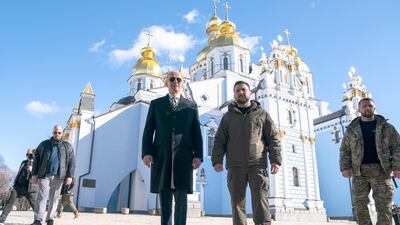
Volodymyr Zelenskyy with US President Joe Biden at St Michael's Golden-Domed Cathedral in Kyiv during Mr Biden's surprise visit, on February 20. AP -
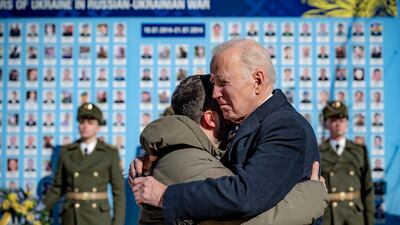
The two presidents embrace each other at a wreath-laying ceremony at the Wall of Remembrance of the Fallen for Ukraine, in Kyiv. EPA -

President of the European Council Charles Michel, European Commission President Ursula von der Leyen and Mr Zelenskyy at a EU summit in Brussels in February 2023. AFP -
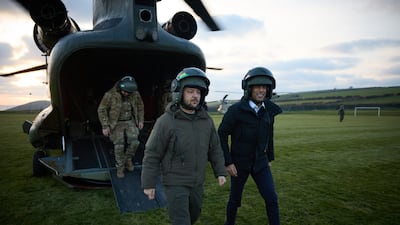
British Prime Minister Rishi Sunak and Mr Zelenskyy arriving to visit Ukrainian troops being trained in southern England in February 2023. PA -
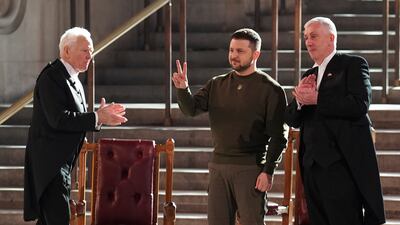
Mr Zelenskyy is applauded after his address to parliamentarians at Westminster Hall, London, in February 2023. AP -

Ukraine's President receives a warm welcome at No 10 Downing Street. Photo: Simon Walker / No 10 Downing Street -
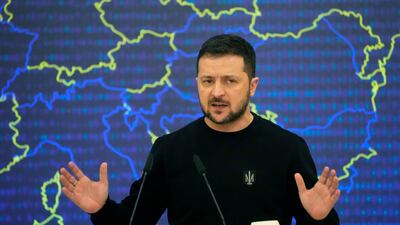
Mr Zelenskyy addresses a media conference after the EU-Ukraine summit in Kyiv in February 2023. AP -
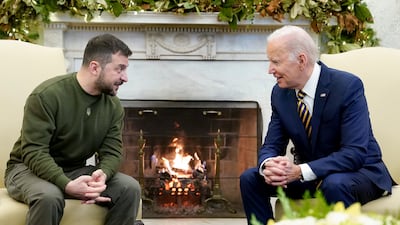
Joe Biden speaks to Mr Zelenskyy in the Oval Office of the White House, Washington DC, in December 2022. AP -

Rishi Sunak and Mr Zelenskyy meet in Kyiv in November 2022. Getty Images -
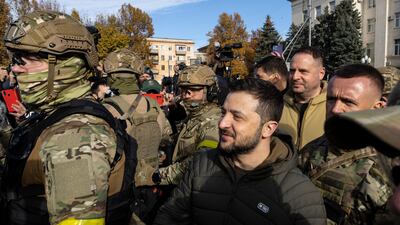
Mr Zelenskyy makes a surprise visit to Kherson, Ukraine, in November 2022. Getty Images -
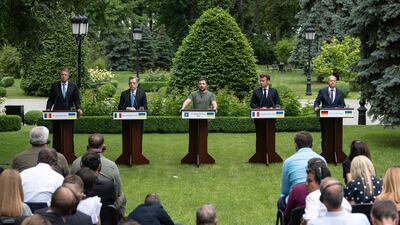
Romanian President Klaus Iohannis, Italian Prime Minister Mario Draghi, Mr Zelenskyy, France President Emmanuel Macron and German Chancellor Olaf Scholz hold a press conference in Kyiv in June 2022. Getty Images -
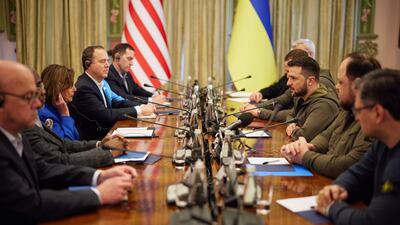
Mr Zelenskyy meets US Speaker Nancy Pelosi during a visit by a US congressional delegation in April 2022 in Kyiv. Getty Images -
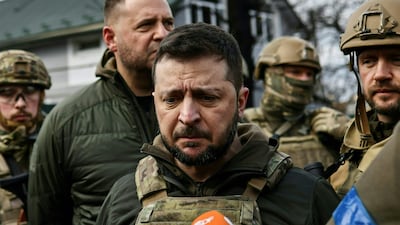
Mr Zelenskyy speaks to the press in the town of Bucha, north-west of Kyiv, in April 2022, where he said the Russian leadership was responsible for killing civilians. AFP -

Mr Zelenskyy receives a standing ovation before he addresses the German Bundestag, in Berlin, via live video link from Kyiv in March 2022. Getty Images -
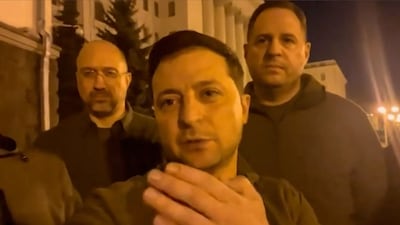
A still from a video posted on the Facebook account of Mr Zelenskyy in February 2022 shows him speaking to camera in Kyiv after Russia's invasion. He said 'we are all here'. AFP -
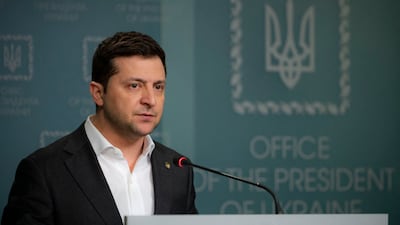
Mr Zelenskyy holds a briefing at the Office of the Head of State in Kyiv in February 2022, after Russian President Vladimir Putin launched a full-scale invasion of Ukraine. AFP -
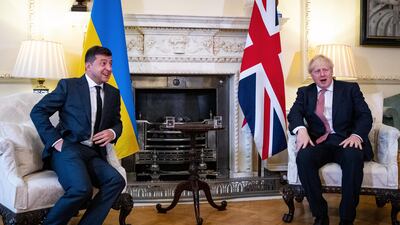
British prime minister at the time, Boris Johnson, meets Mr Zelenskyy in No 10 Downing Street, London, in October 2020. Getty Images -
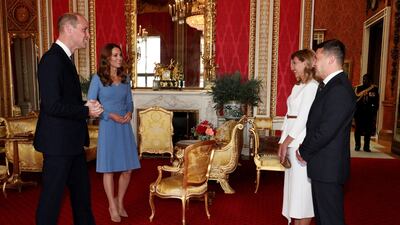
Prince William and his wife Catherine meet Mr Zelenskyy and his wife Olena at Buckingham Palace in October 2020. Getty Images -
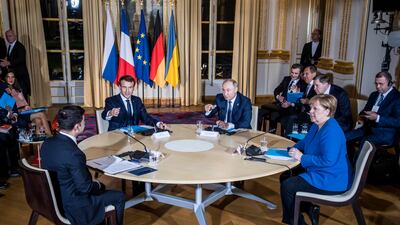
Mr Zelenskyy, Mr Macron, Mr Putin and then-German chancellor Angela Merkel attend a summit on Ukraine at Elysee Palace in Paris in December 2019. Getty Images -
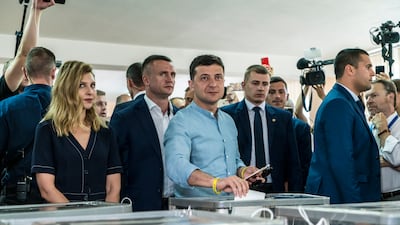
Mr Zelenskyy casts his ballot in parliamentary elections in July 2019 in Kyiv. Getty Images -

Mr Zelenskyy, as Ukrainian president-elect, walks into the parliament to be sworn in, in May 2019. Getty Images -
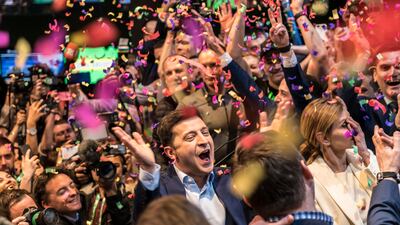
Mr Zelenskyy celebrates his victory in Ukraine's presidential election in April 2019 in Kyiv. Getty Images -
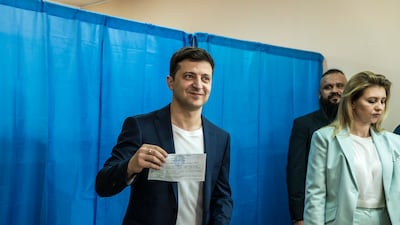
Mr Zelenskyy, as Ukrainian presidential candidate, and his wife Olena cast their ballots in April 2019 in Kyiv. Getty Images -
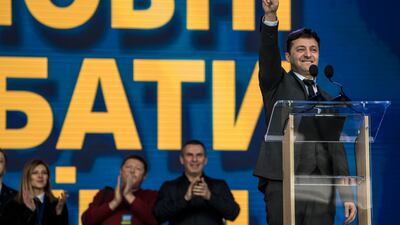
Mr Zelenskyy takes centre stage before a debate with then-president Petro Poroshenko at the Olympiskiy Stadium in April 2019 in Kyiv. Getty Images -
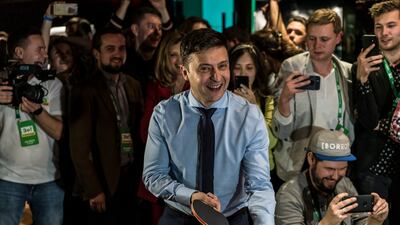
Playing table tennis with a journalist at his election night gathering in March 2019 in Kyiv. Getty Images -
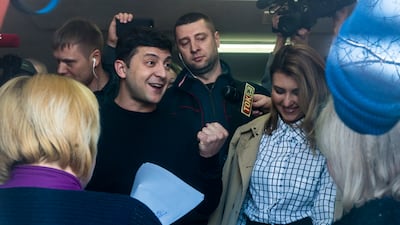
Mr Zelenskyy holds his ballot at a polling station before voting in Ukraine's presidential election in March 2019 in Kyiv. Getty Images -

Mr Zelenskyy backstage during the filming of his comedy show Liga Smeha (League of Laughter) in March 2019 in Kyiv. Getty Images



