


Since September 21, a Twitter account claiming to belong to the new Taliban-appointed chancellor of Kabul University has posted a series of missives appearing to confirm many fears about what Afghanistan's education system under the Taliban will look like.
“Folks! I give you my word as the chancellor of Kabul University, as long as a real Islamic environment is not provided for all, women will not be allowed to come to universities or work,” stated said one recent tweet, apparently written by the new chancellor, Mohammad Ashraf Ghairat.
A number of international media outlets soon ran the story and singled out Mr Ghairat for his hard-line views.
But this week, the Twitter account under Mr Ghairat’s name posted a new tweet in which the author admitted it was fake and had been set up by a student frustrated with the suspension of classes and the appointment of Mr Ghairat after the Taliban sacked his predecessor, Osman Babury, on September 20.
Mr Ghairat has a journalism degree but was previously unknown in Afghan academia and has no pedagogical qualifications.
The admission has been shared widely on social media by students amused by what they regard as a joke on the Taliban and by Taliban sympathisers amused at the hoodwinking of the international media.
The student, a 20-year-old law undergraduate identified by the pseudonym Mahmoud, told The National he set up the account to highlight the undoing of Afghan education.
“What is going on in Afghanistan right now is the real joke,” Mahmoud said in a phone call from Kabul. “It’s ridiculous. All of our leaders left the country and we are the ones left facing the Taliban.
-
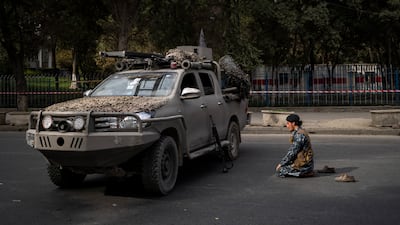
A Taliban fighter prays next to a demonstration organised by the Afghan Society of Muslim Youth, demanding the release of frozen international money in Kabul, Afghanistan. AP Photo -
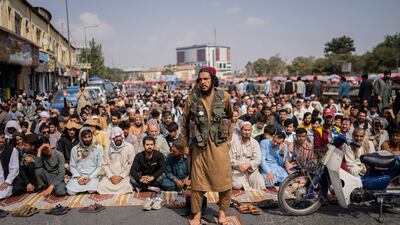
A Taliban fighter and a group of Afghan men attend Friday prayers in Kabul. AP Photo -
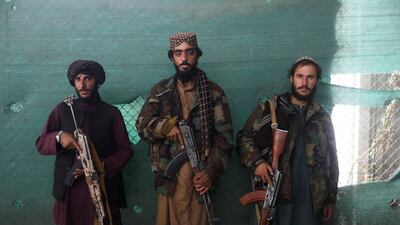
Taliban soldiers in Bagram Air Base in Parwan. Reuters -
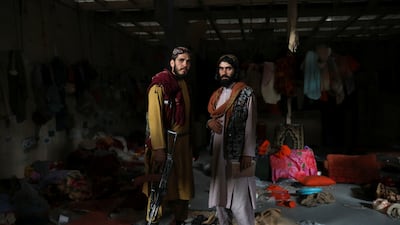
Taliban soldiers Seifatollah and Vasighollah stand in a prison in Bagram Air Base. Reuters -
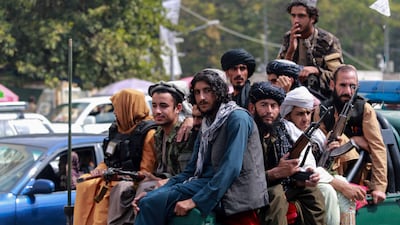
Taliban patrol Kabul. EPA -
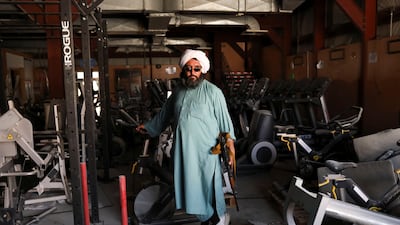
Vahdat, a Taliban soldier and former prisoner, stands next to exercise equipment in Bagram Air Base. Reuters -
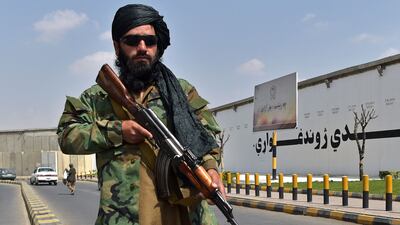
A Taliban fighter stands guard near Zanbaq Square in Kabul. AFP -
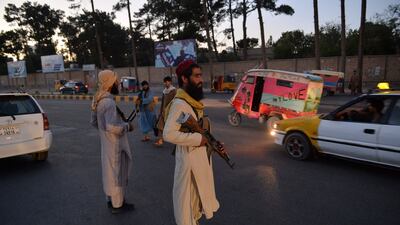
Taliban fighters police a road in Herat. AFP


Since his appointment, Mr Ghairat has held meetings in the university chancellor’s office with various pro-Taliban academics, including Anwarulhaq Jabarkhail, a self-styled philosopher of Islam and health who has appeared on Afghan television networks in the past year promoting the consumption of olive tea as a treatment for Covid-19.
Mr Jabarkhail has said that during their meeting, he advised the chancellor to replace the supply of tea at the university with olive tea.
“I have to deal with an uneducated guy as my chancellor — a guy who meets with people like Jabarkhail,” Mahmoud said.
While Mahmoud’s decision to set up the fake account was driven in part by his frustration, it was also a desire to prove a point about the Taliban.
“You know what the most interesting thing is?” he says. “Nobody doubted me. I was just tweeting what the Taliban are already really thinking.”
Insult to injury
For many Kabul University students already alarmed by the sudden halt in their education, Mr Ghairat’s appointment has added insult to injury.
Students at the university, Afghanistan’s largest public institution of higher education, have dealt with many disappointments. They were only a week into their term when, on August 15, classes were paused for the religious holiday of Ashura.
Rumours swirled that morning that the holiday period would last longer than normal this year, as the Afghan government sought to curb public life to stem the tide of a new Covid-19 wave.
No one had expected, however, what would occur later that afternoon, when Taliban fighters entered Kabul and seized control of the central government. After a week of chaos and uncertainty, university staff returned to their posts.
But teaching at public institutions, including Kabul University, remains suspended.
Private universities, on the other hand, have reopened fully, albeit with new rules requiring men and women to either be taught separately or in shared classrooms partitioned by a curtain. The rules have been criticised heavily by many within Afghanistan and the international community, as they place new constraints on an education system already coping with a desperate shortage of teachers.
With the country facing an extreme financial crisis that has affected budgets across all ministries, public university students have been asked to remain home indefinitely. Among Kabul University’s 25,000 students, nearly half of whom moved to the capital from other provinces for their education, frustration has mounted.
Kabul University staff are prohibited from speaking to journalists without permission. But a senior administrator at the university, who spoke to The National on the condition of anonymity, confirmed that no policy prohibiting women specifically from attending classes exists. The administrator says that the suspension of teaching is not directly related to the need to institute Taliban policies, but rather the extremity of Afghanistan’s financial crisis.
-

A man selling balloons at night in Kabul a month since the start of Taliban rule. All photos by Stefanie Glinski -
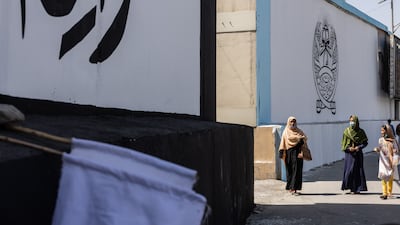
Children stand outside the former US embassy in Kabul where the banner of the 'Islamic Emirate' has replaced previous murals. -
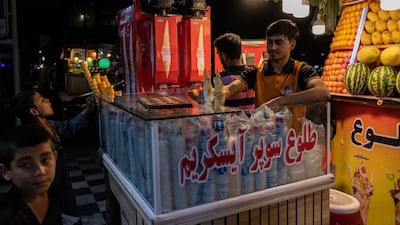
Evenings in Kabul have seen children joined by fighters buying fruit juice and ice cream. -
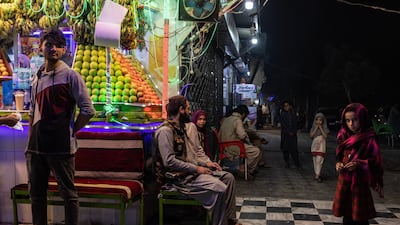
Taliban fighters sit awaiting for their fruit juice among civilians. -
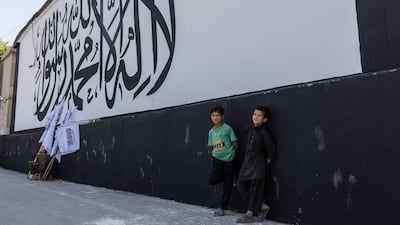
Children stand outside the former US embassy in Kabul where the banner of the 'Islamic Emirate' has replaced previous murals. -
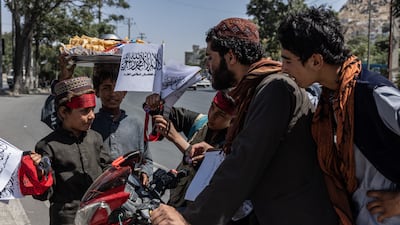
Street-working children are selling Taliban flags and bandanas in Kabul. -
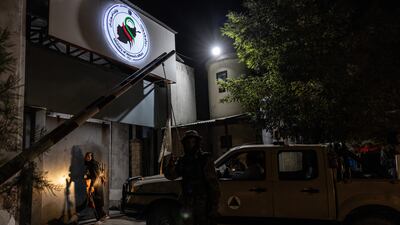
Taliban fighters stand outside the Ministry of Women's Affairs, not part of the new government.


The university’s budget is reliant on money from the government, but since the Taliban’s takeover of the country, Afghanistan has experienced an acute shortage of hard currency. Billions of dollars of Afghan government assets held in the US have been frozen by Washington, and aid from the International Monetary Fund and World Bank has been suspended.
For Mahmoud, the most grating thing about the Taliban’s gender segregation policies is not the social aspect, but rather that they will further stretch the resources available to universities during the financial crisis.
“There will not be enough teachers or enough space, and they will not be able to continue our education properly,” he says.
While Mahmoud has chosen to convey these points through parody, other students have sought to engage with Mr Ghairat directly.
Safiullah Hakimi, a fourth-year economics major who last year was president of the university’s students' union, has, together with a group of student body representatives, met with Mr Ghairat and a senior official from the Ministry of Higher Education to brainstorm solutions to resource issues.
“The meeting was good,” Mr Hakimi says. “Though when I met him, I was expecting someone who would behave more like a university chancellor. He couldn’t talk about issues in a very sophisticated way.
“But even under Prof Babury, we always found that senior staff cannot or don’t want to understand our problems. Mr Ghairat, at least, seems sympathetic to the students so far.”
Mr Hakimi claims that when he asked Mr Ghairat and the ministry representative when students could expect new information on the resumption of classes, both responded by saying they were “waiting for orders”.
Until those orders come, uncertainty continues to grip the students of Kabul University, not only about when they will go back to school but also the quality of education they will receive under Mr Ghairat’s pro-Taliban leadership when they do.
The university administrator who spoke to The National says that staff are trying to stay positive.
“Everyone at the university, including the chancellor but also me and all the other faculty, has their own job description,” the official says. “If everyone does their jobs, we will probably not be so dependent on him.”

