


Follow for live UN General Assembly coverage
UN Secretary General Antonio Guterres said the world is hurtling towards ecological destruction, sounding a bleak opening tone on Tuesday at the annual UN General Assembly meeting in New York.
Speaking a day after convening world leaders to ratchet up their climate commitments, Mr Guterres said the “climate alarm bells” are “ringing at fever pitch".
In the run-up to the next major UN climate conference, November's Cop26 meeting in Glasgow, Mr Guterres said global climate efforts are falling far short and he warned of catastrophic temperature rises if emissions are not cut more than currently planned.
“We are weeks away from the UN Climate Conference in Glasgow, but seemingly light-years away from reaching our targets,” Mr Guterres told world leaders. “We must get serious. And we must act fast.”
Instead of scrapping coal-fired power stations and other polluting technologies, countries are instead burning fossil fuels. Emissions are expected to rise by 16 per cent by 2030.
“That would condemn us to a hellscape of temperature rises of at least 2.7°C above pre-industrial levels”, with worsening fires, droughts, storms and other devastating weather tragedies, Mr Guterres said.
In his virtual address, China's President Xi Jinping said his country would stop funding coal projects overseas, reducing a key source of pollution behind climate change.
"China will step up support for other developing countries in developing green and low carbon energy and will not build new coal-fired power projects abroad," Mr Xi said.
In his speech to the General Assembly, US President Joe Biden pushed for more co-operation between nations in fighting climate change and said the US would “double” its contribution to international climate financing towards the goal of mobilising $100 billion for vulnerable nations.
Experts said the announcement would take the US contribution to the commitment, made by developed countries before the 2015 Paris Agreement, to approximately $11.4bn annually.
“This will make the United States a leader in public climate finance,” Mr Biden told world leaders in New York, saying he would work with Congress to achieve the goal.
The $100bn goal is key, as there is a big gap before rich and poor nations when it comes to climate negotiations.
Developing nations and others are reluctant to curb emissions further without help from developed nations, which, in the words of British Prime Minister Boris Johnson, are “the guys that created the problem".
-

French glaciologist Pierre Rene makes ice height measurements at the Ossoue glacier on the Vignemale peak in the French Pyrenees last month. The glacier, the highest and the largest in the French Pyrenees, is expected to disappear by 2050 due to climate change. AFP -
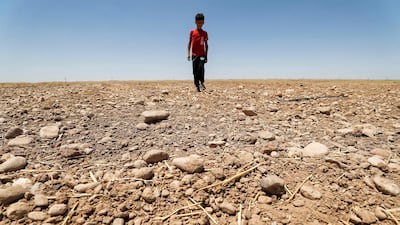
A boy walks through a dry field in eastern Iraq. Reduced agricultural production, water scarcity, rising sea levels and other adverse effects of climate change could force up to 216 million people to migrate within their own countries by 2050, the World Bank has said. AFP -
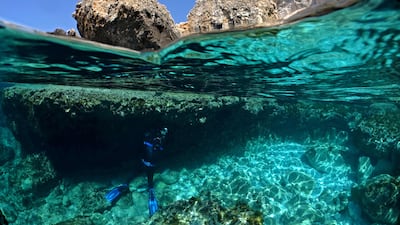
Cypriot marine ecologist Louis Hadjioannou takes pictures of coral as he monitors the effects of climate change in the crystal clear waters off the island's south-eastern shore. AFP -
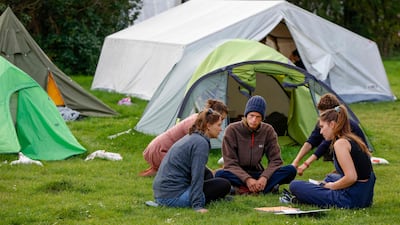
Climate activists at a protest camp in Berlin. The activists were involved in a weeks-long hunger strike as they demanded meetings with German party leaders to discuss the environment. AFP -
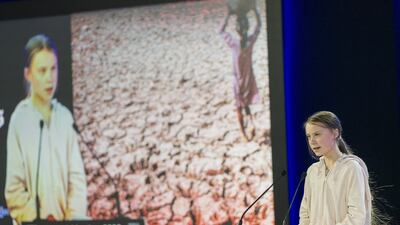
Swedish climate activist Greta Thunberg addresses a panel session during the 50th annual meeting of the World Economic Forum in Davos, Switzerland. EPA -
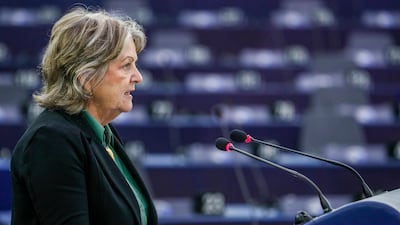
European Commissioner for Cohesion and Reforms Elisa Ferreira discusses the effects of natural disasters in Europe due to climate change, during a plenary session at the European Parliament in Strasbourg, France. AFP


Developing countries tend to be the most vulnerable to costly climate impacts and have the least amount of resources to deal with them.
Maldives President Ibrahim Mohamed Solih, whose Indian Ocean nation is at critical risk from rising seas, said the world must reject the “lacklustre, business-as-usual practices that currently dominate the global climate change regime".
“It requires countries to adopt more stringent measures to halt their emissions. It needs the world's wealthy nations to help smaller nations receive the support in the form of capacity-building, technology transfers and financial resources to ramp up their defences in the climate fight,” he told the assembly.
Colombian President Ivan Duque expressed the concern shared by many developing countries.
“We are a country which only represents 0.6 per cent of global CO2 emissions. But we find ourselves to be the most threatened by the effects of climate change,” he said.
Mr Guterres last week said the Glasgow summit was at risk of failure because of mistrust between developed and developing countries, and a lack of ambitious goals among some emerging economies.
The conference aims to bring much more ambitious climate action and funding from participants around the globe after scientists said last month that global warming is dangerously close to being out of control.
Meanwhile, the world remains behind in its battle to cut carbon emissions and the pace of climate change has not been slowed by the global Covid-19 pandemic, the World Meteorological Organisation said on Thursday.
Scientists have said that unless major action is taken to cut emissions, the average global temperature is likely to hit or pass the level of 1.5°C above pre-industrial times within 20 years.

