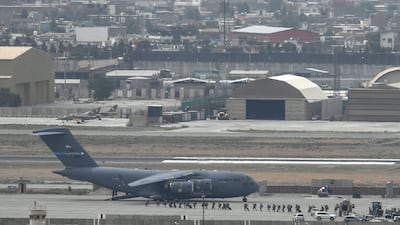
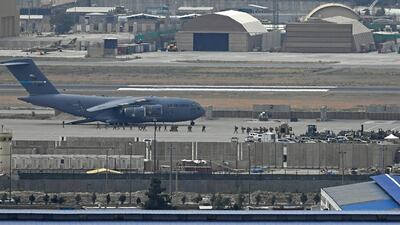
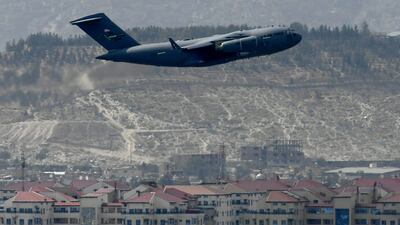
US President Joe Biden addresses the nation on the US exit from Afghanistan after a failed 20-year war that he had vowed to end but whose chaotic last days are now overshadowing his presidency. AFP

Biden's pivot from international interventions worries allies


  • English
  • Arabic

President Joe Biden is using America's defeat in Afghanistan to accelerate his approach to US foreign policy that breaks from the kinds of expensive and drawn-out military interventions that have defined the global security order since the end of the Second World War.

With the Taliban back in power after 20 years and unresolved conflicts simmering across the Middle East, the US has not managed a clear-cut military success since the 1991 Gulf War, when it recaptured Kuwait from Iraq's Saddam Hussein.

During a speech defending his handling of America’s messy withdrawal from Kabul, Mr Biden said his decision to end the war was also about “ending an era of major military operations to remake other countries".

“We must set missions with clear, achievable goals — not ones we’ll never reach,” he said.

It's a turnaround for Mr Biden.

First as a senator, then as vice president, he repeatedly voted for foreign military interventions, from Yugoslavia in 1999 to Libya in 2011, as well as the Afghanistan and Iraq wars.

“As we turn the page on the foreign policy that's guided our nation the last two decades, we've got to learn from our mistakes,” he said, noting that future military interventions must be focused mainly on the “fundamental national security interest of the US”.

But a reduced role for America as the world’s policeman worries allies in the Middle East and Europe.

“It sounds like the end of an era,” said Bruno Macaes, a prominent European author on geopolitics and a Portuguese politician.

In his speech, Mr Biden said human rights would be at the centre of US foreign policy, but noted these would not be enforced through “endless military deployments”.

Instead, the US would use “diplomacy, economic tools and rallying the rest of the world for support,” he said.

Mr Biden has sought to reassure allies that “America is back” after four years of Donald Trump’s isolationist “America First” worldview and verbal attacks on partners, including those in Nato.

But several allies, including Britain, France and Germany, are unhappy with America’s end to the Afghanistan war, which came with little co-ordination even though hundreds of troops from those countries had been killed in the two-decade conflict.

“Mr Biden wants to appeal to a strong notion of the American national interest. That has a cost: partners can no longer expect their own interests to be taken into account in major US foreign policy decisions,” Mr Macaes said.

Gerard Araud, the former French ambassador to Washington, put it more bluntly on Twitter.

“Wake up, Europe! Your nanny has resigned,” he wrote after Mr Biden’s speech.

Gen Mark Milley, Chairman of the Joint Chiefs of Staff, sounded a chastened tone at a Pentagon press conference on Wednesday. For years, military officials assured the American public that the Afghanistan conflict could be won — until suddenly it couldn't.

“Our military mission has now come to an end. We will learn from this experience as a military, and how we got to this moment in Afghanistan will be analysed and studied for years to come,” Gen Milley said.

“We in the military will approach this with humility, transparency and candour.”

Richard Haass, a former US special envoy to Northern Ireland and a seasoned diplomat at the heart of the Washington foreign policy establishment, hit back at Mr Biden's decision to retreat from Afghanistan, but agreed the US should not be looking to nation build.

“Transformation of other societies is not a realistic goal for US foreign policy or good use of the US military. But building up local capacities to tackle terrorism and promote domestic order is a proper foreign policy goal, one in our national security interest,” he said on Twitter.

Mr Biden said America must refocus its foreign policy to counter challenges from Moscow and Beijing.

“There’s nothing China or Russia would rather have, would want more in this competition than the United States to be bogged down another decade in Afghanistan,” he said.

But this approach could grow complicated, as many US allies are hesitant to anger Beijing.

“We are hearing from EU officials that a new caution is necessary on forging a common EU-US policy on China. That’s an immediate and heavy cost of the Biden decision,” said Mr Macaes, author of Belt and Road: A Chinese World Order.

He stressed, however, that European and Asian allies remain dependent on Washington for security — at least for now.

In the Middle East, fears of a similar US withdrawal from Iraq and a more isolationist American policy are forcing regional players to reconfigure their own relations and security.

Over the past two weeks, reconciliation efforts have gained momentum between the UAE and Egypt, and between Turkey and Qatar.

Saudi Deputy Defence Minister Prince Khalid bin Salman visited Russia last week and signed a military agreement.

Karen Young, director of the Economics and Energy Programme at the Middle East Institute, saw these developments as ways for countries to manage their own disputes while the US shrinks its footprint in the region.

“It is all related [to Afghanistan], but also anticipated before the US withdrawal, where there has been a need for Gulf states to de-escalate tension and some active disputes, to create some opportunities for economic co-operation,” Ms Young told The National.

“Without a US commitment to force in the region, there have to be other ways of dispute management.”

Whether it’s Turkey and the UAE mending ties, or Iranian-Saudi backchannel talks, the expert saw it linked to “a more opaque regional security environment, more pressing economic needs and [that] requires some deal-making".


Desert Warrior

Starring: Anthony Mackie, Aiysha Hart, Ben Kingsley

Director: Rupert Wyatt

Rating: 3/5

Who's who in Yemen conflict

Houthis: Iran-backed rebels who occupy Sanaa and run unrecognised government

Yemeni government: Exiled government in Aden led by eight-member Presidential Leadership Council

Southern Transitional Council: Faction in Yemeni government that seeks autonomy for the south

Habrish 'rebels': Tribal-backed forces feuding with STC over control of oil in government territory

MOTHER%20OF%20STRANGERS
%3Cp%3EAuthor%3A%20Suad%20Amiry%3Cbr%3EPublisher%3A%20Pantheon%3C%2Fp%3E%0A%3Cp%3EPages%3A%20304%3Cbr%3EAvailable%3A%20Now%3C%2Fp%3E%0A

Mercer, the investment consulting arm of US services company Marsh & McLennan, expects its wealth division to at least double its assets under management (AUM) in the Middle East as wealth in the region continues to grow despite economic headwinds, a company official said.

Mercer Wealth, which globally has $160 billion in AUM, plans to boost its AUM in the region to $2-$3bn in the next 2-3 years from the present $1bn, said Yasir AbuShaban, a Dubai-based principal with Mercer Wealth.

Within the next two to three years, we are looking at reaching $2 to $3 billion as a conservative estimate and we do see an opportunity to do so,” said Mr AbuShaban.

Mercer does not directly make investments, but allocates clients’ money they have discretion to, to professional asset managers. They also provide advice to clients.

“We have buying power. We can negotiate on their (client’s) behalf with asset managers to provide them lower fees than they otherwise would have to get on their own,” he added.

Mercer Wealth’s clients include sovereign wealth funds, family offices, and insurance companies among others.

From its office in Dubai, Mercer also looks after Africa, India and Turkey, where they also see opportunity for growth.

Wealth creation in Middle East and Africa (MEA) grew 8.5 per cent to $8.1 trillion last year from $7.5tn in 2015, higher than last year’s global average of 6 per cent and the second-highest growth in a region after Asia-Pacific which grew 9.9 per cent, according to consultancy Boston Consulting Group (BCG). In the region, where wealth grew just 1.9 per cent in 2015 compared with 2014, a pickup in oil prices has helped in wealth generation.

BCG is forecasting MEA wealth will rise to $12tn by 2021, growing at an annual average of 8 per cent.

Drivers of wealth generation in the region will be split evenly between new wealth creation and growth of performance of existing assets, according to BCG.

Another general trend in the region is clients’ looking for a comprehensive approach to investing, according to Mr AbuShaban.

“Institutional investors or some of the families are seeing a slowdown in the available capital they have to invest and in that sense they are looking at optimizing the way they manage their portfolios and making sure they are not investing haphazardly and different parts of their investment are working together,” said Mr AbuShaban.

Some clients also have a higher appetite for risk, given the low interest-rate environment that does not provide enough yield for some institutional investors. These clients are keen to invest in illiquid assets, such as private equity and infrastructure.

“What we have seen is a desire for higher returns in what has been a low-return environment specifically in various fixed income or bonds,” he said.

“In this environment, we have seen a de facto increase in the risk that clients are taking in things like illiquid investments, private equity investments, infrastructure and private debt, those kind of investments were higher illiquidity results in incrementally higher returns.”

The Abu Dhabi Investment Authority, one of the largest sovereign wealth funds, said in its 2016 report that has gradually increased its exposure in direct private equity and private credit transactions, mainly in Asian markets and especially in China and India. The authority’s private equity department focused on structured equities owing to “their defensive characteristics.”

Real Madrid 1
Ronaldo (87')

Athletic Bilbao 1
Williams (14')

Tips for job-seekers
  • Do not submit your application through the Easy Apply button on LinkedIn. Employers receive between 600 and 800 replies for each job advert on the platform. If you are the right fit for a job, connect to a relevant person in the company on LinkedIn and send them a direct message.
  • Make sure you are an exact fit for the job advertised. If you are an HR manager with five years’ experience in retail and the job requires a similar candidate with five years’ experience in consumer, you should apply. But if you have no experience in HR, do not apply for the job.

David Mackenzie, founder of recruitment agency Mackenzie Jones Middle East

Book%20Details
%3Cp%3E%3Cem%3EThree%20Centuries%20of%20Travel%20Writing%20by%20Muslim%20Women%3C%2Fem%3E%3Cbr%3E%3Cstrong%3EEditors%3A%20%3C%2Fstrong%3ESiobhan%20Lambert-Hurley%2C%20Daniel%20Majchrowicz%2C%20Sunil%20Sharma%3Cbr%3E%3Cstrong%3EPublisher%3A%20%3C%2Fstrong%3EIndiana%20University%20Press%3B%20532%20pages%3Cbr%3E%3C%2Fp%3E%0A
The Voice of Hind Rajab

Starring: Saja Kilani, Clara Khoury, Motaz Malhees

Director: Kaouther Ben Hania

Rating: 4/5

The specs

Engine: 2.9-litre twin-turbo V6

Power: 540hp at 6,500rpm

Torque: 600Nm at 2,500rpm

Transmission: Eight-speed auto

Kerb weight: 1580kg

Price: From Dh750k

On sale: via special order

Dust and sand storms compared

Sand storm

  • Particle size: Larger, heavier sand grains
  • Visibility: Often dramatic with thick "walls" of sand
  • Duration: Short-lived, typically localised
  • Travel distance: Limited 
  • Source: Open desert areas with strong winds

Dust storm

  • Particle size: Much finer, lightweight particles
  • Visibility: Hazy skies but less intense
  • Duration: Can linger for days
  • Travel distance: Long-range, up to thousands of kilometres
  • Source: Can be carried from distant regions

GOLF’S RAHMBO

- 5 wins in 22 months as pro
- Three wins in past 10 starts
- 45 pro starts worldwide: 5 wins, 17 top 5s
- Ranked 551th in world on debut, now No 4 (was No 2 earlier this year)
- 5th player in last 30 years to win 3 European Tour and 2 PGA Tour titles before age 24 (Woods, Garcia, McIlroy, Spieth)

UAE currency: the story behind the money in your pockets

Trolls World Tour

Directed by: Walt Dohrn, David Smith

Starring: Anna Kendrick, Justin Timberlake

Rating: 4 stars

Classification of skills

A worker is categorised as skilled by the MOHRE based on nine levels given in the International Standard Classification of Occupations (ISCO) issued by the International Labour Organisation. 

A skilled worker would be someone at a professional level (levels 1 – 5) which includes managers, professionals, technicians and associate professionals, clerical support workers, and service and sales workers.

The worker must also have an attested educational certificate higher than secondary or an equivalent certification, and earn a monthly salary of at least Dh4,000. 

UAE currency: the story behind the money in your pockets
The five pillars of Islam

1. Fasting 

2. Prayer 

3. Hajj 

4. Shahada 

5. Zakat 

Updated: September 02, 2021, 5:31 AM