


British businesses with ties to Afghan rug weavers have expressed fears that their suppliers could be targets of reprisals by Taliban militants.
Trade links between the countries have grown over the past two decades, with handwoven rugs and vivid handblown glass particularly popular among buyers.
But the collapse of Afghanistan to Taliban militants has put traders in the country at risk of execution over their association with the West.
British businessman James Wilthew has built up close ties with Afghan rug weavers and sellers. He buys the sought-after carpets directly from the northern provinces, the industry's traditional base.
The ex-serviceman sells them at his shop in Hebden Bridge, West Yorkshire, and estimates his company, The Afghan Rug Shop, supports about 200 families.
A share of the proceeds goes to Afghanaid, a British charity supporting people in Afghanistan.
Now he is battling to fly out contacts he believes will be Taliban targets owing to their association with a former Nato base in the region.
“As a result of that, they are now in immediate danger,” as they do not fall under the British government criteria for evacuation, Mr Wilthew said.
He said he was frustrated by the British government's response, despite an emotive emergency debate on the crisis in Parliament and urgent calls for help.
“Nothing happens. There's been no action,” he said.
“Government bureaucracy will result in the deaths of thousands of people.”
The former RAF officer worked in Afghanistan in 2004, on the UK Provincial Reconstruction Team, set up to help development projects.
Asked if Islamist extremists could target those who worked with him because of his UK military background, he said: “Yes, of course.”

The Taliban could say: “You've been working for Mr James,” he said. “It's just the association.”
“I'm not necessarily how sure the Taliban will go with these things: we just don't know what the spectrum of danger is.”
Afghan rugs are a major commodity and the country's second-largest non-agricultural export, according to the World Trade Organisation.
Textiles are by far the most significant Afghan import to the UK, worth about £2.4 million ($3.3m) per year, government figures show.
The ancient carpet trade survived under the previous Taliban regime, which ruled Afghanistan with an iron fist from 1996 until its removal in the US-led invasion in 2001.
But Mr Wilthew said the uncertainty and chaos since the extremists' return was “a temporary issue”.

“Under the Taliban regime, that trade [in textiles] will continue. They need the tax from that business, the employment,” he said.
“It's their export commodity. It's how they make an income.”
Most Afghan carpets are exported through neighbouring Pakistan. Mr Wilthew is unusual in dealing directly with Afghan artisans and traders.
That could force him to change his business model, possibly using a middleman in Pakistan and switching from US dollars to another currency if the greenback is banned in Afghanistan.
He is also unlikely to be able to continue using international shipping and delivery companies DHL and FedEx for delivery, he added.
“Acquiring rugs from Afghanistan is not a concern for me. It's not an issue; the issue is my friends,” he said.
Another company, Ishkar, in London, sells Afghan carpets with modern designs, as well handblown tumblers, jewellery and clothes.
-
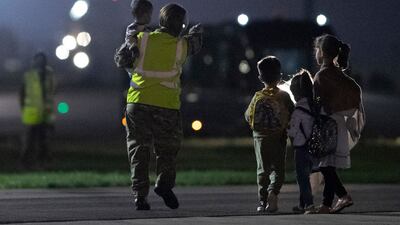
People flown out of Kabul on a British Royal Air Force plane arrive at the RAF Brize Norton airbase in southern England. AFP -
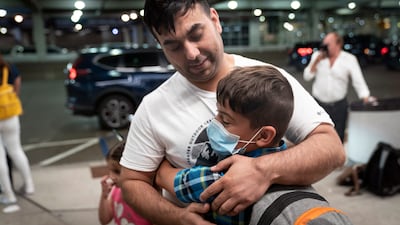
Ziaullah Qazizada embraces his son, Mesbahullah, at Minneapolis-Saint Paul International Airport in the US state of Minnesota. The 10-year-old had been stuck in Afghanistan after travelling to visit family in July. AP -
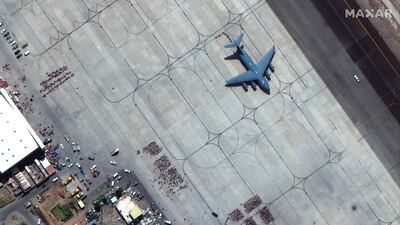
A military aircraft waits at Kabul airport on Monday. AP -
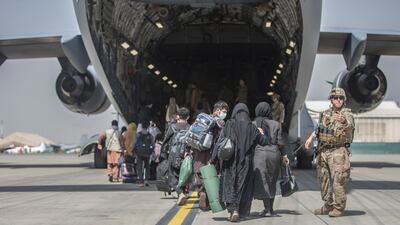
Families board a US Air Force Boeing C-17 Globemaster III transport aircraft at Kabul airport. AP -
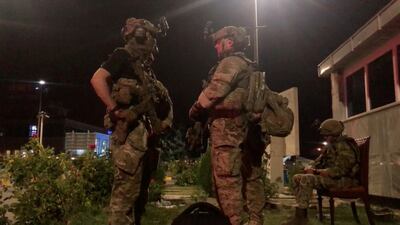
Troops stationed at Kabul airport during the international evacuation effort. Reuters TV -
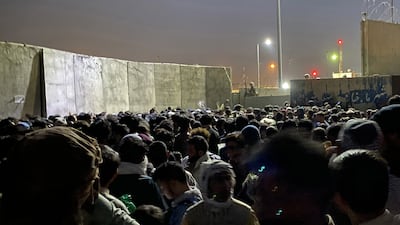
A crowd waits to enter Kabul airport as thousands try to flee the city following the Taliban takeover. EPA -
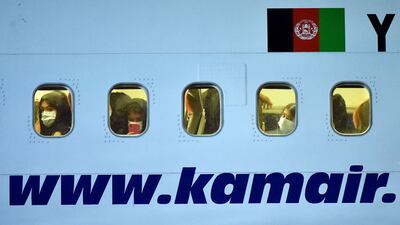
People arrive at Boryspil International Airport, outside the Ukrainian capital Kiev, after fleeing Afghanistan on board a Kam Air passenger plane. AFP -

An Afghan refugee binds his hands with cable during a rally outside the UN refugee agency's office in Jakarta, Indonesia. Demonstrators have called for justice and resettlement. Reuters -
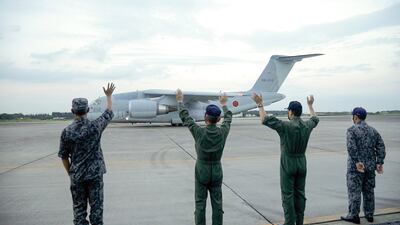
A Japanese military transport aircraft departs from Iruma Airbase, north-west of Tokyo, on a mission to get Japanese citizens and Afghan staff at the Japanese embassy out of Kabul. EPA -
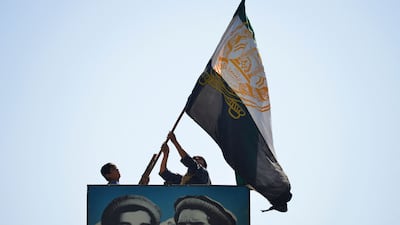
Afghans wave a flag above a portrait of the late Afghan resistance leader Ahmad Shah Massoud in north-eastern Panjshir province, the only region of Afghanistan that has not yet fallen to the Taliban. AFP -
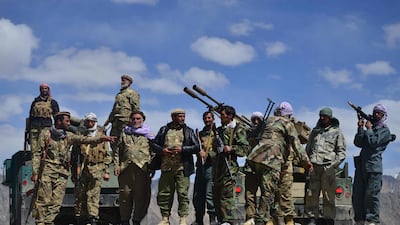
Afghan resistance fighters and anti-Taliban troops stand guard at an outpost in Kotal-e Anjuman, Panjshir province. AFP -

People travel on the Kandahar-Kabul road after fleeing their homes following the Taliban's return to power. EPA


The brand's creative director, Electra Simon, said she was in daily contact with people in Afghanistan, and “pretty much everybody is trying to leave”.
“They just basically want to get out. They can't leave their houses right now,” she said.
She said they felt “sheer desperation” at the situation.
“It's really hard: the relationships we've built up with people, seeing them in these massively tricky situations,” she said.
Ishkar's online shop is selling photographic prints of Afghanistan to raise funds for Emergency, which provides medical treatment to conflict victims.
The company works with about 30 people in the country. To protect its Afghan partners, it has removed references to them from its website.
“We want to do everything possible to continue working with people in Afghanistan, if it doesn't put them at risk,” she said
“Some of them will be [at risk], others probably not as much because they are just traditional artisans working, so hopefully we can continue working with them.”
Some artisans in areas captured by the Taliban have been able to keep working, she said, although the logistics of exporting to Britain were now impossible.
She and Mr Wilthew said the situation was still too fluid to predict, and that a clearer picture would appear in the coming weeks.
“It will definitely be different for us, that's 100 per cent,” she said.

