Getty, Reuters, Nick Donaldson


Three options for the UN to lead in Gaza


Adam Day
Adam Day
  • English
  • Arabic

December 15, 2023

This week, a UN General Assembly resolution calling for a humanitarian ceasefire in Gaza was passed by an overwhelming majority: 153 in favour and only 10 against. The Gaza resolution garnered 10 more votes than the March 2022 resolution condemning Russia’s invasion of Ukraine. In strictly numerical terms, the US is now more isolated internationally than Russia. This clearly has US President Joe Biden worried. He has issued increasingly blunt warnings to Israel about dwindling international support for its military operation in Gaza.

But a ceasefire, on its own, appears to be unacceptable to Israeli Prime Minister Benjamin Netanyahu, who has said he would see any pause in the fighting as giving Hamas time to regroup. A standalone ceasefire also would do little to shape a much-needed intra-Palestinian process to determine new leadership in Gaza, or to contribute to a withdrawal of Israeli troops. This is a moment for the UN to offer a vision for Gaza that goes beyond a humanitarian pause in the fighting. There are three options that could be added to demands for a ceasefire in Gaza.

The most expansive one would be for the UN to offer to deploy a transitional administration in Gaza. There are precedents for this, including in Bosnia-Herzegovina in 1995, and both Kosovo and East Timor in 1999. There are also early precedents in Palestine itself, going back to the 1947 General Assembly decision to partition portions of Palestine under UN control. In 2014, Palestinian President Mahmoud Abbas requested that the UN place Gaza and the West Bank under international protection, though no action was taken by the Security Council. While UN Secretary-General Guterres ruled out a UN protectorate for Gaza, he also indicated that the international community needed to move into a “transition period”.

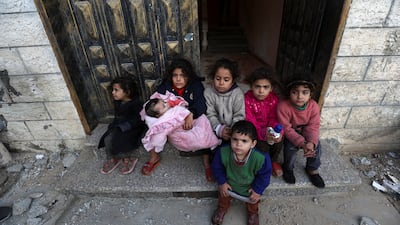
  • Palestinian children look at the site of an Israeli strike on a house. Reuters
    Palestinian children look at the site of an Israeli strike on a house. Reuters
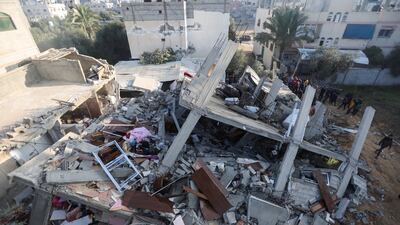
  • Palestinians inspect the site after an Israeli strike on a house. Reuters
    Palestinians inspect the site after an Israeli strike on a house. Reuters
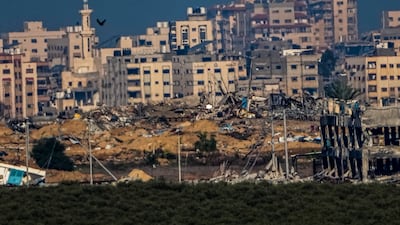
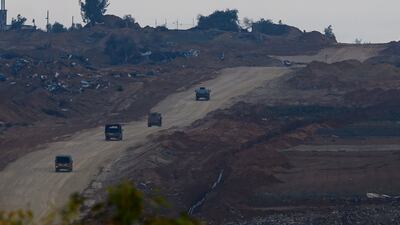
  • Israeli military vehicles as seen from southern Israel, operate inside Gaza Strip on Sunday. AP Photo
    Israeli military vehicles as seen from southern Israel, operate inside Gaza Strip on Sunday. AP Photo
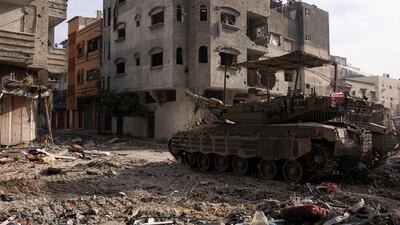
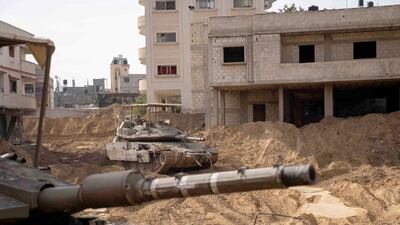
  • An Israeli Merkava tank in the Gaza Strip amid the continued war between Israel and Gaza. Reuters
    An Israeli Merkava tank in the Gaza Strip amid the continued war between Israel and Gaza. Reuters
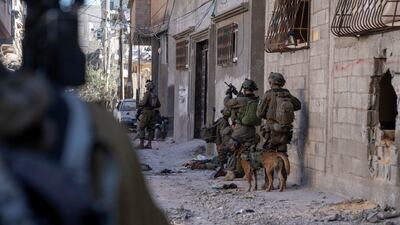
  • Israeli soldiers in the Gaza Strip. Reuters
    Israeli soldiers in the Gaza Strip. Reuters
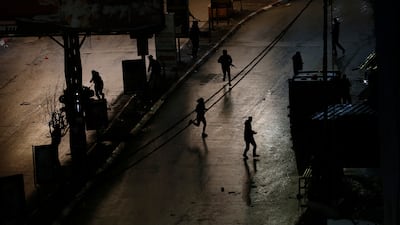
  • Palestinian militants clash with the Israelis at Jenin refugee camp in the occupied the West Bank. EPA
    Palestinian militants clash with the Israelis at Jenin refugee camp in the occupied the West Bank. EPA
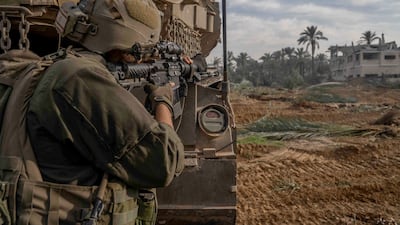
  • An Israeli soldier in the Gaza Strip. Reuters
    An Israeli soldier in the Gaza Strip. Reuters
  • Israeli military vehicles. Reuters
    Israeli military vehicles. Reuters
  • Israeli vehicles drive into Gaza from Israel. Getty Images
    Israeli vehicles drive into Gaza from Israel. Getty Images
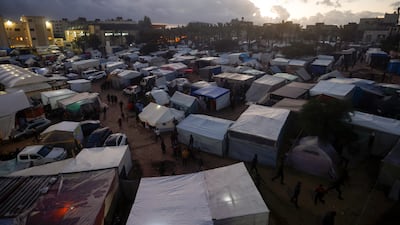
  • Displaced Palestinians in tents in Khan Younis. AP
    Displaced Palestinians in tents in Khan Younis. AP
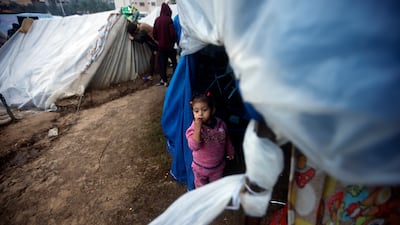
  • A Palestinian child in Khan Younis. AP
    A Palestinian child in Khan Younis. AP
  • Benjamin Netanyahu vows to fight on in Gaza. 'Nothing will stop us,' he said. AP
    Benjamin Netanyahu vows to fight on in Gaza. 'Nothing will stop us,' he said. AP
  • A Palestinian girl wounded in the Israeli bombardment arrives at a hospital in Rafah. AP
    A Palestinian girl wounded in the Israeli bombardment arrives at a hospital in Rafah. AP
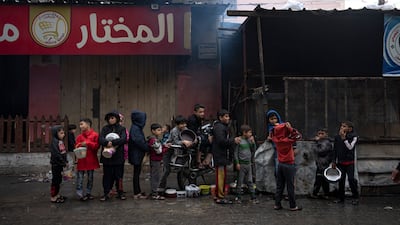
  • Palestinian children wait in line for food in Rafah. AP
    Palestinian children wait in line for food in Rafah. AP
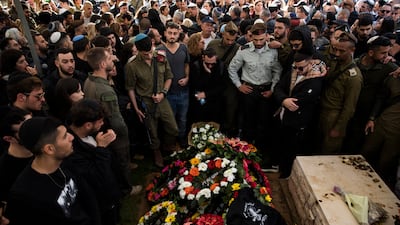
  • Family and friends mourn during a funeral for Maj Roy Meldasi in Afula, Israel. Getty Images
    Family and friends mourn during a funeral for Maj Roy Meldasi in Afula, Israel. Getty Images
  • Maj Meldasi's funeral. Getty Images
    Maj Meldasi's funeral. Getty Images
  • An Israeli military helicopter fires a missile. EPA
    An Israeli military helicopter fires a missile. EPA
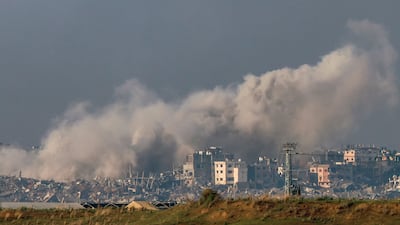
  • Smoke billowing during Israeli bombardment on northern Gaza. AFP
    Smoke billowing during Israeli bombardment on northern Gaza. AFP
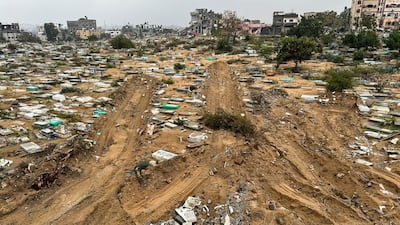
  • Graves damaged during the Israeli ground offensive in the Fallujah neighbourhood, in Jabalia. Reuters
    Graves damaged during the Israeli ground offensive in the Fallujah neighbourhood, in Jabalia. Reuters
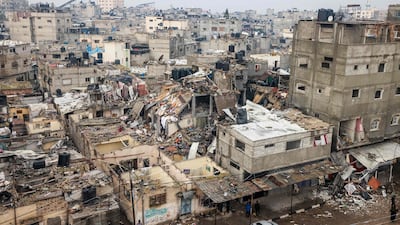
  • Damage in Rafah. AFP
    Damage in Rafah. AFP
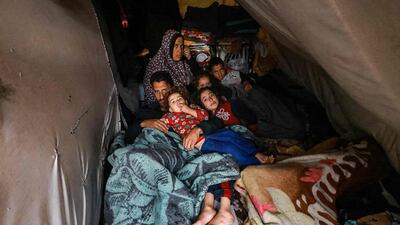
  • Palestinians rest in their makeshift tent at a camp set up at a school in Rafah. AFP
    Palestinians rest in their makeshift tent at a camp set up at a school in Rafah. AFP
  • Palestinian boys in their tent. AFP
    Palestinian boys in their tent. AFP
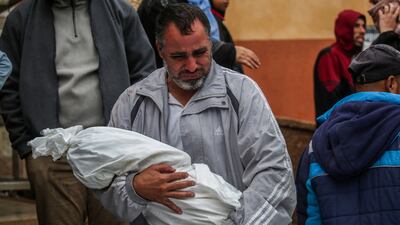
  • Mourners collect the bodies of Palestinians killed in an air strike in Khan Younis. Getty Images
    Mourners collect the bodies of Palestinians killed in an air strike in Khan Younis. Getty Images
  • The results of a draft resolution vote calling for a ceasefire at the UN General Assembly. Getty Images
    The results of a draft resolution vote calling for a ceasefire at the UN General Assembly. Getty Images
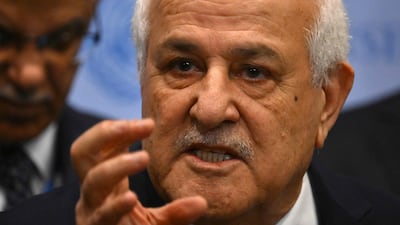
  • Palestinian ambassador to the UN Riyad Mansour speaks after the vote in New York. AFP
    Palestinian ambassador to the UN Riyad Mansour speaks after the vote in New York. AFP
  • Humanitarian aid lorries wait to be inspected at the Kerem Shalom crossing. Reuters
    Humanitarian aid lorries wait to be inspected at the Kerem Shalom crossing. Reuters
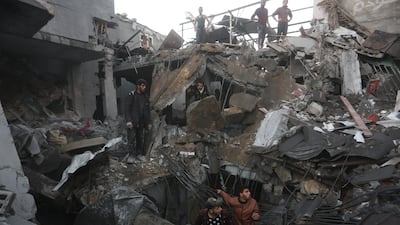
  • Palestinians look for survivors in Rafah. AP
    Palestinians look for survivors in Rafah. AP
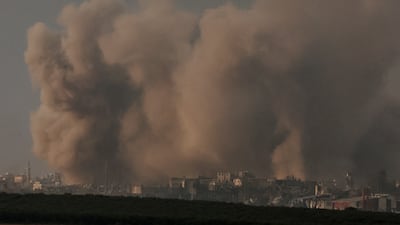
  • Smoke rises over Gaza, seen from southern Israel. Reuters
    Smoke rises over Gaza, seen from southern Israel. Reuters
  • A child reacts following an Israeli air strike on Palestinian houses in Rafah. Reuters
    A child reacts following an Israeli air strike on Palestinian houses in Rafah. Reuters

Could some combination of international and regional powers come together to co-lead a transitional administration in Gaza? Such a “neotrusteeship” might help allay Israeli concerns about security passing too quickly into Palestinian hands, while giving cover for an intra-Palestinian leadership process. And the involvement of Arab neighbours could help put the Arab Peace Initiative back on the table as a longer-term solution.

The second option is a peacekeeping mission. This week’s General Assembly resolution on Gaza was one of the rare examples where resolution 377a (“Uniting for Peace”) was invoked, permitting the GA to act when the Security Council is failing in its duties. The same resolution was the basis for the 1956 deployment of the UN Emergency Force to oversee the withdrawal of Israeli forces from Egypt. It could be used again to create a peace operation to oversee the withdrawal of Israeli troops from Gaza.

Such a mission would need to draw on regional neighbours and could be co-led by the UN Special Coordinator for Middle East Peace and the League of Arab States. It could draw from existing troops deployed in the area, such as the UN Truce Supervision Organization or the UN Disengagement Observer Force. Former Israeli prime minister Ehud Olmert has proposed that Nato troops could be deployed – could the UN deploy a joint mission with them (or would Turkey block such an action)?

While there are no easy solutions, it is vital that the UN offer visible leadership and alternatives at a time when the US, Israel and Palestine are failing

The advantage of such a mission is that it could contain important observation and monitoring functions, ensuring that all parties were meeting the conditions of a ceasefire. Of course, its mandate would need to be tied to a clear exit strategy, probably involving the election of Palestinian leadership and benchmarks around security. Without a viable exit plan, the UN could easily become caught in what International Crisis Group’s UN Director Richard Gowan has called the “peacekeeping quagmire”. But it should not be ruled out.

Third, at the bare minimum, any ceasefire would need to have a robust and independent monitoring mechanism to ensure that humanitarian relief was reaching starving Gazans. Such a mechanism has been floated by the UAE in a draft Security Council resolution this week, though it may well be shot down by another US veto.

The UN could offer a more expanded version of this mechanism, to include monitoring of the Israeli withdrawal, and potentially of a transitional security arrangement. If, for example, there were a joint Arab security force deployed, the UN monitoring group could report back on progress towards an agreed set of benchmarks.

One creative idea might be a monitoring mechanism with a trigger for a larger deployment if certain conditions were not met. For example, the Security Council (or General Assembly) could set out clear, time-bound conditions on humanitarian access and Israeli troop withdrawal. If these were not met, it could automatically trigger deployment of something more robust, like a peacekeeping mission.

While there are no easy solutions, it is vital that the UN offer visible leadership and alternatives at a time when the US, Israel and Palestine are failing. Last week, the UN Secretary-General took the extraordinary and bold step of invoking Article 99 in calling for a ceasefire for Gaza. A ceasefire is absolutely needed but will not be enough for the people of Gaza, or to prevent the increasing risks of regional spillover. The UN needs to lead by putting more options on the table.


Farage on Muslim Brotherhood

Nigel Farage told Reform's annual conference that the party will proscribe the Muslim Brotherhood if he becomes Prime Minister.
"We will stop dangerous organisations with links to terrorism operating in our country," he said. "Quite why we've been so gutless about this – both Labour and Conservative – I don't know.
“All across the Middle East, countries have banned and proscribed the Muslim Brotherhood as a dangerous organisation. We will do the very same.”
It is 10 years since a ground-breaking report into the Muslim Brotherhood by Sir John Jenkins.
Among the former diplomat's findings was an assessment that “the use of extreme violence in the pursuit of the perfect Islamic society” has “never been institutionally disowned” by the movement.
The prime minister at the time, David Cameron, who commissioned the report, said membership or association with the Muslim Brotherhood was a "possible indicator of extremism" but it would not be banned.

Who's who in Yemen conflict

Houthis: Iran-backed rebels who occupy Sanaa and run unrecognised government

Yemeni government: Exiled government in Aden led by eight-member Presidential Leadership Council

Southern Transitional Council: Faction in Yemeni government that seeks autonomy for the south

Habrish 'rebels': Tribal-backed forces feuding with STC over control of oil in government territory

The White Lotus: Season three

Creator: Mike White

Starring: Walton Goggins, Jason Isaacs, Natasha Rothwell

Rating: 4.5/5

PROFILE

Name: Enhance Fitness 

Year started: 2018 

Based: UAE 

Employees: 200 

Amount raised: $3m 

Investors: Global Ventures and angel investors 

The Prison Letters of Nelson Mandela
Edited by Sahm Venter
Published by Liveright

Landfill in numbers

• Landfill gas is composed of 50 per cent methane

• Methane is 28 times more harmful than Co2 in terms of global warming

• 11 million total tonnes of waste are being generated annually in Abu Dhabi

• 18,000 tonnes per year of hazardous and medical waste is produced in Abu Dhabi emirate per year

• 20,000 litres of cooking oil produced in Abu Dhabi’s cafeterias and restaurants every day is thrown away

• 50 per cent of Abu Dhabi’s waste is from construction and demolition

Results

Ashraf Ghani 50.64 per cent

Abdullah Abdullah 39.52 per cent

Gulbuddin Hekmatyar 3.85 per cent

Rahmatullah Nabil 1.8 per cent

What drives subscription retailing?

Once the domain of newspaper home deliveries, subscription model retailing has combined with e-commerce to permeate myriad products and services.

The concept has grown tremendously around the world and is forecast to thrive further, according to UnivDatos Market Insights’ report on recent and predicted trends in the sector.

The global subscription e-commerce market was valued at $13.2 billion (Dh48.5bn) in 2018. It is forecast to touch $478.2bn in 2025, and include the entertainment, fitness, food, cosmetics, baby care and fashion sectors.

The report says subscription-based services currently constitute “a small trend within e-commerce”. The US hosts almost 70 per cent of recurring plan firms, including leaders Dollar Shave Club, Hello Fresh and Netflix. Walmart and Sephora are among longer established retailers entering the space.

UnivDatos cites younger and affluent urbanites as prime subscription targets, with women currently the largest share of end-users.

That’s expected to remain unchanged until 2025, when women will represent a $246.6bn market share, owing to increasing numbers of start-ups targeting women.

Personal care and beauty occupy the largest chunk of the worldwide subscription e-commerce market, with changing lifestyles, work schedules, customisation and convenience among the chief future drivers.

Key developments

All times UTC 4

What is graphene?

Graphene is a single layer of carbon atoms arranged like honeycomb.

It was discovered in 2004, when Russian-born Manchester scientists Andrei Geim and Kostya Novoselov were "playing about" with sticky tape and graphite - the material used as "lead" in pencils.

Placing the tape on the graphite and peeling it, they managed to rip off thin flakes of carbon. In the beginning they got flakes consisting of many layers of graphene. But as they repeated the process many times, the flakes got thinner.

By separating the graphite fragments repeatedly, they managed to create flakes that were just one atom thick. Their experiment had led to graphene being isolated for the very first time.

At the time, many believed it was impossible for such thin crystalline materials to be stable. But examined under a microscope, the material remained stable, and when tested was found to have incredible properties.

It is many times times stronger than steel, yet incredibly lightweight and flexible. It is electrically and thermally conductive but also transparent. The world's first 2D material, it is one million times thinner than the diameter of a single human hair.

But the 'sticky tape' method would not work on an industrial scale. Since then, scientists have been working on manufacturing graphene, to make use of its incredible properties.

In 2010, Geim and Novoselov were awarded the Nobel Prize for Physics. Their discovery meant physicists could study a new class of two-dimensional materials with unique properties. 


Ten tax points to be aware of in 2026

1. Domestic VAT refund amendments: request your refund within five years

If a business does not apply for the refund on time, they lose their credit.

2. E-invoicing in the UAE

Businesses should continue preparing for the implementation of e-invoicing in the UAE, with 2026 a preparation and transition period ahead of phased mandatory adoption. 

3. More tax audits

Tax authorities are increasingly using data already available across multiple filings to identify audit risks. 

4. More beneficial VAT and excise tax penalty regime

Tax disputes are expected to become more frequent and more structured, with clearer administrative objection and appeal processes. The UAE has adopted a new penalty regime for VAT and excise disputes, which now mirrors the penalty regime for corporate tax.

5. Greater emphasis on statutory audit

There is a greater need for the accuracy of financial statements. The International Financial Reporting Standards standards need to be strictly adhered to and, as a result, the quality of the audits will need to increase.

6. Further transfer pricing enforcement

Transfer pricing enforcement, which refers to the practice of establishing prices for internal transactions between related entities, is expected to broaden in scope. The UAE will shortly open the possibility to negotiate advance pricing agreements, or essentially rulings for transfer pricing purposes. 

7. Limited time periods for audits

Recent amendments also introduce a default five-year limitation period for tax audits and assessments, subject to specific statutory exceptions. While the standard audit and assessment period is five years, this may be extended to up to 15 years in cases involving fraud or tax evasion. 

8. Pillar 2 implementation 

Many multinational groups will begin to feel the practical effect of the Domestic Minimum Top-Up Tax (DMTT), the UAE's implementation of the OECD’s global minimum tax under Pillar 2. While the rules apply for financial years starting on or after January 1, 2025, it is 2026 that marks the transition to an operational phase.

9. Reduced compliance obligations for imported goods and services

Businesses that apply the reverse-charge mechanism for VAT purposes in the UAE may benefit from reduced compliance obligations. 

10. Substance and CbC reporting focus

Tax authorities are expected to continue strengthening the enforcement of economic substance and Country-by-Country (CbC) reporting frameworks. In the UAE, these regimes are increasingly being used as risk-assessment tools, providing tax authorities with a comprehensive view of multinational groups’ global footprints and enabling them to assess whether profits are aligned with real economic activity. 

Contributed by Thomas Vanhee and Hend Rashwan, Aurifer

'Ashkal'
%3Cp%3E%3Cstrong%3EDirector%3A%3C%2Fstrong%3E%20Youssef%20Chebbi%3C%2Fp%3E%0A%3Cp%3E%3Cstrong%3EStars%3A%3C%2Fstrong%3E%20Fatma%20Oussaifi%20and%20Mohamed%20Houcine%20Grayaa%3C%2Fp%3E%0A%3Cp%3E%3Cstrong%3ERating%3A%3C%2Fstrong%3E%204%2F5%3C%2Fp%3E%0A
Polarised public

31% in UK say BBC is biased to left-wing views

19% in UK say BBC is biased to right-wing views

19% in UK say BBC is not biased at all

Source: YouGov

Dunki
%3Cp%3E%3Cstrong%3EDirector%3A%3C%2Fstrong%3E%20Rajkumar%20Hirani%C2%A0%3C%2Fp%3E%0A%3Cp%3E%3Cstrong%3EStarring%3A%3C%2Fstrong%3E%20Shah%20Rukh%20Khan%2C%20Taapsee%20Pannu%2C%20Vikram%20Kochhar%20and%20Anil%20Grover%3C%2Fp%3E%0A%3Cp%3E%3Cstrong%3ERating%3A%3C%2Fstrong%3E%204%2F5%3C%2Fp%3E%0A
Five expert hiking tips
    Always check the weather forecast before setting off Make sure you have plenty of water Set off early to avoid sudden weather changes in the afternoon Wear appropriate clothing and footwear Take your litter home with you
Ferrari 12Cilindri specs

Engine: naturally aspirated 6.5-liter V12

Power: 819hp

Torque: 678Nm at 7,250rpm

Price: From Dh1,700,000

Available: Now

The Perfect Couple

Starring: Nicole Kidman, Liev Schreiber, Jack Reynor

Creator: Jenna Lamia

Rating: 3/5

Updated: December 17, 2023, 10:04 AM