

Developing drugs is expensive, with a report this year from the business consultancy Deloitte estimating that major pharmaceutical companies invest, on average, $2.3 billion in each new medicine.
As well as being costly, drug development and testing, including several clinical trial stages, can take a long time, often more than a decade.
Artificial intelligence is creating a stir in the pharmaceutical industry through its potential to find new potential cures for illnesses and to streamline drug development.
As reported in The National, a UAE-backed biotechnology company, Insilico Medicine, which carries out research and development in Abu Dhabi, announced recently that it had begun patient testing of a drug discovered and designed using AI. Phase II trials of the drug, which treats a chronic lung disease called idiopathic pulmonary fibrosis, are taking place in the US and China.

Viji Draviam, professor of quantitative cell and molecular biology and director of industrial innovation at Queen Mary, University of London, says that AI is leading to a transformation in drug discovery and development.
“It’s not hype, it’s reality. There are drugs in clinical trials that have been developed through AI,” she says.
AI will help in at least two important ways, she says, the first being in identifying molecules – usually proteins associated with disease – that drugs can target. Once targets have been identified, AI can search for drugs able to act on them, and ensure that these drugs are effective and safe.
Widening the net in search for cures
There is, she says, a vast unexplored space for potential drugs that could be used against drug targets. AI greatly expands the search: where before 3,000 targets or drugs may have been looked at, with AI the number may be 30,000.
For the many steps in drug development, AI can help by, for example, sifting through vast amounts of information to extract patterns that would otherwise be missed, although it does not replace human input completely.
“The design and discovery cannot be handed to AI – you still need someone who has the background knowledge and context to help adjust the parameters,” Prof Draviam says.
“It’s not a magic black box that will tell you every target for every disease, but the search space is much, much larger.”
A need for caution

Some researchers strike a cautionary tone. For example, Andreas Bender, professor of molecular informatics at the University of Cambridge, says that present technology is not revolutionary, but an evolution of what has been used in previous years, when it may have been described as computer-aided drug discovery or bioinformatics.
“People have used protein-structure models for 30 years or so,” he says. “Of course methods improve. We have more data. But it’s not like a sudden game changer.”
He also notes that no drug developed using AI has yet reached the final phase of clinical trials (phase III), so “proof of the whole concept” is outstanding.
In his university research, Prof Bender uses AI to understand which biological information, such as gene sequence data or imaging data, can indicate drug safety or effectiveness.
“Which types of data tell me a compound does not cause drug-induced liver injury? And which types of data tell me the compound does not cause myotoxity [muscle toxicity]?” he says.
Prof Bender says that there has been a huge increase in the quantity of data available to scientists, but the ability to process and understand that data has not developed as fast. More advanced AI could help.
“We need to move on … to making better decisions, bringing better compounds into the clinic,” says Prof Bender, who is also chief information and technology officer for Pangea Botanica, a company that uses natural products and traditional medicines in drug discovery.
“We need to move on from making quantitative changes to qualitative changes.”
Lee Cronin, regius professor of chemistry at the University of Glasgow in the UK, says that discovering a drug from scratch still cannot be done with AI alone, as it requires existing molecules as a foundation. The technology, he says, cannot invent something from nothing.
For the full potential of AI in drug discovery and development to be realised, he says it will be necessary “to get some creativity into the system”.
Having good quality or clean data to work on will be essential, as will being able to actually make in the laboratory the molecules that AI predicts will be effective. This is done manually and is a “non-trivial” issue, Prof Cronin says.
Surge in drug discoveries expected
A chemical computer programming language is also important so that chemical reactions can take place digitally. A company Prof Cronin founded and runs, Chemify, is among those working in this field of “chemputing”.
He predicts that there will be “a massive explosion in capability” perhaps five or 10 years from now, of the order of that seen with ChatGPT, the AI-based chatbot that generates text.
“The number of promising [drug] candidates will explode,” he says. “That will likely put incredible pressure on regulatory authorities.”
While such bottlenecks may develop, the ultimate result, he hopes, could be many new disease cures.
As well as playing a role in drug discovery and development, AI is improving the ability of scientists to understand drug side effects and how these may affect individual patients.
Chris Fox, professor of clinical psychiatry at the University of Exeter in the UK has, with co-researchers, used AI to determine which anticholinergic medicines (meaning that they inhibit a neurotransmitter called acetylcholine) cause side effects such as blurred vision or dizziness that can increase the risk of falls. Patients may be prescribed anticholinergic medicines for conditions such as depression or Parkinson’s disease.
“We have used real clinical data to train the system,” he says. “Our tool is about 15 per cent to 20 per cent more accurate than the old tools.”
By analysing large amounts of information in existing databases, AI detected previously unidentified anticholinergic side effects in drugs. Analysis that would have taken several years was completed in five days.
The next step in his project is to validate the AI tool using data from patients, after which it could be put into clinical practice, helping doctors to avoid prescribing medicines that could lead to hazardous side effects.
In another example, machine learning has shown why certain patients experience resistance to an anti-cancer drug called Gleevec.
In a study released last year, scientists at the University of Maryland in the US used computer simulations to model how Gleevec binds to and blocks a kinase protein associated with cancer.
Several rounds of modelling showed how Gleeway detaches from the kinase in people with a particular genetic mutation that renders the drug ineffective.
As the technology improves, Christopher Woods, a computational chemistry specialist who heads the Research Software Engineering Group at the University of Bristol in the UK, is optimistic about AI’s influence.
“I strongly suspect that AI/machine learning models will surprise us in a good way, and will come up with leads and new classes of drugs that we haven’t thought about and haven’t conceived of before,” Dr Woods says.
“It is a tool that accelerates human creativity, and so I am very positive that we will see lots of benefits from using AI in drug discovery over the coming years.”
AI in the UAE – in pictures
-
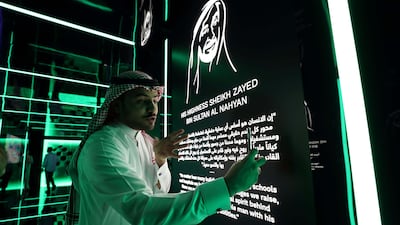
An official at the launch of Mohamed bin Zayed University of Artificial intelligence in Masdar City, Abu Dhabi. AI is central to the UAE's economic growth agenda. Chris Whiteoak / The National -
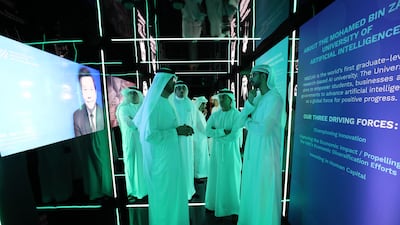
From left, Dr Sultan Al Jaber, Dr Ahmad Al Falasi and Omar Al Olama at the launch of the university. Chris Whiteoak / The National -

The university has teamed up with IBM to open a research centre at its Masdar City campus. Chris Whiteoak / The National -
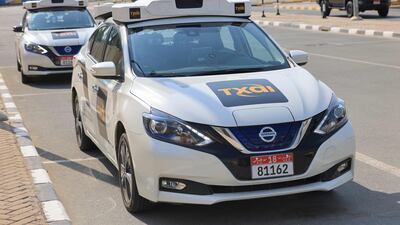
Self-driving taxis in Abu Dhabi. The UAE intends to become one of the leading AI nations by 2031. AFP -
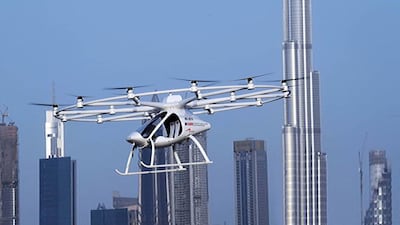
MBZUAI has developed a curriculum and programmes that support academic research to contribute to tackling real-world challenges. AFP -

A robot outside the Dutch pavilion at the Expo 2020 Dubai. New districts are being built in the UAE, with artificial intelligence at their core. AFP -

Ajman's first self-driving bus goes on its first official drive with Sheikh Rashid bin Humaid, director of the Ajman Municipality and Planning Department, and Mr Al Olama onboard. -
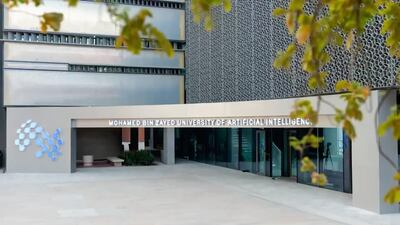
MBZUAI is the only graduate-level university in the world singularly focused on developing AI tools. Photo: MBZUAI -

Through the IBM Skills Academy programme, MBZUAI will have access to lectures, labs, industry use cases and design-thinking sessions. Photo: MBZUAI -
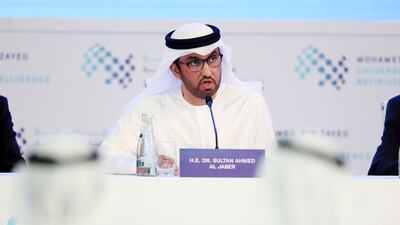
Dr Al Jaber, Minister of Industry and Advanced Technology and chairman of the MBZUAI board of trustees, has in the past emphasised the UAE's plans to use AI as a transformative tool to support its development. Chris Whiteoak / The National -

MBZUAI offers an executive programme to equip UAE government and business leaders with practical skills to tap into the benefits of cutting-edge technology. AFP



