


The electric car market is surging during the concerted global drive to cut emissions on the road to a net-zero future.
Sales of electric vehicles rose by 60 per cent last year, exceeding the 10 million mark for the first time, World Economic Forum figures show.
As recently as 2017, electric vehicles accounted for only one in every 70 new passenger cars sold, yet by 2022 they made up one in seven such sales.
The rise of the electric vehicle shows no sign of slowing, but could its popularity prove problematic for the environment?
A challenge created by the shift to electric is how to deal with the spent batteries that power EVs. Estimates suggest that millions of tonnes of batteries will come to the end of their life in the 2020s alone.
When the approximately 10-year lifespan of a battery is up, ideally it will then be used for stationary energy storage, such as in homes or as backup to improve the stability of electricity grids, before eventually being recycled.
Sending batteries to landfill would be wasteful and environmentally harmful, while the mining of some materials is associated with environmental and human rights concerns, making recycling to allow reuse especially important.
Putting plans in place
In December, in a move that may be replicated elsewhere, the EU passed legislation requiring car makers to recycle spent batteries and recover a minimum proportion of the materials.
Many university research groups and start-up companies are developing better ways to extract these valuable substances to allow reuse in new batteries.

Among them is Watercycle Technologies, which was founded in 2020 and spun out of the University of Manchester in the UK.
According to Dr Sebastian Leaper, its chief executive, without effective recycling of the materials, the sector would “just become beholden to natural resource availability”.
“What sustainability, what net zero represents in a way is liberation from the shackles of resource scarcity, which is what fossil fuel economies are based on,” says Dr Leaper, who is from the UK.
“You need to have a circular economy in which all of these metals are recycled for it to be sustainable.”
Compared with many other materials, metals are ideal for recycling because, in theory, they can be recycled infinitely. Paper, by contrast, can be recycled only about seven times, because the fibres shorten and weaken.
Yet extracting and purifying the metals in EV batteries is not easy, because often the cells have to be shredded, creating a substance called black mass, a mixture of elements such as graphite, nickel, manganese, cobalt and lithium.
Often, black mass is used primarily for the extraction of nickel and cobalt, both high-value metals.
Lithium is central to the functioning of lithium-ion batteries and so as demand for batteries has increased, so has the price, which quadrupled in 2021. In line with this, Dr Leaper says, recycling technology has shifted more towards extracting lithium too.
Watercycle Technologies has worked to take things a step further by, as well as extracting commercial grade lithium carbonate from spent batteries, additionally extracting pure graphite, which can also be reused.
Electric cars – in pictures
-

A Tesla owner charges his vehicle at a charging station. AP Photo -
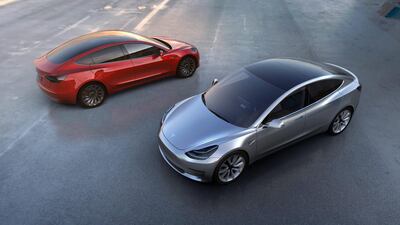
The Tesla Model 3 is one of the most popular used electric vehicles to buy in the UAE. Photo: EPA -

There are four Tesla charging stations located at Masdar Park in Abu Dhabi. Victor Besa / The National -
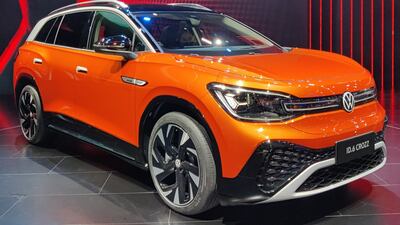
The Volkswagen ID6. Photo: Wikipedia -
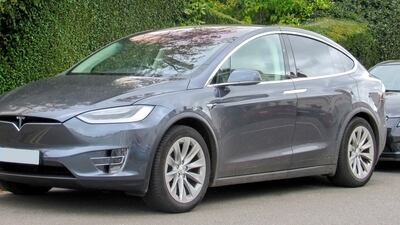
The Tesla Model X is one of the most sought after electric cars on Dubizzle. Photo: Wikimedia commons -
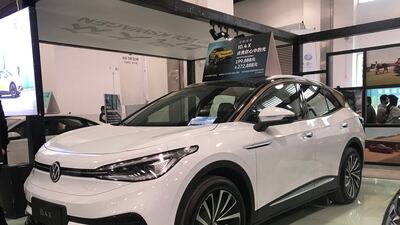
The Volkswagen ID4 is one of the most popular electric cars for people to search for on Dubizzle. Photo: Wikipedia


A form of carbon, graphite is of much lower value than lithium, but is used in much larger quantities, being the largest single constituent of some EV batteries, so the value of the two substances per battery is almost the same.
The company has developed its technology in partnership with a firm called RSBruce in Sheffield, to the east of Manchester.
There are various approaches to extracting the substances in spent EV batteries. One, called pyrometallurgical, makes use of the methods of pyrometallurgy, where materials are heated to extreme temperatures, allowing them to be separated because they have different melting points.
In keeping with its name, Watercycle Technologies, however, takes a hydrometallurgical approach, in which water and various reagents separate the components chemically. Unlike some other methods, the technology is said to not produce contaminated wastewater.
The company says that its method can be used with batteries based on various types of chemistry. Some are lithium-nickel-manganese-cobalt-oxide batteries, abbreviated as NMC. Another key type of battery is lithium-iron-phosphate or LFP (the F comes from iron’s chemical symbol of Fe), which have lower power density but are cheaper.
“NMC in terms of performance is still superior, but LFP is growing quickly, particularly in China. You have slightly less mileage in your car but they last longer and they’re cheaper to produce,” Dr Leaper says.
Watercycle Technologies says that its technology is applicable to a wide range of battery types.
“Having mixtures is enabling recyclers to collect batteries from different places and not have to worry too much about separation upstream. We would use a similar technique for treating those different batteries,” Dr Leaper says.
Recycling processes for lead-acid batteries of the kind typically used in petrol or diesel vehicles can recover about 98 per cent of the materials. For EV batteries, recycling rates for the lithium are about 70 per cent, so substantial improvement may be possible.
“We believe the recovery rate of lithium will be much higher than 70 per cent,” says Dr Ahmed Abdelkarim, Watercycle Technologies’ chief technology officer, who is from Egypt.
Keeping recycling in mind
According to Prof Karl Ryder, from the University of Leicester in the UK, there is an increasing trend for car batteries to be designed for recycling. He and his colleagues are involved in work to make it easier to extract the materials.
Some ways, he says, involve disassembling the cells rather than shredding them to produce black mass.
“It’s more technologically elegant and in the long run more economically sustainable to try to separate the valuable materials at source rather than shred them up,” he says.
“The clever way to try to design so you have a disassembly process that allows you to recover component materials.”
This may involve creating adhesives, for example, that allow for easy disassembly. Such considerations reflect a wider trend in the automotive industry, driven by legislation, of making vehicles as a whole more recyclable.
Streamlining recycling processes can be complicated by the way that batteries vary from one car company to the next.
“Every manufacturer has a different shape, which makes it hard to design a generic process,” he says. "[Also] a lot of materials have been developed and optimised without thinking about how they will be recovered.”
Meanwhile, at a time when the number of spent EV batteries is poised to increase, Watercycle Technologies is looking to commercialise its technology, possibly through a partnership with a major vehicle manufacturer, which could see the company create a battery recycling plant.
The firm’s process has, Dr Leaper says, been shown to work when kilograms of material are being processed per day, but needs to be ramped up.
“The process is fundamentally scalable … but we need to get to the pilot stage to do this over a long period of time at the tonnes-per-day scale to then validate the technology and test the materials that are produced – the quality of the graphite and lithium, etc,” he says.
“If that version is commercially viable, it could be a matter of months to go from there to a commercial-scale system.”

