


Throughout the years he spent meeting victims of the Troubles in Northern Ireland, Bertie Ahern’s determination to put an end to the decades-old violence blighting the region intensified.
The prime minister, or taoiseach, of the Republic of Ireland at the time, saw his efforts culminate in the signing of the Good Friday Agreement at Stormont on April 10, 1998.
It halted the conflict that had for generations raged between the minority-Roman Catholic Irish nationalists and the majority-Protestant unionists. While both sides still hold opposing views – nationalists seek a reunification of Northern Ireland with the Republic, while unionists favour remaining part of the UK – peace between the two groups largely prevails.
As he prepares to mark the 25th anniversary of the breakthrough deal, of which he was a co-signatory, Mr Ahern, 71, told The National the victims of Northern Ireland’s darkest and deadliest days will be front and centre on his mind.
Speaking from Dublin, he reflected on what was achieved in the historic treaty, his regret that such a deal could not have come sooner, and the new risks posed to the hard-won peace.
Tony Blair famously said he could “feel the hand of history upon our shoulder” in the run-up to the agreement.
Mo Mowlam, who was Northern Ireland secretary at the time, said by working together people can “overcome many obstacles, often within themselves” and bring about a better world.
US Senator George Mitchell, who chaired the talks, said the landmark accord was testament to the “courage, vision and strength” of politicians on both sides.
After the accord had been signed, Mr Ahern told the world's media it signified “the promise of a bright future” for Northern Ireland's long-suffering and historically divided communities.
Building trust with Tony Blair

As the Irish leader, the strength of Mr Ahern’s relationship with the British prime minister was a crucial factor in determining the success of any peace talks. In the years before coming into office in 1997, both men began laying the groundwork while leaders of their respective parliament’s oppositions by holding talks. These meetings would set the stage for what later became a famously close working relationship.
“Tony Blair, to me, was a great colleague to work with,” Mr Ahern said. “We built up a great friendship, great relationship, great trust, we worked together as a team, brought a lot of confidence into the negotiations.”
The two men and their teams knuckled down to months-long complex negotiations, meeting regularly for talks at No 10 Downing Street, Chequers, Hillsborough Castle and Castle Buildings in Northern Ireland.
The task facing them was monumental: stop the bombings and usher in a new era of peace in a region blighted by decades of sectarian tensions, violence and terrorism.
Mr Ahern recalled how relations between Northern Ireland’s pro-union and nationalist politicians were at rock bottom.
“There was very little trust in those days in Northern Ireland between politicians,” he recalled. “A big part of the job was trying to get people to trust and be confident to negotiate and get a sense of good spirit around the talks. That wasn’t easy. It wasn’t easy to get it going and it wasn’t easy to keep it going. But thankfully we did it to the best of our ability.”
The former Fianna Fail leader, who served as taoiseach from 1997 to 2008, identified two key reasons why the lengthy negotiations produced an Anglo-Irish peace deal – they were inclusive of all sides and comprehensive in nature.
The US-brokered Belfast Agreement, also known as the Good Friday Agreement, led to the establishment of a system of devolved government in Northern Ireland and the creation of several new institutions, including the NI Assembly and Executive. Northern Irish political leaders agreed to put the past behind them and work together for the good of their communities – a prospect unimaginable just a few years before the deal came about.
While the immediate effects of the deal were confined to the region, the UK and the Republic of Ireland, where the violence had spilled over, also benefited. The treaty encompassed areas such as demilitarisation of the border and the establishment of a non-partisan police force, the early release of paramilitary prisoners.
Asked if he had imagined such a deal would be possible in the years before its signing, Mr Ahern said: “No, because there had been 25 years of Troubles and that had been on the back of decades [of violence] before that, all the way back to 1920 when there was very little stability.”
“There were a lot of difficult times,” he added. “It was hard to bring an end to it.”
The agreement was signed by Mr Ahern, Mr Blair, Ms Mowlam and the Irish foreign minister, David Andrews.
The enormity of such an achievement reverberated around the world and was touted as a lesson for others. The sight of Catholics and Protestants in Northern Ireland agreeing to work together for a shared future on the back of decades of hatred and bloodshed offered hope to people caught up in sectarian fighting in distant lands.
'Deal celebrated around the world'
Mr Ahern remembers being inundated with calls from dignitaries offering their congratulations and applause.
“I remember receiving calls from, obviously, President [Bill] Clinton and [UN secretary general] Kofi Annan and messages from all my European colleagues that I was working with at the time,” he said. “I think there was a great sense of relief that the main issue was to try and bring an end to the violence, to stop the killing, and the bloodshed, and the bombings, and the shootings, and the damage that was being done to society."
Keen to emphasise the “peace process” at the centre of the agreement, the former Irish leader expressed regret over the collapse of power-sharing in Northern Ireland. The Assembly has been suspended since February 2022 when the Democratic Unionist Party (DUP) resigned in protest over post-Brexit arrangements. There are also fears of a resurgence of sectarian violence after an off-duty policeman was left fighting for his life after a shooting in February, for which the New IRA claimed responsibility.
It is “not desirable or acceptable to the people of Northern Ireland that we have this stop-start process of the institution”, Mr Ahern said, as he called for the formation of a devolved government to end the deadlock.
Drawing on his own experience in negotiating with politicians with opposing views and compromising on key areas, he said work has to continue even after a breakthrough is reached.
He voiced hope that the Windsor Framework, agreed by the UK and the EU, would be embraced by Northern Irish politicians and help the region’s post-Brexit economy “catch up from ground that was lost from decades of the Troubles”. He said he hoped the DUP would eventually come around and back the deal.

Although there had been discord between republicans and unionists since the creation of Northern Ireland in 1921, it was from the late 1960s that the worst violence raged. From then until 1998 the Troubles resulted in 3,532 people losing their lives, while more than 47,000 were injured.
Today, a new generation of Northern Irish people have grown up in an era their ancestors could only have dreamed of.
These days Mr Ahern keeps a foot in the political world, and has recently been tipped as a possible candidate in the next Irish presidential election in 2025.
During a speech at University College Dublin this week, Mr Ahern said “it pains us all” to see Northern Ireland’s institutions out of action, but expressed hope of a restoration of power-sharing in the coming months.
He and his former colleagues, including Mr Blair, will be joined by US President Joe Biden at a ceremony in Belfast next week to commemorate the Good Friday Agreement, a quarter of a century on.
While celebrations will be on the cards, Mr Ahern said it will be a poignant day for him because the victims of the Troubles will bear heavily on his conscience.
“I particularly think of all the people who died, unfortunately [because] we couldn’t have had solutions earlier," he said. “And secondly, to think of all those that are alive because we did succeed.
"But I always think that the victims of the Troubles, the families who are still around who lost loved ones during the Troubles. It’s hard for them. They’ve had to see everything move on but they’ve had to suffer a lot. Because I meet so many of the victims’ groups ... you always think of those on the special days because it is hard for them and it’s very emotional for them.”
Good Friday Agreement - in pictures
-

Former British prime minister Tony Blair and former Taoiseach Bertie Ahern sign the Good Friday agreement on April 10, 1998. This year marks 25 years since the signing of the historic agreement. PA -
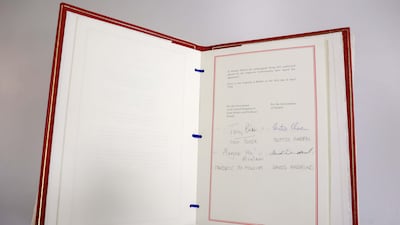
The original Good Friday agreement. PA -
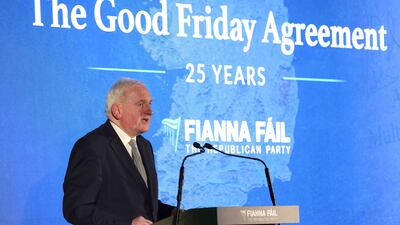
Mr Ahern speaking at University College Dublin at an event organised by the Fianna Fail party to commemorate the 25th anniversary of the Good Friday Agreement in Dublin. PA -
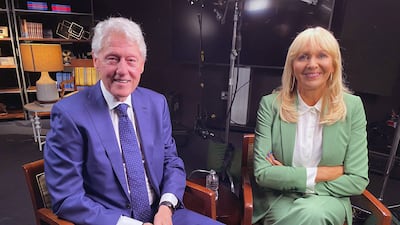
RTE television presenter Miriam O'Callaghan with former US president Bill Clinton, who appeared on Prime Time in April to mark 25 years of the agreement. PA -
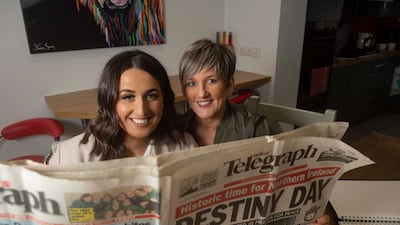
Erin McArdle, left, who was born on April 10, 1998, and her mother Caroline, hold The Telegraph which was published on the same day, at her home in Ballymena in Northern Ireland. EPA -
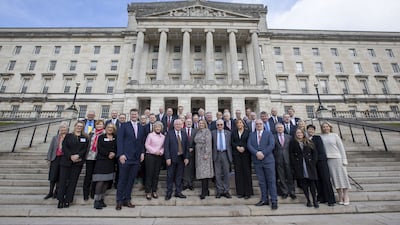
Attendees of the 63rd Plenary of the British-Irish Parliamentary Assembly pose together in March on the steps of Parliament Buildings in Stormont in Belfast, to mark the 25th anniversary of the agreement. PA -
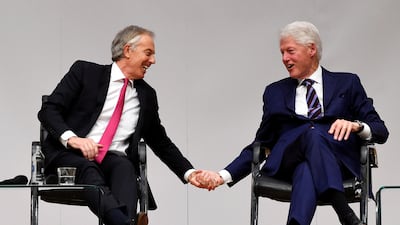
Mr Blair and Mr Clinton hold hands an event to celebrate the 20th anniversary of the Good Friday Agreement in Belfast, Northern Ireland, on April 10, 2018. Reuters -
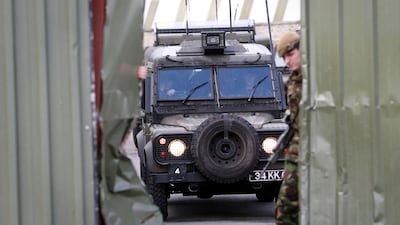
British army soldiers from 2nd Battalion, The Prince of Wales Royal Regiment, leave Bessbrook British army base for the last time in South Armagh in Northern Ireland, on June 25, 2007. AP -

Mr Blair, former US Senator George Mitchell and Mr Ahern, at Downing Street, London, to announce a review of the Northern Ireland peace process in July 1999. PA -
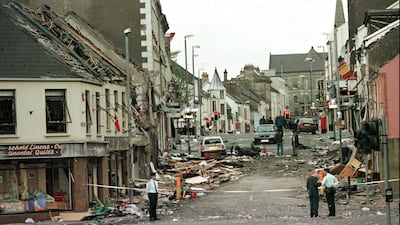
Royal Ulster Constabulary Police officers stand on Market Street after a car bombing in the centre of Omagh in Northern Ireland, in August 1998. AP -
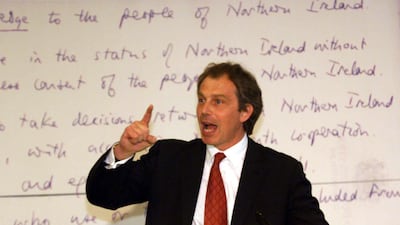
Mr Blair argues his case for the Yes vote in the peace referendum at the University of Ulster in Northern Ireland in May 1998. PA -
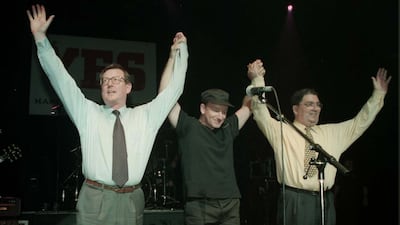
Ulster Unionist leader David Trimble, U2 singer Bono, and SDLP leader John Hume on stage for the 'YES' concert at the Waterfront Hall in Belfast in May 1998. PA -
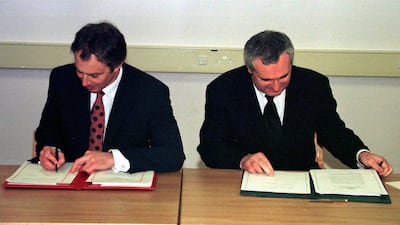
Mr Blair and Mr Ahern sign the Good Friday Agreement on April 10, 1998. PA -

Mr Blair, former US senator George Mitchell, and Mr Ahern pose after signing the agreement. AP -
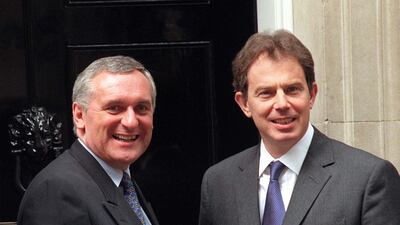
Mr Blair greets Mr Ahern at Downing Street, London, in July 1997. PA -
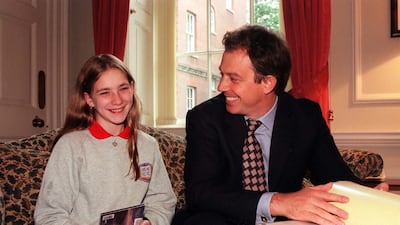
Mr Blair and a Belfast schoolgirl, Margaret Gibney, inside 10 Downing Street in June 1997. Ms Gibney had become popular around the world after she asked Mr Blair to bring peace to Northern Ireland. PA -
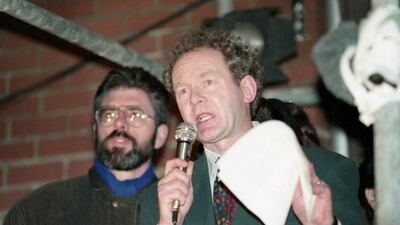
The Sinn Fein's deputy leader, Martin McGuinness, and leader Gerry Adams at a rally in Belfast in December 1994. AP -
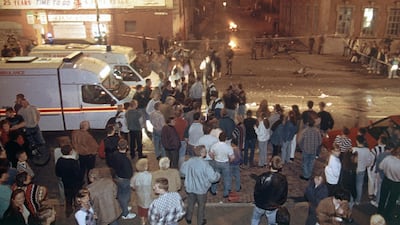
People gather at the scene of a car bomb explosion outside the Sinn Fein headquarters in West Belfast in Northern Ireland in September 1994. AP -
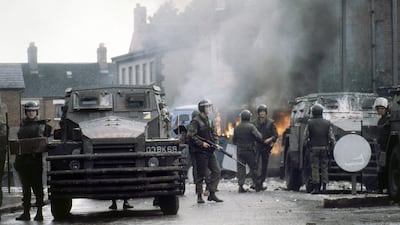
British troops with armoured vehicles surround a blazing barricade near the Andersonstown Police Station in Belfast in 1979. AP -
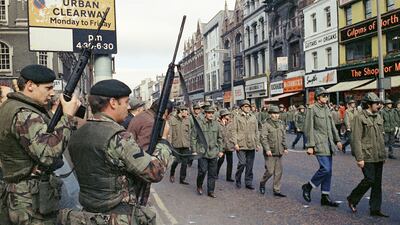
British troops look on as members of the Ulster Defence Association march through Belfast in 1972. AP



