


The Wilcock family were relaxing at home when they heard a thud outside. A “bump in the night” is how they describe it.
They could not see anything in the dark at the time.
But the next morning they found it — a “kind of splatter”, which looked like coal had been dumped on their drive in Winchcombe, Gloucestershire.
Unbeknown to Rob, Cathryn and daughter Hannah, who were at home together that day, the pile of “soot” on the driveway was a meteorite.
But the Winchcombe meteorite, as it is now known, having been named after their village, turned out to be one of the rarest examples of its type yet discovered.
Having documented its arrival, the family quickly raised the alarm ― leading to years of research into the building blocks of life.
The fall
Meteorites had been predicted in the area and planned media coverage meant they began to suspect it could be linked to reports of a fireball over the UK that was predicted to land in the area.
Putting two and two together, the family were then able to send their images to scientists hoping for a stroke of luck.
The meteorite fell to Earth through clear skies on February 28, 2021, and lay out in the elements for only 12 hours before it was collected by CSI-style scientists who turned up to scour their garden with tweezers, looking for fragments. The total known mass of recovered fragments was 602g.

Among the scientists scrambled to analyse it was Queenie Chan, a lecturer in Earth Sciences at the Department of Earth Sciences at Royal Holloway, University of London.
She recently published some of her findings in the journal Meteoritics & Planetary Science.
“It was just about the same time when I was pregnant, so it was exciting,” Dr Chan told The National.
“I managed to complete the analysis before I went on maternity leave. This is part of the many reasons why we didn't publish the paper sooner ― writing with a newborn baby [her second child] around wasn't so easy.”
'We dropped everything'
Her team dropped everything to focus on the space rock at the time ― and for good reason.
“It was obvious early on that it was rare. It looked dark and crumbly, like a carbon-rich meteorite.”
Most meteorites are made from ordinary chondrite, the material that makes up much of the inner solar system, within the asteroid belt.
But analysis showed this was a carbonaceous type made from something farther away ― potentially giving scientists a glimpse into the birth of the universe.
The material in carbonaceous meteorites is more volatile, with more water potential and more organic material.
“This chondritic type of meteorite has not melted since they were formed,” Dr Chan said.
“So they retain the original composition, the signature, the texture, everything, at the birth of this meteorite.
“So this asteroid, when it was formed, was like that. So unlike planet Earth or Jupiter or any larger solar system bodies that have melted in the past.
“Any signature of the early solar system was lost during that planetary formation. But not so for the chondritic type of meteorite.”
To say it was exciting was an understatement.
Rarer than rare
Meteorites made of carbonaceous chondrite are already rare. And the specific type of this one, known as CM chondrite, is even more rare.
“And then CM chondrite associated with a fall event is even rarer,” said Dr Chan, 37.
Only a handful of “fall meteorites” occur each year.
“This is one of the most rare types of meteorite. One of the cleanest meteorites we could ever study,” she said.
“The skies were clear that night and there was no rain, which means less contamination.
“So we eliminate a lot of issues with some other meteorites that have been collected 10,000 years after they landed. They are called 'find meteorites'. Because you find them. You don’t know when they fell.”
Find meteorites are actually fairly common. A 7.8kg specimen the size of a cantaloupe was recently found in Antarctica, where most are discovered because they stand out against the white snow.
Researchers discover meteorite in Antarctica — in pictures
-

A team of researchers have discovered a rare meteorite in Antarctica that weighs 7.6kg. All photos: Maria Valdes -

Space rocks are often found in the parts of the icy continent but mostly ones that are very small. Only about 100 of the 45,000 meteorites retrieved from Antarctica over the past century have been large-sized -
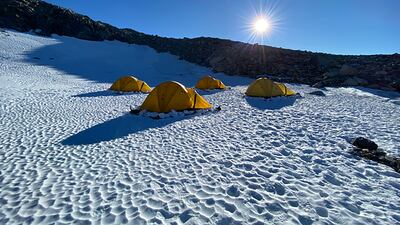
The team endured freezing temperatures of -10°C and spent days riding snowmobiles, trekking through ice fields and sleeping in tents. -

It is estimated that 300,000 meteorites are scattered on the icy landscape covering 14 million square kilometres and are waiting to be found. -

Nasa said scientists have been trying to find the rocks using the ‘meteorite stranding zones’ – areas where the local geology, flow of the ice and climate conditions have caused meteorites to accumulate at the surface.


Some estimates suggest there are 300,000 space rocks waiting to be collected there.
Scientists say studying meteorites is important, because they can provide clues about how life started on Earth.
“This meteorite arrived two years ago, but billions of years ago Earth was heavily bombarded by meteorite impacts or asteroid impacts,” Dr Chan said.

“The molecules that it provided the early Earth caused further chemical reaction to occur. So we then formed life here from these asteroids.”
They may be found in abundance in Antarctica, but far fewer are discovered in the UK.
The meteorite that fell in Winchcombe was the first found in the UK for more than 30 years — and the first carbonaceous chondrite meteorite in the country.

The team spent months cleaning their lab, making sure it was spotless and free of potential contaminants ahead of their analysis.
And by the summer they were ready to inspect it, crushing it down to analyse the meteorite, which is believed to have originated on the surface of an asteroid near Jupiter.
The research
They chose first to focus on amino acids, molecules that combine to form proteins that are one of the known building blocks of life.
The ones present in it needed water to form, which suggested the meteorite was probably formed during a liquid-rich phase.
“So 4.5 billion years ago there was liquid water on that asteroid to form amino acids,” Dr Chan said.
But there were fewer amino acids than expected — 10 times less than other meteorites of its type.
“It was very interesting. We gave a hypothesis to that, which is [the asteroid] contained liquid water but possibly it occurred in smaller episodes.
“It doesn’t occur for a long period of time.”
They do not yet know why.
The team plans to look at another type of organic compound next, known as polycyclic aromatic hydrocarbons — PAHs — one of the more abundant types of organic molecule found in meteorites.
“We will probably be studying this for at least five or six years. There are so many different types of organic molecules we can look at.”
The find also had a major effect on the Wilcocks, who have enjoyed becoming part of a science project. They even set up their own website documenting their discovery.
On it, Mrs Wilcock writes: “Collecting a shattered meteorite on your drive continues to be hard to believe, awe-inspiring, mind-blowing, whatever superlatives you choose to use — truly Out of this World.
“No words can really match the magnitude of a meteorite with stones from outer space that are 4.567 billions years old and from as far away as the asteroid belt between Jupiter and Mars. Bumps in the night don't come more extraterrestrial than that.”

