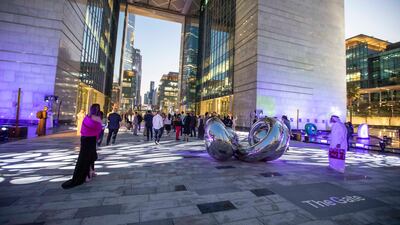
Since opening in 2004, Dubai International Financial Centre has grown into one of the world's foremost financial centres. This is the centre's first building, The Gate, in 2008. Philip Cheung / The National
Since opening in 2004, Dubai International Financial Centre has grown into one of the world's foremost financial centres. This is the centre's first building, The Gate, in 2008. Philip Cheung / The Na

Timeframe: 18 years of DIFC, a symbol of Dubai's ability to bring dreams to life


Hareth Al Bustani
  • English
  • Arabic

On September 18, 2004, Dubai’s international financial free zone, the Dubai International Financial Centre (DIFC), opened for the first time.

The next year, Sheikh Mohammed bin Rashid, Vice President and Ruler of Dubai, said: "Dubai and the UAE have moved into the more sophisticated world of high finance. And I am pleased to learn that in only one year of operation, the Dubai International Financial Centre has surpassed all expectations."

He also said: “We are a living proof that when human beings have the courage and commitment to transform a dream into reality — there is nothing that can stop them."

In its first year, DIFC had hoped to attract 15 companies, but instead managed to bring in more than 100. It has since attracted more than 4,000 companies, growing into the largest financial centre in the Middle East and Africa, and the 19th biggest in the world, according to the Global Financial Centres Index ranking published last year.

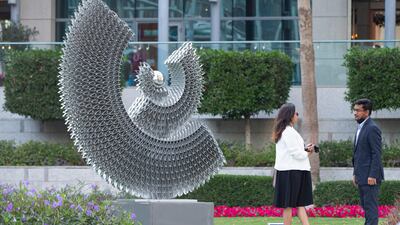
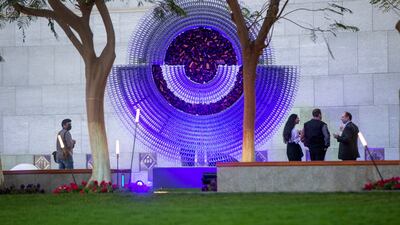
This year, DIFC devoted an area to a sculpture park to commemorate the UAE's 50th year. This is 'Alphabet of Life' by artist Azza Alqubaisi. Ruel Pableo for The National

Today, DIFC is the world’s best-performing free zone in attracting foreign direct investment (FDI) projects in the financial services. Last year, a report from the Dubai Investment Development Agency said that its success helped propel Dubai to the top international spot for attracting FDI — performing better than other major hubs such as London, Singapore, New York and Paris.

Looking ahead, DIFC is setting up the world’s first global centre for ultra-wealthy and family businesses, in a bid to double its contribution to Dubai’s economy by 2030. The centre is expected to bring family businesses and ultra-high net worth individuals — people with a net wealth of $30 million or more — to the emirate from other regional and global markets.

It has also called for financial centres around the world to become more green, digital, inclusive and collaborative by 2030.

But DIFC is more than simply a financial centre. Nestled within its striking architectural landmarks is a dynamic array of art galleries, five-star hotels, coffee shops, high-end boutiques and restaurants — centred on the downtown destination, Gate Village.

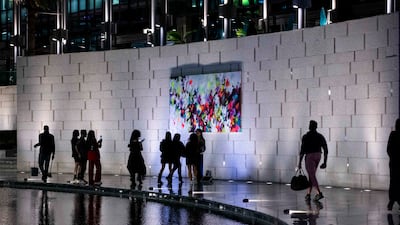
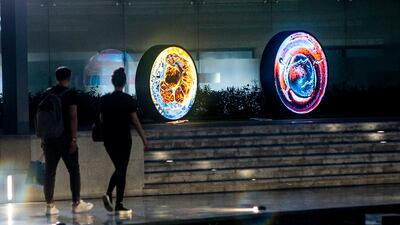
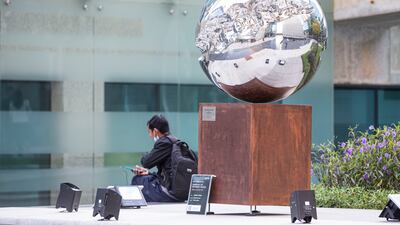
Earlier this year, DIFC transformed the area around the landmark Gate Building into a sculpture park, to commemorate the UAE's Golden Jubilee. The open-air gallery featured 50 sculptures, as well as paintings by established local and international artists.

As the centre continues to add to its allure with projects such as the sprawling Gate Avenue, DIFC looks set to continue propelling the growth of Dubai's economy, and cultural landscape, for years to come.

Scroll through more images of the DIFC sculpture park below

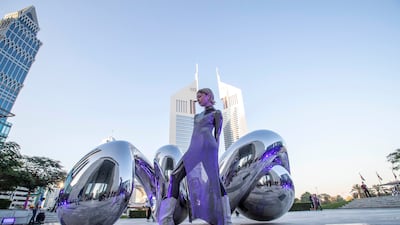
  • A sculpture park has been unveiled at Dubai International Financial Centre, transforming the area around the landmark Gate Building into an open-air gallery. In the foreground is 'Rainbow Baby' by artist Ayla Turan. All photos: Ruel Pableo for The National
    A sculpture park has been unveiled at Dubai International Financial Centre, transforming the area around the landmark Gate Building into an open-air gallery. In the foreground is 'Rainbow Baby' by artist Ayla Turan. All photos: Ruel Pableo for The National
  • The sculpture park is a tribute to the UAE's 50th Golden Jubilee.
    The sculpture park is a tribute to the UAE's 50th Golden Jubilee.
  • 'Alphabet of Life' by Azza Al Qubaisi.
    'Alphabet of Life' by Azza Al Qubaisi.
  • 'Irene' by Ana D'Castro.
    'Irene' by Ana D'Castro.
  • The DIFC sculpture park is curated under the theme Harmony of Different Voices and features 50 sculptures as well as several paintings.
    The DIFC sculpture park is curated under the theme Harmony of Different Voices and features 50 sculptures as well as several paintings.
  • 'Unwind' by Richard Hudson.
    'Unwind' by Richard Hudson.
  • 'Sculpture II' by Mert Ege Kose.
    'Sculpture II' by Mert Ege Kose.
  • 'Sculpture I' by Mert Ege Kose.
    'Sculpture I' by Mert Ege Kose.
  • 'Rainbow Baby' by Ayla Turan.
    'Rainbow Baby' by Ayla Turan.
  • 'Lightbox l' and 'll' by Emre Namyeter.
    'Lightbox l' and 'll' by Emre Namyeter.
  • 'Forms' by Mia Fonssagrives Solow.
    'Forms' by Mia Fonssagrives Solow.
  • 'Eclisse d’Acciaio' by Helidon Xhixha.
    'Eclisse d’Acciaio' by Helidon Xhixha.
  • Another view of 'Sculpture II' by Mert Ege Kose.
    Another view of 'Sculpture II' by Mert Ege Kose.

Mercer, the investment consulting arm of US services company Marsh & McLennan, expects its wealth division to at least double its assets under management (AUM) in the Middle East as wealth in the region continues to grow despite economic headwinds, a company official said.

Mercer Wealth, which globally has $160 billion in AUM, plans to boost its AUM in the region to $2-$3bn in the next 2-3 years from the present $1bn, said Yasir AbuShaban, a Dubai-based principal with Mercer Wealth.

Within the next two to three years, we are looking at reaching $2 to $3 billion as a conservative estimate and we do see an opportunity to do so,” said Mr AbuShaban.

Mercer does not directly make investments, but allocates clients’ money they have discretion to, to professional asset managers. They also provide advice to clients.

“We have buying power. We can negotiate on their (client’s) behalf with asset managers to provide them lower fees than they otherwise would have to get on their own,” he added.

Mercer Wealth’s clients include sovereign wealth funds, family offices, and insurance companies among others.

From its office in Dubai, Mercer also looks after Africa, India and Turkey, where they also see opportunity for growth.

Wealth creation in Middle East and Africa (MEA) grew 8.5 per cent to $8.1 trillion last year from $7.5tn in 2015, higher than last year’s global average of 6 per cent and the second-highest growth in a region after Asia-Pacific which grew 9.9 per cent, according to consultancy Boston Consulting Group (BCG). In the region, where wealth grew just 1.9 per cent in 2015 compared with 2014, a pickup in oil prices has helped in wealth generation.

BCG is forecasting MEA wealth will rise to $12tn by 2021, growing at an annual average of 8 per cent.

Drivers of wealth generation in the region will be split evenly between new wealth creation and growth of performance of existing assets, according to BCG.

Another general trend in the region is clients’ looking for a comprehensive approach to investing, according to Mr AbuShaban.

“Institutional investors or some of the families are seeing a slowdown in the available capital they have to invest and in that sense they are looking at optimizing the way they manage their portfolios and making sure they are not investing haphazardly and different parts of their investment are working together,” said Mr AbuShaban.

Some clients also have a higher appetite for risk, given the low interest-rate environment that does not provide enough yield for some institutional investors. These clients are keen to invest in illiquid assets, such as private equity and infrastructure.

“What we have seen is a desire for higher returns in what has been a low-return environment specifically in various fixed income or bonds,” he said.

“In this environment, we have seen a de facto increase in the risk that clients are taking in things like illiquid investments, private equity investments, infrastructure and private debt, those kind of investments were higher illiquidity results in incrementally higher returns.”

The Abu Dhabi Investment Authority, one of the largest sovereign wealth funds, said in its 2016 report that has gradually increased its exposure in direct private equity and private credit transactions, mainly in Asian markets and especially in China and India. The authority’s private equity department focused on structured equities owing to “their defensive characteristics.”

Islamophobia definition

A widely accepted definition was made by the All Party Parliamentary Group on British Muslims in 2019: “Islamophobia is rooted in racism and is a type of racism that targets expressions of Muslimness or perceived Muslimness.” It further defines it as “inciting hatred or violence against Muslims”.

Pupils in Abu Dhabi are learning the importance of being active, eating well and leading a healthy lifestyle now and throughout adulthood, thanks to a newly launched programme 'Healthy Lifestyle'.

As part of the Healthy Lifestyle programme, specially trained coaches from City Football Schools, along with Healthpoint physicians have visited schools throughout Abu Dhabi to give fun and interactive lessons on working out regularly, making the right food choices, getting enough sleep and staying hydrated, just like their favourite footballers.

Organised by Manchester City FC and Healthpoint, Manchester City FC’s regional healthcare partner and part of Mubadala’s healthcare network, the ‘Healthy Lifestyle’ programme will visit 15 schools, meeting around 1,000 youngsters over the next five months.

Designed to give pupils all the information they need to improve their diet and fitness habits at home, at school and as they grow up, coaches from City Football Schools will work alongside teachers to lead the youngsters through a series of fun, creative and educational classes as well as activities, including playing football and other games.

Dr Mai Ahmed Al Jaber, head of public health at Healthpoint, said: “The programme has different aspects - diet, exercise, sleep and mental well-being. By having a focus on each of those and delivering information in a way that children can absorb easily it can help to address childhood obesity."

The specs

Engine: 2.0-litre four-cylinder turbo

Power: 268hp at 5,600rpm

Torque: 380Nm at 4,800rpm

Transmission: CVT auto

Fuel consumption: 9.5L/100km

On sale: now

Price: from Dh195,000 

Copa del Rey final

Sevilla v Barcelona, Saturday, 11.30pm (UAE), match on Bein Sports

Formula One top 10 drivers' standings after Japan

1. Lewis Hamilton, Mercedes 306
2. Sebastian Vettel, Ferrari 247
3. Valtteri Bottas, Mercedes 234
4. Daniel Ricciardo, Red Bull 192
5. Kimi Raikkonen, Ferrari 148
6. Max Verstappen, Red Bull 111
7. Sergio Perez, Force India 82
8. Esteban Ocon, Force India 65
9. Carlos Sainz Jr, Toro Rosso 48
10. Nico Hulkenberg, Renault 34

Updated: September 17, 2022, 9:22 AM