

It took 46 sessions and 29 months for Lebanon’s parliament to finally elect President Michel Aoun in 2016, ending a stalemate that laid bare the deep and numerous divisions in Lebanese politics.
The term of the octogenarian former army chief will end in October 2022. Even with a new parliament in place after elections this month, it sets the scene for another potentially protracted wait over selecting Lebanon’s next head of state.
In Lebanon’s confessional political scene, by convention, the president is always a Maronite Christian. It may narrow down the candidates, but competition is tough for the top Christian job.
“It's not easy to pick the president. You won't have the ideal person you want,” said Samy Gemayel, the leader of the Christian Kataeb party, pointing to the difficulties of obtaining a majority in a deeply fragmented political system. His father Amine served as president from 1982 to 1988 after his uncle Bachir Gemayel was elected president but assassinated in a bombing in 1982 before taking office.
“You would have to find someone that is moderate and that is capable of talking to everyone and finding solutions to the problems,” said Mr Gemayel, a strong critic of Hezbollah, the militant group and political party.
Since 2019, Lebanon has suffered a devastating economic collapse and the local currency has depreciated by more than 90 per cent. Much of the population has been plunged into poverty, and there are widespread shortages in medicine, electricity and other basic supplies.
Along with the huge reforms needed to tackle this crisis, the task of electing the next president falls to Lebanon’s new parliament after nationwide elections on May 15.
Iran-backed Hezbollah and its allies — including the Free Patriotic Movement party that Mr Aoun founded — lost their parliamentary majority, while opponents gained ground. It also ushered in 13 anti-establishment MPs, many linked to the October 2019 nationwide protests against the incumbent political parties.
If anything, those elections only hardened the divisions in the legislature which faces the more immediate tasks of electing its speaker and forming a government.
“This election result has produced the perfect scenario for a prolonged governance stalemate, shedding doubt as to whether the newly elected parliament can form a government or elect a president,” said Imad Salamey, a political analyst and professor at the Lebanese American University.
“It is deeply divided and fragmented, with a large number of anti-system parliamentarians who will have a difficult time reaching consensus with traditional parties. This will only deepen the crisis of the confessional regime and turn the prospect of electing a new president highly unlikely.”
-
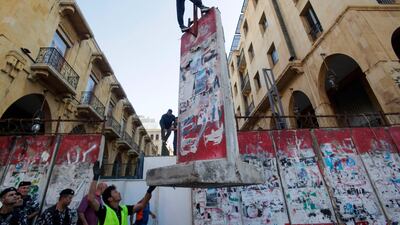
Workers remove sections of the concrete barrier, which was erected by Lebanese security forces in 2020 to bar access to streets leading to the country's parliament building, at the entrance of the Lebanese Parliament in the capital Beirut. AFP -
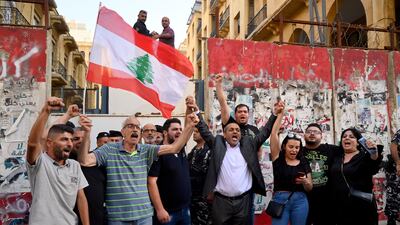
Lebanese authorities have ordered that the concrete barriers that have blocked access to the Parliament building since 2019 be removed. EPA -

The blockade was put in place after nationwide protests against Lebanon's ruling classes broke out. EPA -
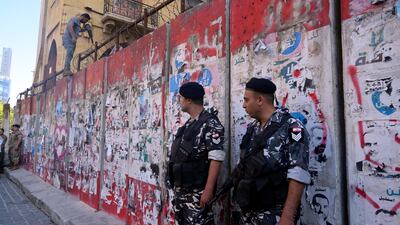
The removal of the barrier comes after parliamentary elections on May 15. EPA -
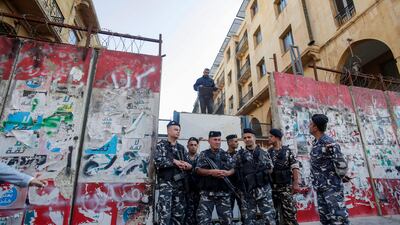
Among those elected were 13 independent opposition MPs — many of whom were linked to the uprising in 2019. AFP -

Of the independents, 12 will be entering Parliament for the first time, most of whom had previously called for the barriers to be taken down. AP -
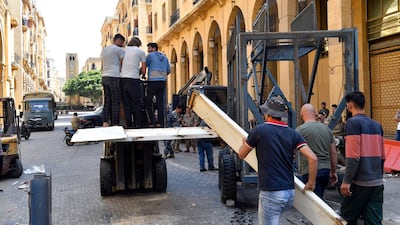
New MP Elias Jradi said: 'There are no walls that rise between the representatives of the nation and citizens.' EPA -
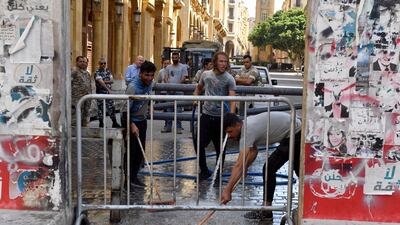
The blocks were being carted away and workers cleaned the surrounding streets. EPA


From May 2014, when the term of president Michel Suleiman ended, numerous parliamentary sessions never went anywhere after the initial candidates failed to obtain the necessary majority.
Some parties, particularly Hezbollah and the Free Patriotic Movement, boycotted the sessions as they sought to get their favoured candidates into the top job via the traditional back-room negotiations — as a result, the required parliamentary quorum was not met.
The stalemate began to ease when Mr Aoun unexpectedly received grudging support from some of his main foes. In January 2016, arch Hezbollah critic and Lebanese Forces leader Samir Geagea backed his rival, Mr Aoun, for the presidency after the parties reconciled. That support was followed in October 2016 by that of Saad Hariri and his Sunni-led Future Movement, ending the impasse — with Mr Hariri becoming prime minister in return.
According to the Lebanese constitution, a two-thirds majority is required to win in the first round. If that does not happen, in the second round only an absolute majority is needed — or 65 votes in the 128-seat chamber.
Many have been talked about as potential presidents.
It has long been said that Mr Aoun is grooming Gebran Bassil, his son-in-law and successor as party leader of the Free Patriotic Movement, to succeed him. But Mr Bassil is a deeply divisive figure and his party lost seats in the election.
Marada Movement leader Suleiman Frangieh was another main contender in the previous elections, while there are suggestions that Mr Geagea, who now heads the largest Christian bloc in parliament, may also run.
Hilal Khashan, a professor of political science at the American University of Beirut, predicted that a new president would not be in place this autumn.
He also suggested that army commander Joseph Aoun could be a dark horse, pointing to the historical precedent of military chiefs ascending to the Lebanese presidency.
Mr Gemayel is another name that has been talked of and he says the Kataeb party, which has five seats in the parliament, will not back “anyone who will not be able to tackle the issue of the weapons of Hezbollah. Because any president that comes [in] and is not willing to open up the subject of the weapons of Hezbollah and put it on the table and discuss it and try to find the solution for it — for us, he would be an ally of Hezbollah”.
But the reality is that the parliamentary election results may not have too much of an impact. Almost all of Lebanon’s previous presidents since independence from France in 1943 have been elected after agreements or interventions between regional or world powers, and Lebanon’s rival parties.
“I think both sides of the political chessboard in Lebanon might have overestimated the impact of the legislative elections on the race for the presidency," said Karim Bitar, professor at Saint Joseph University in Beirut.
Ultimately, Prof Bitar said, the parliamentary elections will not make or break a candidate.
“Whatever arithmetic majority controls the parliament, is never enough to make a president. Losing a parliamentary election is certainly symbolically significant. But ultimately, as has always been the case, the president will have to be elected after a compromise is reached and it will most probably be a candidate that does not face a veto from any of the major actors.
“What I would say is that the outcome of these legislative elections indicates that a likely scenario would be the election of a consensual president.
“It would no longer be the ‘strong president’ idea that has been peddled in the past few years by the Free Patriotic Movement. It will not necessarily be a Christian politician with significant popular backing. The preferable scenario given the current landscape in parliament would be the election of a consensual figure … a figure that would be able to talk to all sides, to help mitigate the crisis,” he said.

