Ramy Finge spent two years braving tear gas and rubber bullets, sometimes trying to scale the cement walls surrounding Lebanon’s Parliament during anti-government protests.
Soon, he will be able to walk in through the front door.
The dentist from the northern city of Tripoli is among 13 independent newcomers who won seats in Parliament in the May 15 elections, building on the protest movement that seeks to break the hold of the traditional parties.
The unexpectedly strong showing by civil society activists restored some hope among despairing Lebanese that change in their ailing country is possible.
But the nascent reform movement is fragmented and faces enormous challenges in fighting an entrenched ruling class.
Many worry the incoming Parliament will exacerbate polarisation and paralysis at a time when the country is dealing with one of the worst economic meltdowns in history. It is hobbled by divisions between the old guard and newcomers, as well as between supporters and opponents of the militant group Hezbollah.
In the run-up to the elections, candidates drawn from the protest movement that formed in October 2019 ran on competing lists.
-
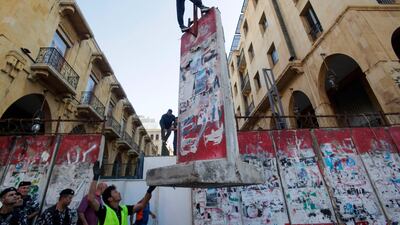
Workers remove sections of the concrete barrier, which was erected by Lebanese security forces in 2020 to bar access to streets leading to the country's parliament building, at the entrance of the Lebanese Parliament in the capital Beirut. AFP -
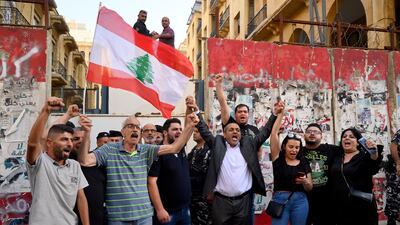
Lebanese authorities have ordered that the concrete barriers that have blocked access to the Parliament building since 2019 be removed. EPA -

The blockade was put in place after nationwide protests against Lebanon's ruling classes broke out. EPA -
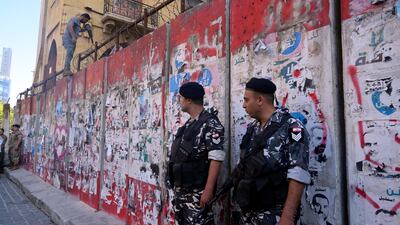
The removal of the barrier comes after parliamentary elections on May 15. EPA -
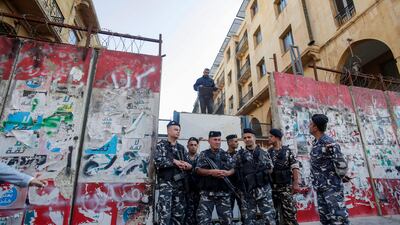
Among those elected were 13 independent opposition MPs — many of whom were linked to the uprising in 2019. AFP -

Of the independents, 12 will be entering Parliament for the first time, most of whom had previously called for the barriers to be taken down. AP -
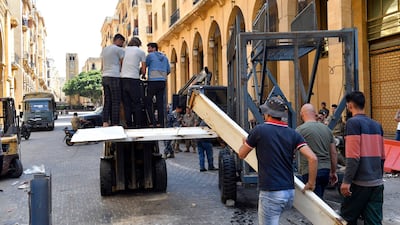
New MP Elias Jradi said: 'There are no walls that rise between the representatives of the nation and citizens.' EPA -
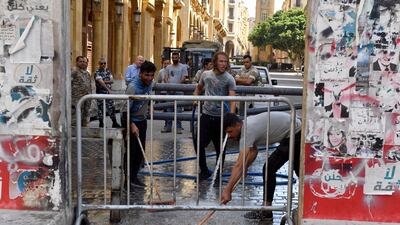
The blocks were being carted away and workers cleaned the surrounding streets. EPA


Broadly, they share the view that the decades-old grip on power by civil war-era warlords and sectarian-based political dynasties is the root cause behind rampant corruption, mismanagement, lack of services and lack of accountability that have driven the country into ruin.
But in the details, they are divided on almost everything, from their approach to reforming the economy and restructuring the collapsed banking sector, to their views on Hezbollah’s weapons and whether disarming the Iranian-backed group should be prioritised.
Still, it is no small accomplishment that they were able to break through despite an electoral law tailored for a ruling class with enormous power at its disposal. The elections were a setback for the Hezbollah-led coalition, which lost its majority in the 128-seat Parliament, though it remains the largest bloc.
“This is the first achievement by the Thawra [Arabic for revolution] because we were able to get in,” Mr Finge, 57, said at his modest home in Lebanon’s impoverished city of Tripoli this week.

“And from inside we will work with all our strength and courage to … dismantle this corrupt ruling class, which is destined to fall no matter how long it takes."
Like his colleagues from the protest movement, Mr Finge said he has been subjected to pressure and intimidation in the past two years. He proudly recalled the exuberant protests in Tripoli and Beirut that filled the squares starting in late 2019, when police would fire volleys of tear gas and pellets at demonstrators who often tried to scale the giant security barriers around Parliament.
In February 2021, he was summoned by security and questioned about a makeshift kitchen he had set up in Tripoli distributing food to protesters and the needy. He called it Matbakh Al Thawra, or the Revolution Kitchen.
The independents who won seats are a motley group of doctors, professors, professionals and activists from across Lebanon and from a variety of religious sects.
Among them is Firas Hamdan, 35, a lawyer and activist who was hit in the chest by a rubber bullet fired by police during a protest at the Parliament. Elias Jaradeh, an eye surgeon, won a seat held for 30 years by a pro-Syrian politician.

Najat Aoun, a chemistry professor and environmental activist, was one of four female independents who won, bringing the number of women in parliament from six to eight.
The newcomers say they plan to form a unified bloc to strengthen their influence in parliament, but that won’t be easy considering what they are up against.
Their mere presence in parliament is a decent start, but the challenge now is to organise and carry out a programme, Bilal Saab, senior fellow and founding director of the defence and security programme at the Middle East Institute, wrote in an analysis.
“This obviously will be very difficult given the still considerable power of Hezbollah and its allies, and the next presidential race in October will show the immediate impact of these parliamentary elections,” he wrote.
The first test will be at parliament’s first meeting, expected in the coming days, when lawmakers must elect a Speaker. The incumbent, Nabih Berri, 84, has held the position for the past 30 years and is running again for a seventh term, so far uncontested. The powerful head of the Shiite Amal militia is seen by many as the godfather of Lebanon’s corrupt sectarian-based and elite-dominated political system.
Independents and some of the Christian parties in parliament have said they will not vote for him, risking his re-election with a much slimmer than usual majority from mainly Shiite parties. Some have speculated Mr Berri may refrain from calling for the inaugural session, which according to the constitution must be held before June 6, if he is not assured of the desired number of votes he will get.
“For us, it’s clear that we will not elect any symbol of the ruling class, including Speaker Berri,” one of the new independents, architect Ibrahim Mneimneh, 46, told AP. He acknowledged, however, that they have yet to develop a clear alternative course of action.
A bigger test will be formation of a Cabinet that can win parliament’s confidence on key issues such as an economic recovery plan, finalising a bailout deal with the IMF, resuming the stalled investigation into the 2020 blast at Beirut port, and how to deal with the longtime central bank governor Riad Salameh.
The top banker is being investigated locally and in several European countries on charges of money laundering and embezzlement. Backed by the ruling class, he remains in his position despite a financial meltdown.
The new parliament will have to elect a new president when President Michel Aoun’s six-year term ends on October 31, with no clear successor.

