


A new strategy to increase the number of Emiratis working in the UAE's private sector presents graduates and job seekers with a huge opportunity, an Emirati banking executive has said.
Saeed Al Awar, head of the Middle East office at investment bank Rothschild & Co, said financial incentives and pay top-ups should ensure UAE nationals look beyond government jobs.
On Sunday, ministers outlined a major policy that requires 10 per cent of staff at private companies be Emirati within five years.
Rothschild & Co Middle East
For Emirati employees, there are also financial incentives, including a monthly salary top-up of up to Dh5,000 ($1,360) for university graduates who take a non-government job.
The announcement is part of the Projects of the 50 plan to boost the UAE economy and growth.
“If you think about our country when it started 50 years ago, the biggest gift that we had was oil. That oil has got us to where we are today,” said Mr Al Awar, who was at the unveiling of the government's policy at Abu Dhabi's Presidential Palace.
“The most important thing now is to invest now in the even more important asset for our country, which is UAE nationals, and that's what's going to take our country to the next phase of growth.”
Mr Al Awar, who began his career as a lawyer in London before moving into banking, said young Emiratis could no longer complain that government jobs offered better packages.
“You need to look at the whole thing as a package. It's an incentive that didn't exist before,” he said.
“There were a lot of questions from Emiratis about stability of the job [in the private sector] … salaries not on par with what the government pays.
“These initiatives bring an equilibrium, so people don't have an excuse any more.
“And I have to say from someone who's been in the private sector for so long, it's great to get people to see the successes that you can achieve in the private sector,” Mr Al Awar said.
“We can't just focus on people getting jobs. We need Emiratis to create jobs.
“And I think that bit of the initiative is vital to diversifying even job opportunities for Emiratis who are going to come in [to the job market] five years from now.
“It's complete integrated package that gets people excited about getting into the private sector.
“And the most important part that we shouldn't lose track of is that it's an investment in people, in Emiratis, and that's what gets us to the next stage of growth from an economic perspective,” Mr Al Awar said.
-
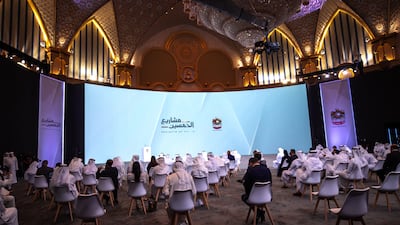
At Qasr Al Watan, the Presidential Palace in Abu Dhabi, ministers set out the latest 13 items in the UAE's 'Projects of the 50' plan. -

A series of major projects were unveiled on Sunday at Qasr Al Watan in Abu Dhabi. These are to boost the UAE's economy and development in the years to come. Photos: Victor Besa / The National -
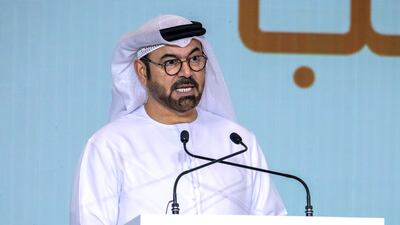
Minister of Cabinet Affairs, Mohammed Al Gergawi, said one of the plans was a scheme to spend up to Dh24 billion on getting 75,000 Emiratis into private-sector jobs. -
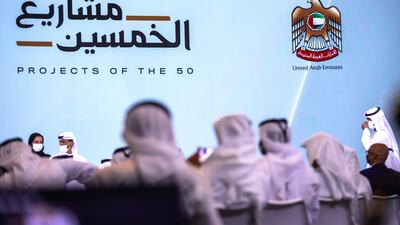
The 13 plans relate to boosting the country's human capital and significantly increasing the number of Emiratis employed in the private sector. -
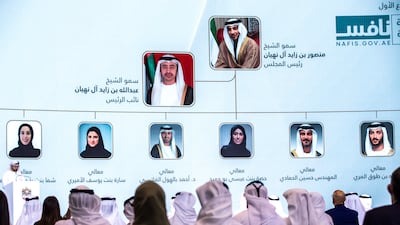
Cabinet ministers and senior officials heard how UAE citizens would be given a series of incentives to choose private-sector work. -

University graduates will be encouraged to take up jobs in the private sector, with the government offering to boost their salary. -
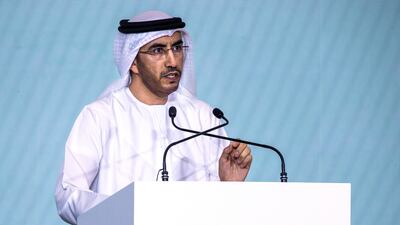
Ghannam Al Mazrouei, General Secretary of the Emirati Talent Competitiveness Council, addresses ministers and officials. -
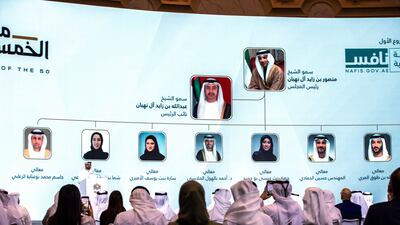
Cabinet ministers and senior officials heard how UAE citizens would be given a series of incentives to choose private-sector work. -

At Qasr Al Watan, ministers set out the latest 13 items in the UAE's 'Projects of the 50' plan.


The 13 latest projects
1) Emirati Talent Competitiveness Council: With Sheikh Mansour bin Zayed, Deputy Prime Minister and Minister of Presidential Affairs, as chairman and Sheikh Abdullah bin Zayed, Minister of Foreign Affairs and International Co-operation, as vice chairman, the council brings together representatives across federal government. It is tasked with strengthening private sector partnerships and implementing projects to provide 75,000 private sector jobs for Emiratis.
2) Emirati Salary Support Scheme: A grant contributing to the recruitment and training costs of Emirati graduates in the private sector, with a monthly top-up of up to Dh8,000 for graduates during the first year of training and a monthly top-up of up to Dh5,000 for five years after recruitment. Top-ups are conditional and based on a range of defined target salaries.
3) Merit Programme: A fixed monthly salary top-up of Dh5,000 to be provided for five years to Emirati workers in specialised fields, including nurses, accountants and financial auditors, lawyers, financial analysts and coders.
4) Pension Programme: A five-year subsidy against the pension plan contributions of Emirati staff earning less than Dh20,000 per month, and a government-paid contribution on behalf of the company against the cost of pension plans for Emirati staff in the first five years. This ensures zero contributions to the cost of Emiratis' pensions in the first year of private sector employment.
5) Child Allowance Scheme: A government child allowance payment will be paid to Emirati staff working in the private sector of up to Dh800 per child, up to a maximum of Dh3,200 per month, to help with the costs of childcare. This will run up to the age of 21.
6) Talent Programme: An investment of Dh1.25 billion in developing specialised vocational skills for Emiratis, with internationally recognised certifications in property management, accounting, business management and technology skills.
7) Apprentice Programme: A train-to-hire initiative to build vocational training for Emiratis in private and semi-private companies with a range of financial awards across a number of business sectors.
8) Recruitment Targets: Every private sector company in the UAE must ensure 10 per cent of its workforce is Emirati within five years. The figure should rise by 2 per cent each year until 10 per cent is reached, and the jobs given to UAE nationals should be in “knowledge and skilled roles".
9) National Healthcare Programme: An educational grant programme targeting the development of 10,000 Emirati healthcare workers within the next five years. This will involve rolling out a Graduate Healthcare Assistant Programme, a Higher Diploma in Emergency Medicine and a Bachelor's degree in Nursing. Supported and led by Fatima College of Health Sciences and ACTVET.
10) Unemployment Benefit: An unemployment benefit to be paid to Emiratis working in the private sector who lose their jobs due to circumstances beyond their control, giving them a six-month period to find another position.
11) Start-up Break: Beginning 2021, a subsidised career break of six to 12 months for Emiratis in federal government positions to start a business. Employments will receive 50 per cent of their salary while away. This will be open to a limited number of staff each year, with employer approval.
12) Early Retirement: An opportunity for Emiratis in federal government positions to take early retirement in order to explore business opportunities and start a new private sector business. Will include financing of five years' salary payments or a lump sum golden handshake payment. Will be open to a limited number of staff each year, with employer approval.
13) Graduate Fund: A Dh1 billion fund, under the patronage of Sheikh Mansour, to provide micro-loans for new graduates to support their business projects, in collaboration with UAE universities.

