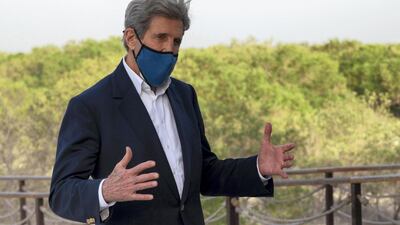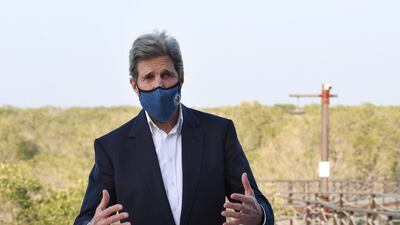
US Special Presidential Envoy for Climate John Kerry, at Jubail Mangrove Park in Abu Dhabi in April.

UAE and US vow to step up climate action before Washington summit


  • English
  • Arabic

The UAE and US underlined their joint commitment to robust action on climate change before a crucial summit in Washington.

Both countries agreed to raise ambitions in tackling the issue.

The commitment came during talks on Thursday between UAE Special Envoy for Climate, Dr Sultan Al Jaber, and US Secretary of Energy, Jennifer Granholm.

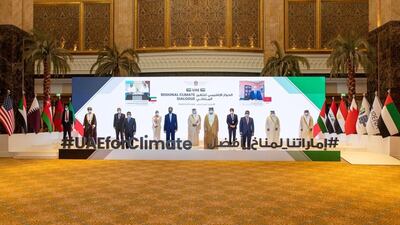
The two met after the Regional Climate Dialogue in Abu Dhabi this month and their discussion came before the Leaders Summit on Climate next week being organised by US President Joe Biden.

As the world will still rely on hydrocarbon fuels for decades, it is essential to ensure they are produced responsibly

“The UAE believes there is a sound business case for progressive climate action, which can deliver more economic growth with fewer emissions,” Dr Al Jaber said.

“As the world will still rely on hydrocarbon fuels for decades, it is essential to ensure they are produced responsibly and are as low carbon as possible.

"The UAE is one of the least carbon-intensive producers in the world, and we are investing in technology to build on this distinct competitive advantage. Just as in the US, climate considerations are at the core of decision-making in the UAE, including domestic policy, foreign policy and national security."

UAE Special Envoy for Climate, Dr Sultan Al Jaber, and US Secretary of Energy, Jennifer Granholm. Both sides underlined their commitment to tackling climate change.

Dr Al Jaber said that the partnership between companies across the US and UAE energy systems can be built upon to maximise opportunities for sustainable growth.

The discussion touched on the UAE's climate leadership as an early investor in successful renewable energy projects within the Emirates and around the world. The discussion also focused on the UAE's development of new zero-carbon fuels, such as hydrogen, that have the potential to play a significant role in the energy system in the next 20 years.

The two also discussed carbon-capture technologies as an essential tool for climate mitigation, with Dr Al Jaber noting that Adnoc is pioneering the use of industrial-scale carbon-capture technologies with the first such facility in the region.

Al Reyadah site has the capacity to capture 800,000 tonnes of carbon dioxide annually.

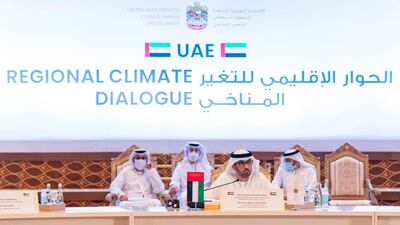
The meeting followed the visit of John Kerry, the US special presidential envoy for climate, to Abu Dhabi for the Regional Climate Dialogue hosted by the UAE. Regional leaders pledged bold action in the run-up to the Cop26 meeting in Glasgow this November.

The Regional Climate Dialogue in Abu Dhabi – in pictures

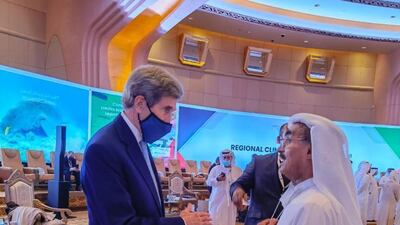
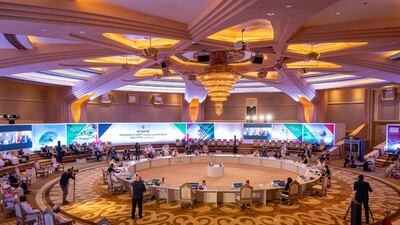
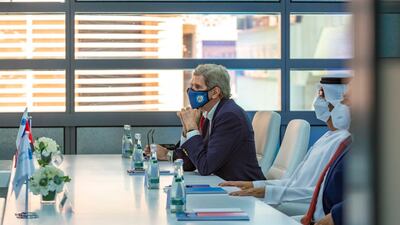
  • US climate envoy John Kerry attends the Regional Climate Dialogue in Abu Dhabi on Sunday. This is Mr Kerry's first visit to the Middle East, and Asia, since being appointed to the role. Courtesy: Office of the UAE Special Envoy for Climate Change
    US climate envoy John Kerry attends the Regional Climate Dialogue in Abu Dhabi on Sunday. This is Mr Kerry's first visit to the Middle East, and Asia, since being appointed to the role. Courtesy: Office of the UAE Special Envoy for Climate Change
  • US climate envoy John Kerry attends the Regional Climate Dialogue in Abu Dhabi on Sunday. This is Mr Kerry's first visit to the Middle East, and Asia, since being appointed to the role. Courtesy: Office of the UAE Special Envoy for Climate Change
    US climate envoy John Kerry attends the Regional Climate Dialogue in Abu Dhabi on Sunday. This is Mr Kerry's first visit to the Middle East, and Asia, since being appointed to the role. Courtesy: Office of the UAE Special Envoy for Climate Change
  • Alok Sharma, President of Cop26, attends the Regional Climate Dialogue in Abu Dhabi.
    Alok Sharma, President of Cop26, attends the Regional Climate Dialogue in Abu Dhabi.
  • The pledge issued at the end of the Regional Climate Dialogue vowed to help the most vulnerable.
    The pledge issued at the end of the Regional Climate Dialogue vowed to help the most vulnerable.
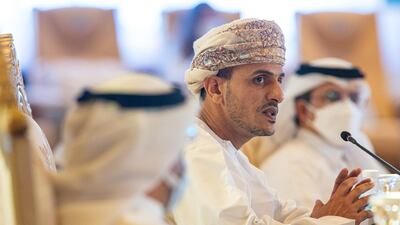
  • Delegates at the talks in Abu Dhabi.
    Delegates at the talks in Abu Dhabi.
  • Abdullah Al Nuaimi, UAE Minister of Climate Change and Environment and John Kerry, US climate envoy at the dialogue.
    Abdullah Al Nuaimi, UAE Minister of Climate Change and Environment and John Kerry, US climate envoy at the dialogue.
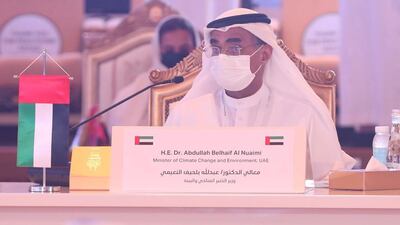
  • Abdullah Al Nuaimi, UAE Minister of Climate Change and Environment, at the Regional Climate Dialogue.
    Abdullah Al Nuaimi, UAE Minister of Climate Change and Environment, at the Regional Climate Dialogue.
  • The dialogue comes during a critical year in the global fight to halt rising temperatures. Courtesy: Office of the UAE Special Envoy for Climate Change
    The dialogue comes during a critical year in the global fight to halt rising temperatures. Courtesy: Office of the UAE Special Envoy for Climate Change
  • The UAE's Special Envoy for Climate Change, Dr Sultan Al Jaber, at the Regional Climate Dialogue. Courtesy: Office of the UAE Special Envoy for Climate Change
    The UAE's Special Envoy for Climate Change, Dr Sultan Al Jaber, at the Regional Climate Dialogue. Courtesy: Office of the UAE Special Envoy for Climate Change
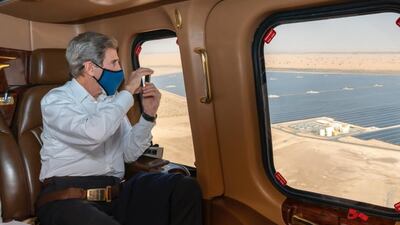
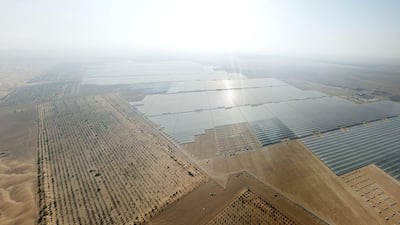
  • US climate envoy John Kerry is given a helicopter tour of Noor solar park, outside Abu Dhabi on Saturday. Courtesy: Office of the UAE Special Envoy for Climate Change
    US climate envoy John Kerry is given a helicopter tour of Noor solar park, outside Abu Dhabi on Saturday. Courtesy: Office of the UAE Special Envoy for Climate Change
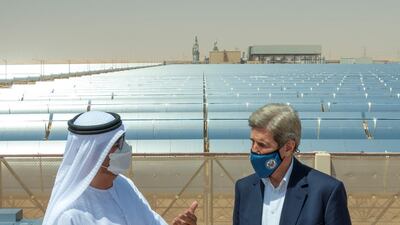
  • John Kerry speaks with Dr Sultan Al Jaber at Abu Dhabi's Shams 1 solar park on Saturday. The National
    John Kerry speaks with Dr Sultan Al Jaber at Abu Dhabi's Shams 1 solar park on Saturday. The National
  • This is John Kerry's first visit to the Middle East since being appointed US climate envoy. The National
    This is John Kerry's first visit to the Middle East since being appointed US climate envoy. The National
  • Mr Kerry has vowed to make up for the 'lost years' of the Donald Trump presidency and put the US at the forefront of efforts to protect the environment. The National
    Mr Kerry has vowed to make up for the 'lost years' of the Donald Trump presidency and put the US at the forefront of efforts to protect the environment. The National
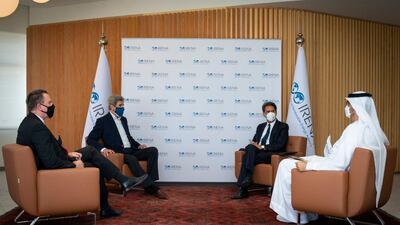
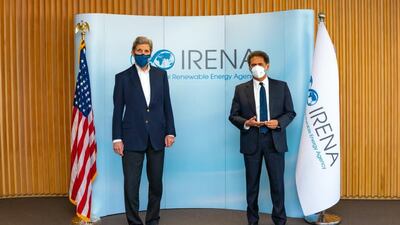
  • John Kerry meets Francesco La Camera, director general of International Renewable Energy Agency, which has its global headquarters in Abu Dhabi. The National
    John Kerry meets Francesco La Camera, director general of International Renewable Energy Agency, which has its global headquarters in Abu Dhabi. The National
  • US climate envoy John Kerry visits Jubail Mangrove Park. Courtesy Office of the UAE Special Envoy for Climate Change
    US climate envoy John Kerry visits Jubail Mangrove Park. Courtesy Office of the UAE Special Envoy for Climate Change
  • An aerial image of Abu Dhabi's Noor solar park. Its 3.2 million panels make it the largest single-site solar park in the world. Courtesy: Noor Abu Dhabi
    An aerial image of Abu Dhabi's Noor solar park. Its 3.2 million panels make it the largest single-site solar park in the world. Courtesy: Noor Abu Dhabi
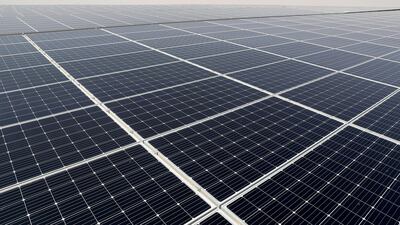
  • Arrayed panels at Abu Dhabi's Noor solar park. Pawan Singh / The National
    Arrayed panels at Abu Dhabi's Noor solar park. Pawan Singh / The National
Tamkeen's offering
  • Option 1: 70% in year 1, 50% in year 2, 30% in year 3
  • Option 2: 50% across three years
  • Option 3: 30% across five years 
Gulf Under 19s final

Dubai College A 50-12 Dubai College B

Mercer, the investment consulting arm of US services company Marsh & McLennan, expects its wealth division to at least double its assets under management (AUM) in the Middle East as wealth in the region continues to grow despite economic headwinds, a company official said.

Mercer Wealth, which globally has $160 billion in AUM, plans to boost its AUM in the region to $2-$3bn in the next 2-3 years from the present $1bn, said Yasir AbuShaban, a Dubai-based principal with Mercer Wealth.

Within the next two to three years, we are looking at reaching $2 to $3 billion as a conservative estimate and we do see an opportunity to do so,” said Mr AbuShaban.

Mercer does not directly make investments, but allocates clients’ money they have discretion to, to professional asset managers. They also provide advice to clients.

“We have buying power. We can negotiate on their (client’s) behalf with asset managers to provide them lower fees than they otherwise would have to get on their own,” he added.

Mercer Wealth’s clients include sovereign wealth funds, family offices, and insurance companies among others.

From its office in Dubai, Mercer also looks after Africa, India and Turkey, where they also see opportunity for growth.

Wealth creation in Middle East and Africa (MEA) grew 8.5 per cent to $8.1 trillion last year from $7.5tn in 2015, higher than last year’s global average of 6 per cent and the second-highest growth in a region after Asia-Pacific which grew 9.9 per cent, according to consultancy Boston Consulting Group (BCG). In the region, where wealth grew just 1.9 per cent in 2015 compared with 2014, a pickup in oil prices has helped in wealth generation.

BCG is forecasting MEA wealth will rise to $12tn by 2021, growing at an annual average of 8 per cent.

Drivers of wealth generation in the region will be split evenly between new wealth creation and growth of performance of existing assets, according to BCG.

Another general trend in the region is clients’ looking for a comprehensive approach to investing, according to Mr AbuShaban.

“Institutional investors or some of the families are seeing a slowdown in the available capital they have to invest and in that sense they are looking at optimizing the way they manage their portfolios and making sure they are not investing haphazardly and different parts of their investment are working together,” said Mr AbuShaban.

Some clients also have a higher appetite for risk, given the low interest-rate environment that does not provide enough yield for some institutional investors. These clients are keen to invest in illiquid assets, such as private equity and infrastructure.

“What we have seen is a desire for higher returns in what has been a low-return environment specifically in various fixed income or bonds,” he said.

“In this environment, we have seen a de facto increase in the risk that clients are taking in things like illiquid investments, private equity investments, infrastructure and private debt, those kind of investments were higher illiquidity results in incrementally higher returns.”

The Abu Dhabi Investment Authority, one of the largest sovereign wealth funds, said in its 2016 report that has gradually increased its exposure in direct private equity and private credit transactions, mainly in Asian markets and especially in China and India. The authority’s private equity department focused on structured equities owing to “their defensive characteristics.”