Discounts on Uber services and RTA taxis are available to travellers who need to make a connecting flight. Dubai Airports

Free shuttle service and discounted taxi rides for Dubai airports during runway closure


Sarah Forster
  • English
  • Arabic

Passengers who need to transfer between Dubai International Airport (DXB) and Dubai World Central Airport (DWC) can use a free shuttle service, Dubai Airports has said.

The service will operate every 30 minutes, 24 hours a day, and is being offered to assist passengers arriving at DXB whose connecting flights have been moved to DWC owing to the closure of the northern runway at the international airport.

Discounts on Uber services and Roads and Transport Authority taxis are also available to travellers who need to make a connecting flight.

Uber uses must enter the code "DWC2022" when making a booking on the app, although it is unclear what discount is being offered.

RTA taxis will remove the fixed start fee for passengers travelling from DWC.

DWC airport also has 2,500 parking spaces for travellers who will start their journey in Dubai and wishing to drive themselves.

The Northern Runway Rehabilitation project at DXB began on May 9 and will run until June 22.

Dubai Airports has advised all passengers to check their flight information before heading to their departure airport. Travellers are urged to allow extra time to get through security to avoid delays when reaching their gate.

Dubai Airport's 60th anniversary: in pictures

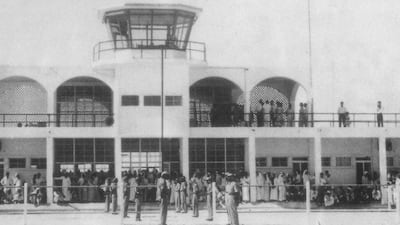
  • Dubai International Airport celebrated its 60th anniversary in 2020. Here passengers board a plane parked on a sand compacted runway in the 1960s. All photos: Dubai Airports
    Dubai International Airport celebrated its 60th anniversary in 2020. Here passengers board a plane parked on a sand compacted runway in the 1960s. All photos: Dubai Airports
  • Dubai airport in the 1960s. By 1968 the airport was served by nine international airlines flying to 20 destinations
    Dubai airport in the 1960s. By 1968 the airport was served by nine international airlines flying to 20 destinations
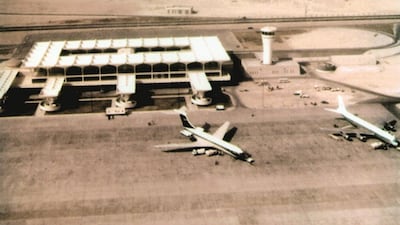
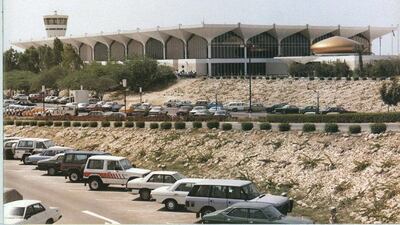
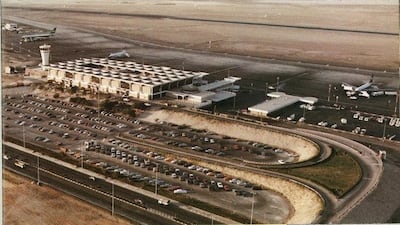
  • Developments in the 1970s included a new three-storey terminal building, control tower, additional taxiways and longer runways
    Developments in the 1970s included a new three-storey terminal building, control tower, additional taxiways and longer runways
  • The airport's second runway, equipped with the latest technology, was opened in 1984
    The airport's second runway, equipped with the latest technology, was opened in 1984
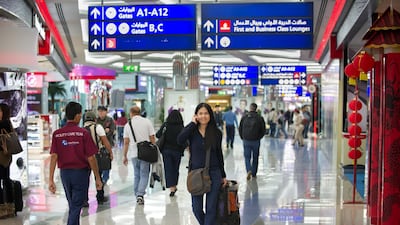
  • The transit lounge at Dubai International airport in the 1970s
    The transit lounge at Dubai International airport in the 1970s
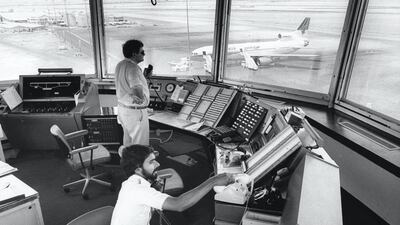
  • The air traffic control tower at Dubai International airport in the 1970s
    The air traffic control tower at Dubai International airport in the 1970s
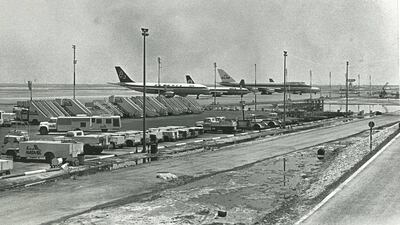
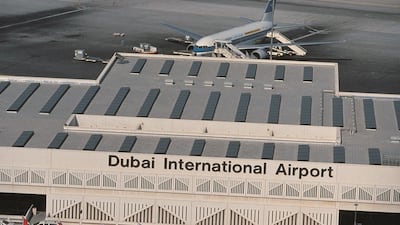
  • The airport in the 1970s
    The airport in the 1970s
  • Dubai Duty Free began operations in 1983 and had an annual turnover of $20 million in its first year
    Dubai Duty Free began operations in 1983 and had an annual turnover of $20 million in its first year
  • An aerial view of the airport in the 1970s
    An aerial view of the airport in the 1970s
  • Dubai International Airport has served more than a billion passengers travelling on almost 7.5 million flights since it opened in 1960
    Dubai International Airport has served more than a billion passengers travelling on almost 7.5 million flights since it opened in 1960
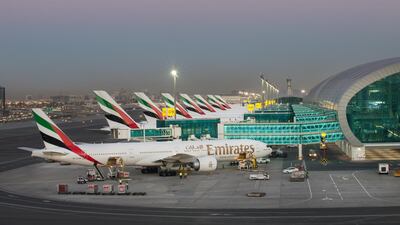
  • Terminal 3, the exclusive terminal for Emirates airline, was opened in 2008. It is the world’s largest single terminal
    Terminal 3, the exclusive terminal for Emirates airline, was opened in 2008. It is the world’s largest single terminal
  • In 2014, Dubai International welcomed 70.4 million passengers, becoming the world’s busiest airport in terms of international passenger traffic
    In 2014, Dubai International welcomed 70.4 million passengers, becoming the world’s busiest airport in terms of international passenger traffic
  • The airport welcomed its one billionth international passenger in 2018
    The airport welcomed its one billionth international passenger in 2018
  • It retained its title of the world’s busiest airport for international passengers for the sixth consecutive year in 2019, with 86.4 million passengers
    It retained its title of the world’s busiest airport for international passengers for the sixth consecutive year in 2019, with 86.4 million passengers
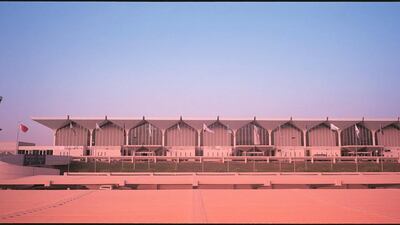
  • Dubai airport in the 1990s. It was the first to introduce e-gates in 2002. Now, millions of passengers use the smart gates, which require residents to scan their passport or Emirates ID to avoid long queues
    Dubai airport in the 1990s. It was the first to introduce e-gates in 2002. Now, millions of passengers use the smart gates, which require residents to scan their passport or Emirates ID to avoid long queues
Ten tax points to be aware of in 2026

1. Domestic VAT refund amendments: request your refund within five years

If a business does not apply for the refund on time, they lose their credit.

2. E-invoicing in the UAE

Businesses should continue preparing for the implementation of e-invoicing in the UAE, with 2026 a preparation and transition period ahead of phased mandatory adoption. 

3. More tax audits

Tax authorities are increasingly using data already available across multiple filings to identify audit risks. 

4. More beneficial VAT and excise tax penalty regime

Tax disputes are expected to become more frequent and more structured, with clearer administrative objection and appeal processes. The UAE has adopted a new penalty regime for VAT and excise disputes, which now mirrors the penalty regime for corporate tax.

5. Greater emphasis on statutory audit

There is a greater need for the accuracy of financial statements. The International Financial Reporting Standards standards need to be strictly adhered to and, as a result, the quality of the audits will need to increase.

6. Further transfer pricing enforcement

Transfer pricing enforcement, which refers to the practice of establishing prices for internal transactions between related entities, is expected to broaden in scope. The UAE will shortly open the possibility to negotiate advance pricing agreements, or essentially rulings for transfer pricing purposes. 

7. Limited time periods for audits

Recent amendments also introduce a default five-year limitation period for tax audits and assessments, subject to specific statutory exceptions. While the standard audit and assessment period is five years, this may be extended to up to 15 years in cases involving fraud or tax evasion. 

8. Pillar 2 implementation 

Many multinational groups will begin to feel the practical effect of the Domestic Minimum Top-Up Tax (DMTT), the UAE's implementation of the OECD’s global minimum tax under Pillar 2. While the rules apply for financial years starting on or after January 1, 2025, it is 2026 that marks the transition to an operational phase.

9. Reduced compliance obligations for imported goods and services

Businesses that apply the reverse-charge mechanism for VAT purposes in the UAE may benefit from reduced compliance obligations. 

10. Substance and CbC reporting focus

Tax authorities are expected to continue strengthening the enforcement of economic substance and Country-by-Country (CbC) reporting frameworks. In the UAE, these regimes are increasingly being used as risk-assessment tools, providing tax authorities with a comprehensive view of multinational groups’ global footprints and enabling them to assess whether profits are aligned with real economic activity. 

Contributed by Thomas Vanhee and Hend Rashwan, Aurifer

Updated: May 25, 2022, 1:23 PM