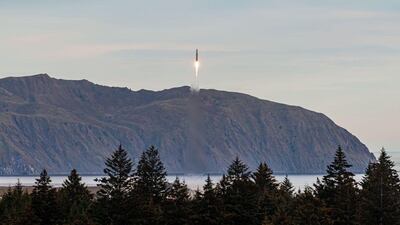

A rocket launch attempt in Alaska ended in massive explosion on Saturday when the launcher crashed seconds after lift-off.
Astra, a launch vehicle company based in California, was carrying out the first orbital test flight for its Rocket 3.1, with no payload on board, from the Pacific Spaceport Complex.
The 12-metre launcher failed during the first-stage engine burn and came crashing down after 17 seconds in the air.
The event was captured on camera by observers, including one who was pushed back by the intensity of the rocket’s explosion. The rocket's engines were fuelled with kerosene and liquid oxygen and could generate a thrust of 14,288 kg.
“Preliminary data review indicates the rocket performed very well,” the company said.
“Early in the flight, our guidance system appears to have introduced some slight oscillation into the flight, causing the vehicle to drift from its planned trajectory leading to a commanded shutdown of the engines by the flight safety system.”
Astra aims to provide cost-effective rides for small satellites and can deliver payloads weighing between 50 to 150kg.
Their Rocket 3.2 is already built and ready for an orbital test flight.
“Over the next several weeks, we’ll be taking a close look at the flight data to determine how to make the next flight more successful,” said Astra’s representatives.
SpaceX owner Elon Musk sent out a tweet shortly after the failure. He said: “Sorry to hear that. I’m sure you’ll figure it out though. Took us four launches to reach orbit. Rockets are hard.”
On Saturday, a Chinese rocket also experienced a failed launch attempt after facing an anomaly.
The Kuaizhou-1A rocket was carrying a remote sensing satellite, called Jilin-1 Gaofen.
It was the country's fourth rocket launch failure this year. Others included the Long March 7A failure in March, Long March 3B in April and the Expace Kuaizhou-11 in July.
2020 - the year of the space mission
-
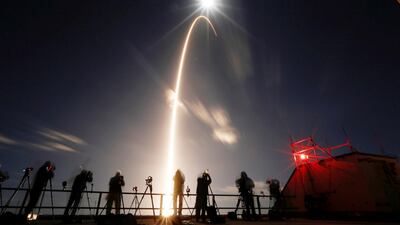
The Solar Orbiter, built for Nasa and the European Space Agency, lifts off from pad 41 aboard a United Launch Alliance Atlas V rocket at the Cape Canaveral Air Force Station in Cape Canaveral, Florida, US, on February 9. Joe Skipper / Reuters -
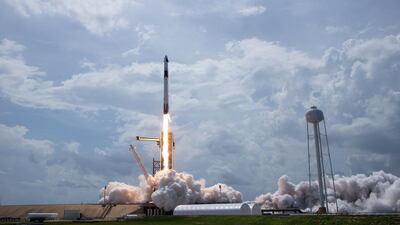
The SpaceX Falcon 9 rocket carries Nasa astronauts Bob Behnken and Doug Hurley into space on May 30. AFP -
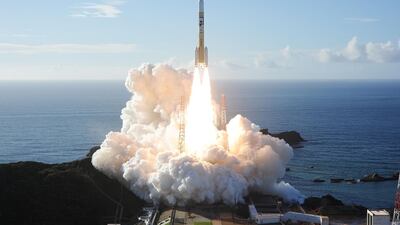
A rocket carrying the UAE's Hope Probe, launches from Japan's Tanegashima Space Centre on July 20. AFP -

A SpaceX Falcon 9 lifts off rom Pad 39A at Kennedy Space Centre early on August 7. The rocket is carrying 57 Starlink satellites and two Earth observation spacecraft for BlackSky. Malcolm Denemark / Florida Today via AP -
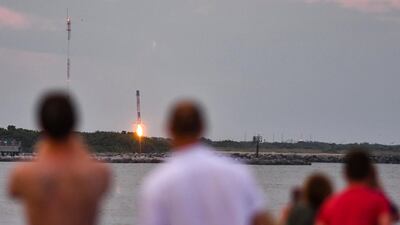
People at Cherie Down Park in Cape Canaveral, Florida, watch the booster landing of the SpaceX Falcon 9, on August 30. The rocket was carrying an Argentinian communications satellite known as SAOCOM-1B. Malcolm Denemark / Florida Today via AP -

A Vega rocket lifts-off from Europe's Spaceport in Kourou, French Guiana on September 2. JM Guillon / ESA - CNES - Arianeespace via AFP -

A Long March-5 rocket carrying the Tianwen-1 Mars probe lifts off from the Wenchang Space Launch Centre in southern China's Hainan Province July 23. Cai Yang / Xinhua via AP)



