• Strawberry Moon seen between the Etihad towers, Grand Hyatt Hotel & Bab Al Qasr structures in Abu Dhabi. Khushnum Bhandari / The National
    Strawberry Moon seen between the Etihad towers, Grand Hyatt Hotel & Bab Al Qasr structures in Abu Dhabi. Khushnum Bhandari / The National
  • Native American tribes in the 1930s called it a "Strawberry Moon" because the event coincided with strawberry harvesting season. Khushnum Bhandari / The National
    Native American tribes in the 1930s called it a "Strawberry Moon" because the event coincided with strawberry harvesting season. Khushnum Bhandari / The National
  • The Strawberry Moon rises by Business Central Towers in Dubai. This is the last supermoon of the year. Chris Whiteoak / The National
    The Strawberry Moon rises by Business Central Towers in Dubai. This is the last supermoon of the year. Chris Whiteoak / The National
  • A supermoon occurs when the Moon is at its closest point to Earth in its orbit and appears larger than normal. Chris Whiteoak / The National
    A supermoon occurs when the Moon is at its closest point to Earth in its orbit and appears larger than normal. Chris Whiteoak / The National
  • This will be the last supermoon of the year. Khushnum Bhandari / The National
    This will be the last supermoon of the year. Khushnum Bhandari / The National
  • Strawberry supermoon rising. EPA/ALI HAIDER
    Strawberry supermoon rising. EPA/ALI HAIDER

Last supermoon of the year brightens UAE skies


Salam Al Amir
  • English
  • Arabic

Stargazers and amateur astronomers were treated to brilliant supermoon display in the skies of the UAE on Thursday night.

The last of the year, it appeared bigger and brighter than other full moons because it orbited closer to Earth.

Called the "strawberry moon", it does not actually appear to be pink.

Instead the annual event got its name from native Americans who noted its appearance at the start of strawberry harvesting season.

This was the third supermoon of the year. The first was in April and appeared 7 per cent bigger and 14 per cent brighter than a regular moon.

The second appeared in May and was the biggest and brightest one of the year.

Other coming astronomical events in the UAE include the Perseid meteor shower in August, the Leonid meteor shower in November and the Geminid meteor shower in December.

In pictures: astronauts take a six hour space walk outside the International Space Station

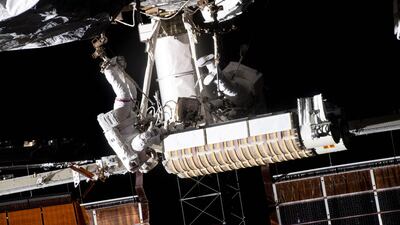
  • French astronaut Thomas Pesquet, left, of the European Space Agency is attached to a foot restraint while installing new solar panels on the International Space Station, with US astronaut Shane Kimbrough. AFP
    French astronaut Thomas Pesquet, left, of the European Space Agency is attached to a foot restraint while installing new solar panels on the International Space Station, with US astronaut Shane Kimbrough. AFP
  • The astronauts installed the panels in a six-hour spacewalk on Sunday, 20 June. AP Photo
    The astronauts installed the panels in a six-hour spacewalk on Sunday, 20 June. AP Photo
  • The pair attached, positioned and deployed six new-generation panels, known as Roll-Out Solar Array, or iROSA. AP Photo
    The pair attached, positioned and deployed six new-generation panels, known as Roll-Out Solar Array, or iROSA. AP Photo
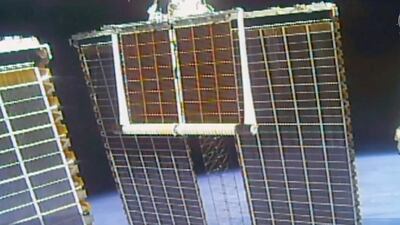
  • Once installed, the panels unrolled over a 10-minute period. Watching them unfurl, Thomas Pesquet described the process as 'beautiful'. AP Photo
    Once installed, the panels unrolled over a 10-minute period. Watching them unfurl, Thomas Pesquet described the process as 'beautiful'. AP Photo
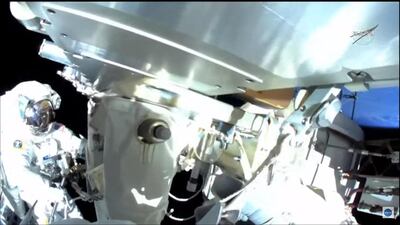
  • A sideview of the newly installed solar panels seen from US astronaut Shane Kimbrough's helmet camera. Five more rollout panels have still to be installed. AFP
    A sideview of the newly installed solar panels seen from US astronaut Shane Kimbrough's helmet camera. Five more rollout panels have still to be installed. AFP
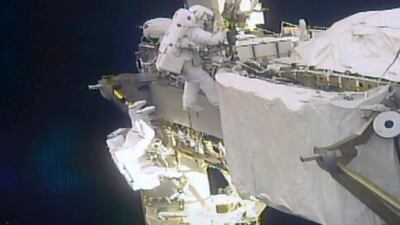
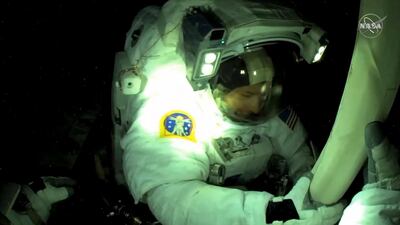
  • US astronaut Shane Kimbrough seen from ESA astronaut Thomas Pesquet's helmet camera, fixing bolts on the new solar panels. AFP
    US astronaut Shane Kimbrough seen from ESA astronaut Thomas Pesquet's helmet camera, fixing bolts on the new solar panels. AFP
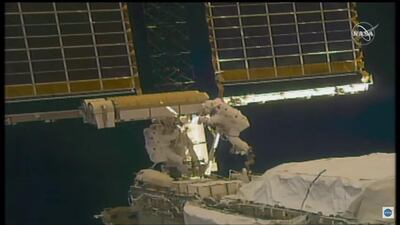
  • A view of Shane Kimbrough, left, and Thomas Pesquet, at work shows the scale of the iROSA solar panels. AFP
    A view of Shane Kimbrough, left, and Thomas Pesquet, at work shows the scale of the iROSA solar panels. AFP
  • Thomas Pesquet uses a space drill while installing the new solar panels. Parts of the ageing International Space Station date from 1998, and the panels with boost energy supplies. AFP
    Thomas Pesquet uses a space drill while installing the new solar panels. Parts of the ageing International Space Station date from 1998, and the panels with boost energy supplies. AFP
  • Shane Kimbrough seen from Thomas Pesquet's helmet camera during unfolding and alignment of the solar panel. The 19-metre panels should have a 15-year lifespan. AFP
    Shane Kimbrough seen from Thomas Pesquet's helmet camera during unfolding and alignment of the solar panel. The 19-metre panels should have a 15-year lifespan. AFP
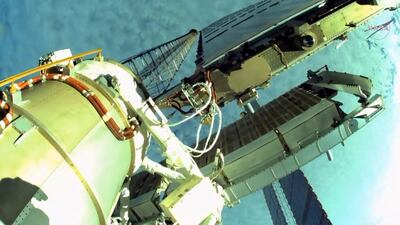
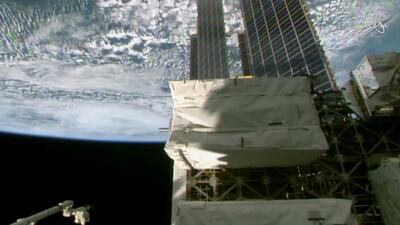
  • The Earth provides a dramatic backdrop to the newly installed solar panels on the International Space Station. AFP
    The Earth provides a dramatic backdrop to the newly installed solar panels on the International Space Station. AFP