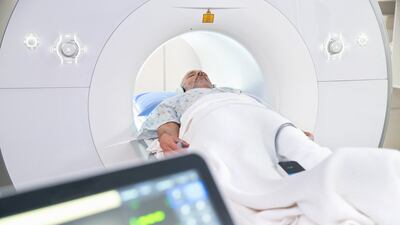
Blood tests similar to those used to check for diabetes and prostate cancer could be used to spot the early signs of a brain tumour, thanks to new research by the University of Bristol. Andrew Henderson / The National
Blood tests similar to those used to check for diabetes and prostate cancer could be used to spot the early signs of a brain tumour, thanks to new research by the University of Bristol. Andrew Henders

Simple blood test could help doctors identify early signs of brain tumours


Nick Webster
  • English
  • Arabic

A simple blood test to detect the early signs of a brain tumour could soon be possible thanks to emerging research that uses computer modelling to spot telltale signs of cancer.

Researchers at the UK's University of Bristol found mathematical models that helped them examine and compare new biomarkers and tests for brain tumours as they emerged.

The breakthrough is part of wider research into the development of a blood test to help GPs diagnose early signs of a cancerous brain tumour, deliver faster care and improve patient recovery.

Biomarkers in the blood are already used to test for glioblastomas (GBMs), a fast-growing, aggressive type of tumour that attacks surrounding brain tissue.

An affordable and fast point-of-care test to detect a tumour could be the next breakthrough, thanks to the research by the University of Bristol and Cancer Research UK.

The project combined biomarker discovery, development of fluorescent nanoparticles to highlight genetic abnormalities and new testing techniques using computational modelling.

“Our findings provide the basis for further clinical data on the impact of lowering the current detection threshold for the known biomarker GFAP [glial fibrillary acidic protein] to allow earlier detection of GBMs using blood tests,” said Dr Johanna Blee, lead author of the research at the university’s department of engineering mathematics.

“With further experimental data, it may also be possible to quantify tumour and patient heterogeneities and incorporate errors into our models and predictions for blood levels for different tumours.

“We have also demonstrated how our models can be combined with other diagnostics such as scans to enhance clinical insight with a view to developing more personalised and effective treatments.”

Researchers used computational modelling to explore the impact of tumour characteristics and patient differences on detection.

Spotting a brain tumour at a late stage hugely diminishes survival chances.

On average, just 20 per cent of those diagnosed live beyond five years of a diagnosis, often because they present late with large inoperable tumours.

Blood tests for cancer are currently used by doctors to determine tumour markers, protein levels, complete blood count and the presence of cancerous cells.

While a test to measure the level of prostate-specific antigen (PSA) in samples has revolutionised the way GPs spot early signs of prostate cancer in men, similar success is hoped for in the detection of other cancers where early diagnosis is critical for survival.

Home DNA testing kits are also now available from private testing facilities in Dubai to detect signs of colorectal cancer.

“These mathematical models could be used to examine and compare new biomarkers and tests for brain tumours as they emerge,” said Dr Blee.

“We are hopeful this research will ultimately aid the development of a simple blood test for brain tumours, enabling earlier and more detailed diagnoses.”

How space technology like the James Webb telescope is improving health care on Earth

Anghami
Started: December 2011
Co-founders: Elie Habib, Eddy Maroun
Based: Beirut and Dubai
Sector: Entertainment
Size: 85 employees
Stage: Series C
Investors: MEVP, du, Mobily, MBC, Samena Capital

Mercer, the investment consulting arm of US services company Marsh & McLennan, expects its wealth division to at least double its assets under management (AUM) in the Middle East as wealth in the region continues to grow despite economic headwinds, a company official said.

Mercer Wealth, which globally has $160 billion in AUM, plans to boost its AUM in the region to $2-$3bn in the next 2-3 years from the present $1bn, said Yasir AbuShaban, a Dubai-based principal with Mercer Wealth.

Within the next two to three years, we are looking at reaching $2 to $3 billion as a conservative estimate and we do see an opportunity to do so,” said Mr AbuShaban.

Mercer does not directly make investments, but allocates clients’ money they have discretion to, to professional asset managers. They also provide advice to clients.

“We have buying power. We can negotiate on their (client’s) behalf with asset managers to provide them lower fees than they otherwise would have to get on their own,” he added.

Mercer Wealth’s clients include sovereign wealth funds, family offices, and insurance companies among others.

From its office in Dubai, Mercer also looks after Africa, India and Turkey, where they also see opportunity for growth.

Wealth creation in Middle East and Africa (MEA) grew 8.5 per cent to $8.1 trillion last year from $7.5tn in 2015, higher than last year’s global average of 6 per cent and the second-highest growth in a region after Asia-Pacific which grew 9.9 per cent, according to consultancy Boston Consulting Group (BCG). In the region, where wealth grew just 1.9 per cent in 2015 compared with 2014, a pickup in oil prices has helped in wealth generation.

BCG is forecasting MEA wealth will rise to $12tn by 2021, growing at an annual average of 8 per cent.

Drivers of wealth generation in the region will be split evenly between new wealth creation and growth of performance of existing assets, according to BCG.

Another general trend in the region is clients’ looking for a comprehensive approach to investing, according to Mr AbuShaban.

“Institutional investors or some of the families are seeing a slowdown in the available capital they have to invest and in that sense they are looking at optimizing the way they manage their portfolios and making sure they are not investing haphazardly and different parts of their investment are working together,” said Mr AbuShaban.

Some clients also have a higher appetite for risk, given the low interest-rate environment that does not provide enough yield for some institutional investors. These clients are keen to invest in illiquid assets, such as private equity and infrastructure.

“What we have seen is a desire for higher returns in what has been a low-return environment specifically in various fixed income or bonds,” he said.

“In this environment, we have seen a de facto increase in the risk that clients are taking in things like illiquid investments, private equity investments, infrastructure and private debt, those kind of investments were higher illiquidity results in incrementally higher returns.”

The Abu Dhabi Investment Authority, one of the largest sovereign wealth funds, said in its 2016 report that has gradually increased its exposure in direct private equity and private credit transactions, mainly in Asian markets and especially in China and India. The authority’s private equity department focused on structured equities owing to “their defensive characteristics.”

Who's who in Yemen conflict

Houthis: Iran-backed rebels who occupy Sanaa and run unrecognised government

Yemeni government: Exiled government in Aden led by eight-member Presidential Leadership Council

Southern Transitional Council: Faction in Yemeni government that seeks autonomy for the south

Habrish 'rebels': Tribal-backed forces feuding with STC over control of oil in government territory

Updated: August 03, 2022, 9:09 AM