



If an award were to be given to the most significant molecule of the past year, messenger RNA – or mRNA – would be a very strong contender.
Despite no mRNA vaccine having previously been approved for human use before the coronavirus pandemic, shots containing the substance have proved vital to the Covid-19 immunisation drive.
In the US, more than 96 per cent of Covid-19 vaccine doses administered have been Pfizer-BioNTech or Moderna mRNA jabs and these two vaccines account for about 87 per cent of doses given in the European Union.
Covid-19 vaccines are estimated by European health officials and the World Health Organisation to have saved 470,00 Europeans aged over 60 in the first year of use, with mRNA doing much of the heavy lifting.
Yet these jabs represent just the start of what some scientists expect to be a much wider range of medical uses for mRNA.
Valuable tool in fight against disease
Diseases including cancer, osteoporosis, diabetes and cystic fibrosis could all be targeted by mRNA-based treatments or preventative vaccines.
David Taylor, professor emeritus of pharmaceutical and public health policy at University College London, said developments involving mRNA were likely to be “very exciting over the next few decades”.
“It remains to be proven, but it looks to me like it will open the door to both conventional vaccines and new forms of cancer therapy,” he said.
Among the advantages of mRNA is that vaccines or other medicines that use it can be designed relatively quickly and are fairly easy to alter. Also, mRNA medicines can be generated in large quantities, because production is synthetic and does not require cells in which the pathogen itself is grown.
As has been the case with the Covid-19 vaccines, mRNA medicines can have very high efficacy and, while the mRNA Covid-19 vaccines have not been without side effects, the technology is seen as safe.
In a previous interview with The National, Ugur Sahin, the co-founder and chief executive of BioNTech, highlighted that clinical trials of mRNA vaccines went back more than 20 years.
He said mRNA vaccines offered benefits compared to, for example, inactivated vaccines, for which the pathogen is grown in culture before being inactivated by chemicals or heat.
“We understand much better what is in an mRNA vaccine compared with what’s in an inactivated vaccine,” Dr Sahin said.
-

India administered its billionth Covid-19 vaccine dose on October 21, according to the health ministry, half a year after a devastating surge in cases brought the health system close to collapse. Prakash Singh / AFP -
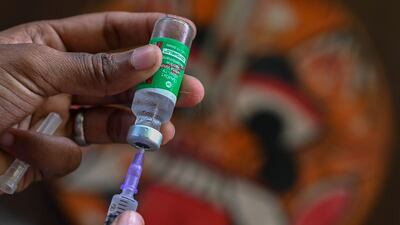
A health worker prepares to administer a Covishield vaccine in Chennai. Arun Sankar / AFP -
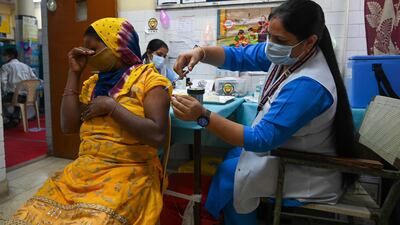
A health worker inoculates a woman with a dose of the Covaxin vaccine in New Delhi. Prakash Singh / AFP -

A health worker, left, registers a man for a dose of the Covaxin vaccine in New Delhi. Prakash Singh / AFP -
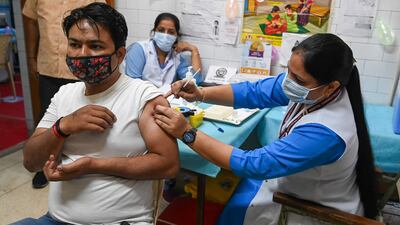
A health worker inoculates a man with a dose of the Covaxin vaccine in New Delhi. Prakash Singh/ AFP -

Volunteers decorate a vaccination centre to celebrate India administering its billionth Covid-19 vaccine. Prakash Singh / AFP


“The inactivated vaccine contains hundreds of components which we don’t know, which are not well investigated. The viral vector vaccines have dozens of other viral proteins.”
Although mRNA can be made artificially, it is not a human invention, because it plays a central role in the production of proteins from an organism’s genes.
Consisting of a single strand of ribonucleic acid (RNA), mRNA is what genes (which in people are made from deoxyribonucleic acid or DNA) are copied inside the nucleus of cells.
The mRNA travels into the liquid area outside the nucleus, the cytoplasm, where, in a process called translation, it codes for the production of a protein.
The sequence of amino acids (protein building blocks) that make up this protein is determined by the sequence of the base pairs or repeating units of the mRNA.
When mRNA is administered as a vaccine or other therapeutic substance, it too ends up in cells, where translation takes place and proteins are produced.
With Covid-19 vaccines, these proteins are coronavirus spike proteins, the immune response to which offers protection if the person is subsequently infected with the virus.
Could vaccine 'holy grail' be next?
Other mRNA vaccines being developed are aimed at influenza, with three vaccine candidates from companies, including Pfizer and Moderna, in clinical trials. Malaria is another mRNA vaccine target.
In December it was reported that experiments on animals indicated that an mRNA vaccine against HIV, the virus that causes Aids, could prove effective, as the vaccine stimulated the hoped-for immune response.
“People are already looking at an HIV vaccine, which is the holy grail – no one has managed to develop one after 30 years,” said Dr Andrew Freedman, an infectious diseases specialist at Cardiff University in the UK.
“I think it will certainly be the case that we’ll get more [mRNA vaccines] against other infections.”
Many potential applications of mRNA were outlined in a new paper co-authored by a UAE-based researcher, Dr Ahmed Negmeldin, an assistant professor at Gulf Medical University in Ajman.
Titled, “Chemically modified mRNA beyond Covid-19: Potential preventive and therapeutic applications for targeting chronic diseases”, the study is the latest of many to highlight mRNA’s myriad potential medical uses.
Others may use the molecule to make a protein that a person’s cells cannot produce correctly. One such “protein replacement therapy” could lead to mRNA being used to promote heart regeneration after a person has had a heart attack.
Typically, damaged cardiomyocytes, the cells that make the heart contract, cannot be remade, leading to scarring, but mRNA treatments could help the organ to regenerate.
Boosting fight against cancer
Another potential use is in the treatment of various forms of cancer, with numerous therapies based on the technology having entered clinical trials.
Many types of cancer immunotherapy, in which the immune system is trained to target cancer cells, are already used, but typically these do not involve mRNA.
Therapeutic mRNA vaccines could offer an additional way of treating cancer that may ultimately improve survival rates for certain forms of the disease.
For example, trials are happening in which mRNA is administered to people with non-small cell lung cancer, which accounts for about 85 per cent of lung cancer cases.
This approach makes use of the fact that cancer cells often produce particular proteins or antigens that non-cancer cells do not make.
If mRNA that codes for these proteins is introduced into a person’s cells, the immune system becomes trained to target these antigens, which should lead to the destruction of cancer cells.
BioNTech is among the companies working on mRNA-based cancer immunotherapies. It is involved with trials in the US in which colon cancer patients are having mRNA vaccines administered.
Drug makers are also trialling mRNA-based therapies against, for example, prostate cancer, a type of kidney cancer and melanoma.
Other illnesses could also be targeted by mRNA-based treatments, including metabolic disorders, such as diabetes.
Studies indicate that mRNA can stimulate pancreatic cells to produce insulin, which could be used to treat Type 1 diabetes, in which the pancreas does not produce much or any insulin.
Animal studies suggest that mRNA may be effective at treating conditions as varied as osteoarthritis and cystic fibrosis.
There are numerous technical hurdles to overcome with some mRNA treatments, as Dr Negmeldin and his co-authors made clear in their recent paper.
These include that production of proteins by mRNA used in medicines may be relatively transient, so ways to ensure that production takes place over a prolonged period are needed in some instances.
The cold-temperature requirements of some mRNA vaccines are another potential hurdle to wide-scale application of the technology.
“Since this innovative technology has been recently employed in the clinical setting, a long-term safety profile has to be established, and thorough pharmacovigilance has to be considered,” Dr Negmeldin and his co-authors wrote.
But overall the potential of mRNA for treating or preventing disease is seen as very significant and many uses could, it is hoped, come to fruition in the coming years and decades.

