

Ramadan 1445 began in the UAE on March 11 this year, after the country's moon-sighting committee saw a new crescent moon the evening before.
In the Emirates, the moon is typically sighted using a telescope but confirmed with the naked eye to maintain tradition.
What is Ramadan?
The month of Ramadan is when able Muslims fast from food, drink or medicine from sunrise (fajr) to sunset (maghrib). Once the sun sets, Muslims break their fast with a meal called iftar.
Considered the holiest month in the Islamic – or Hijri – calendar, Ramadan is believed to be when the Quran was revealed to Prophet Mohammed. It is a time when Muslims strengthen their faith through prayer, recitation of the holy book and charitable work.
How long does Ramadan last?
It typically lasts between 29 to 30 days, depending on the moon phase sightings, as the Islamic calendar is lunar. This also means Ramadan moves up the Gregorian calendar by about 10 days each year. In 2023, Ramadan was called on March 23.
The final day of the holy month will be determined closer to the time by the UAE's moon-sighting committee.
How long must each Muslim fast each day?
With the month falling earlier this year, Muslims can expect to fast for a slightly shorter time than they did last year, but the days lengthen towards the end of the month, as we approach the summer.
This year, Muslims in the UAE will begin the month by fasting for about 14 hours and 27 minutes. The fasting time will steadily increase as Ramadan goes on. By the last day of the holy month, the fast will be 15 hours and 14 minutes – about 47 minutes longer than it was on the first.
The fasting period varies for Muslims worldwide with the shortest hours in Chile this year, with an average of 12 hours and 44 minutes. The longest fasting hours will be experienced by Muslims in Finland, Greenland and Iceland this year with 17 hours of daylight on average.

What time do Muslims pray during Ramadan?
Prayer is one of the five pillars of Islam and Muslims are obliged to pray five times a day: fajr, dhuhr, asr, maghrib and isha. Throughout the holy month, an additional extended evening prayer called taraweeh is performed after isha.
During the final 10 nights of Ramadan, when Muslims increase their piety further, some may choose to perform tahajjud prayers – also known as qiyam al layl – which are carried out after taraweeh throughout the evening.
Muslims typically try to pray at mosques as it is thought there is a greater reward in communal prayer.
Here are the prayer times for the month of Ramadan in the UAE in 2024
Muslims around the world mark the beginning of Ramadan – in pictures
-
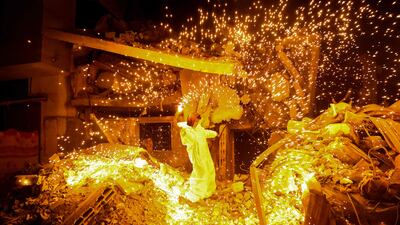
A Palestinian child plays with a sparkler in Rafah, in the southern Gaza Strip, on the eve of Ramadan. AFP -

Worshippers perform fajr prayers on the first day of Ramadan at Al Farooq Omar Bin Al Khattab Mosque in Dubai. Antonie Robertson / The National -

A volunteer distributes food for suhoor in Beirut. AFP -
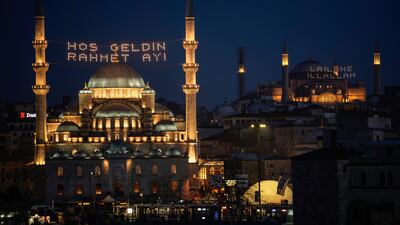
New Valide Sultan Mosque, left, and Hagia Sophia Mosque in Istanbul welcome worshippers on the eve of Ramadan. AP -
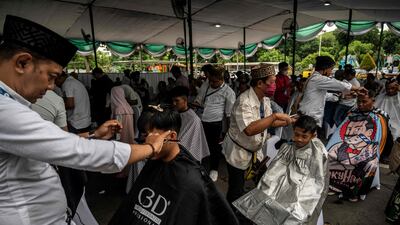
A mass haircut outside Al Akbar Mosque in Surabaya, Indonesia, on the eve of Ramadan. AFP -
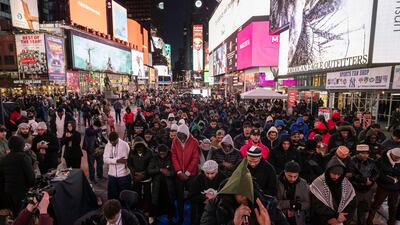
Muslims gather for taraweeh prayers in New York's Times Square. AP -
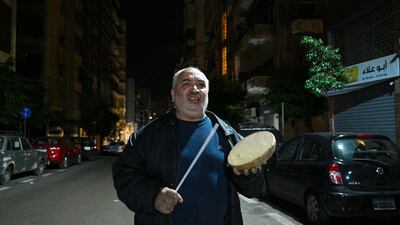
A Lebanese drummer makes his rounds waking people for suhoor, the meal taken during Ramadan before sunrise prayers, in Beirut. EPA -

Devotees attend taraweeh on the eve of Ramadan at Amr bin Al-Aas Mosque, Cairo. Reuters -
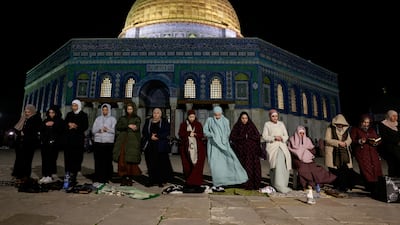
Women gather for taraweeh at Al Aqsa Mosque compound in Jerusalem’s Old City. Reuters -
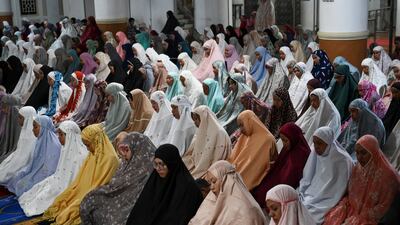
Women offer the first taraweeh prayers of Ramadan at At-Taqwa mosque in Banda Aceh, Indonesia. Reuters -
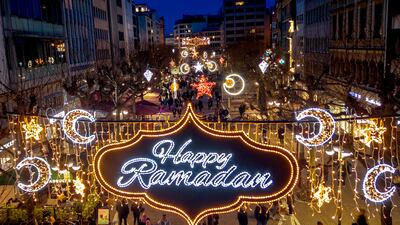
A Ramadan sign is illuminated to mark the beginning of the holy month in Frankfurt, Germany. AP -
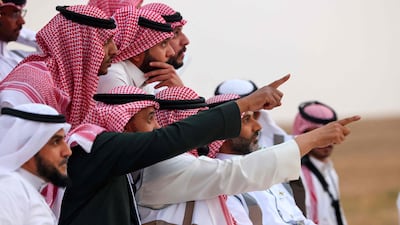
Saudi men look to spot the first crescent of the moon in the southern city of Hautat Sudair. AFP


*A version of this story first appeared in The National in 2023

