Ramadan 2020, in the Islamic year 1441, will always be remembered for one thing: Covid-19. But momentous events have always occurred during the holy month down the years.
As part of a series delving into Ramadan over recent decades, starting in 1950, we look back over the last 70 years at some of the headlines from previous Ramadans, with an emphasis on the positive, of news that shows the strength and creativity of the human spirit.
1990 (1410) March 28 – April 25
At the Berlin Olympics of 1936, Jesse Owens overturned Adolf Hitler’s fantasies of a master race by winning four gold medals, including the 100 meters, under the nose of the Nazi leader.
The irony was that in Owen’s native US, black people were subject to an almost equal degree of racial prejudice, and abuse of their civil rights.
On March 29, 1990, Owens was awarded a fifth gold medal, the Congressional Gold Medal, presented to his wife, Rush, by President George H Bush. It was a posthumous award; Owens had died 10 years earlier, having been denied a visit to the White House or even a telegram of congratulations from President Franklin Roosevelt on his return from Germany 53 years earlier.
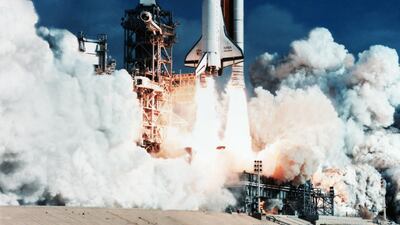
Eid 1990 saw the Space Shuttle Discovery blasted into orbit carrying a cargo that would soon become a household name.
The Hubble Space Telescope, named after the American astronomer Edwin Hubble, would send us some of the most remarkable images of our universe over the next 40 years.
Not at first though. An error in the telescope’s main mirror had to be corrected in a servicing mission three years later. Still operating, Hubble will be replaced by the more powerful James Webb Space Telescope next year.
President George Bush Snr presents Ruth Owens, wife of Olympic star Jesse Owens, with a Congressional Gold Medal on in Washington during a ceremony at the White House. Barry Thumma / AP
1992 (1412) March 6 – April 4
Imran Khan bowls to England tail ender Richard Illingworth, to see him caught by Ramiz Raja. It is March 25, in Ramadan 1992, and Pakistan have beaten England to win their first Cricket World Cup.
The fifth World Cup was hosted jointly by Australia and New Zealand, and Pakistan only narrowly made it to the semi-finals, finishing fourth in the round robin stage, only a point ahead of tournament favourites Australia.
Pakistan reached the final with a semi-final victory over New Zealand, and then defeated England by 22 runs at the Melbourne Cricket Ground with Khan’s captain’s inning of 72 that was his last before retiring from international cricket, and the start of his journey towards becoming the current prime minister of Pakistan.
MELBOURNE, AUSTRALIA - MARCH 25: Pakistan captain Imran Khan (c) celebrates the moment of victort after Rameez Raja (not pictured) had caught England batsman Richard Illingworth (r) to win the 1992 Cricket World Cup Final by 22 runs at the MCG on March 25, 1992 in Melbourne, Australia. (Photo Joe Mann/Allsport/Getty Images)
1996 (1415) January 22 to February 20
On February 10, 1996, Gary Kasparov, a Russian grandmaster, and regarded by many as the greatest chess player in history, sat down with his toughest opponent to date.
The venue was Philadelphia and on the other side of the board was Deep Blue, a supercomputer designed and built by IBM.
After 36 moves, Kasparov resigns. It is the first time a computer has beaten a reigning chess world champion.
The Russian would later claim he believed there had been human intervention in some of the computer’s moves, but went on to win three and draw two of the six game tournament.
Kasparov and Deep Blue, now upgraded, met again the following year and this time the computer narrowly came out on top. The Russian demanded a rematch but Deep Blue had been dismantled by IBM.
By 2006, computers had become so advanced that there were no further matches with humans to determine superiority.
World chess champion Garry Kasparov, L, takes a pawn in the opening minutes of a six-game, six-day chess match against IBM's "Deep Blue" computer in Philadelphia 10 February. Feng-hsiung Hsu, R, the principal designer of "Deep Blue," keys a move into the computer. The computer, capable of computing 200 million positions per second, is powerful enough to be comparable to Kasparov's level of play. Tom Mihalek / AFP
2001 (1422) November 16 – December 16
The Leaning Tower of Pisa’s main claim to fame is, well, that it leans. Built in the 12th Century, the cathedral bell tower has clay foundations that soon began to subside on one side.
By 1990, the tilt had reached 5.5 degrees and the historic building was in real danger of falling over.
A Dh98 million rescue mission was launched by Italian authorities in1990 with the delicate task of lessening the tilt but only just enough to allow the tower’s lean to remain a major tourist attraction.
The cathedral bells were first taken down, while steel cables anchored the tower to the ground. Over 70 tonnes of soil were then removed from one side of the foundations, reducing the tilt by 45cm and returning the building to the lean of 1838.
On December 15, 2001, the (slightly less) Leaning Tower of Pisa was declared stable for the next 200 years and reopened to the public.
According to Guinness World Records, the Capital Gate tower in Abu Dhabi is now the world’s "farthest man-made leaning building” at 18 degrees or five times greater than Pisa.
Tourists visit the Leaning Tower of Pisa on December 15, 2001, the day of the official opening to the public after an 11-year closure for restoration. Alberto Pizzoli / AFP
2008 (1429) September 1 – October 1
September 28, 2008, saw a demonstration satellite payload successfully deployed after launching from an American military airbase in the Pacific.
This was Falcon 1, the first orbital launch of a privately funded and developed space rocket.
Space X had been founded in 2002 by the billionaire Elon Musk with the ambitious goal of reducing the costs of space travel to allow a privately funded mission to Mars.
Musk, born in South Africa but also a US citizen, made his fortune with the creation of PayPal, and had created Tesla, the electric vehicle company in 2003.
Space X was his most ambitious venture yet but the first three flights of his Falcon 1 ended in failure. The success of the fourth launch heralding a new era of commercial space travel, with the next flight, in July 2009, putting an observation satellite developed by Malaysia into low Earth orbit.
Falcon 1 was replaced by the more powerful Falcon 9, whose first stage is reusable and can land under its own power.
It was a Space X Falcon 9 that carried the experiment by Genes in Space winner Alia Al Mansoori to the International Space Station in August 2017.
Space X hopes to make history again later this month, when its Dragon capsule will take American astronauts to the ISS.
It will be the first US manned space flight since the ending of the Space Shuttle programme in 2011 and only the fifth crewed space craft since American sent John Glenn into orbit in 1962.
Musk still has his eyes set on Mars, developing his Starship, which he says will be capable of interplanetary travel and could make its first test flight as early as next year.
Alia Al Mansoori watches her experiment be launched into space in the Space X Falcon 9 rocket in August 2017. Scott A Miller / The National
Winner Dubai Love, Patrick Cosgrave, Saeed bin Suroor.
7.40pm Dubai Dash Listed $175,000 (T) 1,000m
Winner: Equilateral, James Doyle, Charles Hills.
8.15pm Al Bastakiya Trial Conditions $100,000 (D) 1.900m
Winner Laser Show, Kevin Stott, Saeed bin Suroor.
8.50pm Al Fahidi Fort Group Two $250,000 (T) 1,400m
Winner Glorious Journey, James Doyle, Charlie Appleby.
9.25pm Handicap $135,000 (D) 2,000m
Winner George Villiers, Tadhg O’Shea, Satish Seemar.
HAEMOGLOBIN DISORDERS EXPLAINED
Thalassaemia is part of a family of genetic conditions affecting the blood known as haemoglobin disorders.
Haemoglobin is a substance in the red blood cells that carries oxygen and a lack of it triggers anemia, leaving patients very weak, short of breath and pale.
The most severe type of the condition is typically inherited when both parents are carriers. Those patients often require regular blood transfusions - about 450 of the UAE's 2,000 thalassaemia patients - though frequent transfusions can lead to too much iron in the body and heart and liver problems.
The condition mainly affects people of Mediterranean, South Asian, South-East Asian and Middle Eastern origin. Saudi Arabia recorded 45,892 cases of carriers between 2004 and 2014.
A World Health Organisation study estimated that globally there are at least 950,000 'new carrier couples' every year and annually there are 1.33 million at-risk pregnancies.
Cecelia Crocker was on board Northwest Airlines Flight 255 in 1987 when it crashed in Detroit, killing 154 people, including her parents and brother. The plane had hit a light pole on take off
George Lamson Jr, from Minnesota, was on a Galaxy Airlines flight that crashed in Reno in 1985, killing 68 people. His entire seat was launched out of the plane
Bahia Bakari, then 12, survived when a Yemenia Airways flight crashed near the Comoros in 2009, killing 152. She was found clinging to wreckage after floating in the ocean for 13 hours.
Jim Polehinke was the co-pilot and sole survivor of a 2006 Comair flight that crashed in Lexington, Kentucky, killing 49.
Mercer, the investment consulting arm of US services company Marsh & McLennan, expects its wealth division to at least double its assets under management (AUM) in the Middle East as wealth in the region continues to grow despite economic headwinds, a company official said.
Mercer Wealth, which globally has $160 billion in AUM, plans to boost its AUM in the region to $2-$3bn in the next 2-3 years from the present $1bn, said Yasir AbuShaban, a Dubai-based principal with Mercer Wealth.
“Within the next two to three years, we are looking at reaching $2 to $3 billion as a conservative estimate and we do see an opportunity to do so,” said Mr AbuShaban.
Mercer does not directly make investments, but allocates clients’ money they have discretion to, to professional asset managers. They also provide advice to clients.
“We have buying power. We can negotiate on their (client’s) behalf with asset managers to provide them lower fees than they otherwise would have to get on their own,” he added.
Mercer Wealth’s clients include sovereign wealth funds, family offices, and insurance companies among others.
From its office in Dubai, Mercer also looks after Africa, India and Turkey, where they also see opportunity for growth.
Wealth creation in Middle East and Africa (MEA) grew 8.5 per cent to $8.1 trillion last year from $7.5tn in 2015, higher than last year’s global average of 6 per cent and the second-highest growth in a region after Asia-Pacific which grew 9.9 per cent, according to consultancy Boston Consulting Group (BCG). In the region, where wealth grew just 1.9 per cent in 2015 compared with 2014, a pickup in oil prices has helped in wealth generation.
BCG is forecasting MEA wealth will rise to $12tn by 2021, growing at an annual average of 8 per cent.
Drivers of wealth generation in the region will be split evenly between new wealth creation and growth of performance of existing assets, according to BCG.
Another general trend in the region is clients’ looking for a comprehensive approach to investing, according to Mr AbuShaban.
“Institutional investors or some of the families are seeing a slowdown in the available capital they have to invest and in that sense they are looking at optimizing the way they manage their portfolios and making sure they are not investing haphazardly and different parts of their investment are working together,” said Mr AbuShaban.
Some clients also have a higher appetite for risk, given the low interest-rate environment that does not provide enough yield for some institutional investors. These clients are keen to invest in illiquid assets, such as private equity and infrastructure.
“What we have seen is a desire for higher returns in what has been a low-return environment specifically in various fixed income or bonds,” he said.
“In this environment, we have seen a de facto increase in the risk that clients are taking in things like illiquid investments, private equity investments, infrastructure and private debt, those kind of investments were higher illiquidity results in incrementally higher returns.”
The Abu Dhabi Investment Authority, one of the largest sovereign wealth funds, said in its 2016 report that has gradually increased its exposure in direct private equity and private credit transactions, mainly in Asian markets and especially in China and India. The authority’s private equity department focused on structured equities owing to “their defensive characteristics.”
THE SIXTH SENSE
Starring: Bruce Willis, Toni Collette, Hayley Joel Osment
Founded in 1985 by Sheikh Mohammed bin Rashid, Vice President and Ruler of Dubai, the Central Veterinary Research Laboratory (CVRL) is a government diagnostic centre that provides testing and research facilities to the UAE and neighbouring countries.
One of its main goals is to provide permanent treatment solutions for veterinary related diseases.
The taxidermy centre was established 12 years ago and is headed by Dr Ulrich Wernery.
The President's Cake
Director: Hasan Hadi
Starring: Baneen Ahmad Nayyef, Waheed Thabet Khreibat, Sajad Mohamad Qasem

