

More women should be encouraged to become astronauts following the UAE’s phenomenal success in the space sector last year, experts have said.
Hazza Al Mansouri became the country’s first astronaut after his eight day mission to the International Space Station in September.
Now, scientists and engineers in the Emirates have stressed the importance of capitalising on the achievement by inspiring more women to join the industry.
Already, 77 per cent of computer science students in the UAE are women while 44.5 per cent of engineering undergraduates in the country are also female.
“The next step is to send an Emirati woman to space,” said Shaikha Al Falasi, 26, a research engineer at the Mohammed Bin Rashid Space Centre (MBRSC).
“We need to take this momentum and motivate young people. Taking one astronaut into space was not the effort of one person but an eclectic effort.
“When I was an engineer, I was looking for other women who could help me. I was looking for a voice to lift me up.”
Former fighter pilot Maj Al Mansouri became the third Arab in space and the first in more than 20 years following his mission to ISS.
He orbited Earth 128 times during his stay on the station, in a journey of almost five million kilometres.
Since then, Salem Al Marri, director of the Space Systems Development Department at the MBRSC, has said the UAE’s next astronaut could be female.
Already, 40 per cent of staff at the MBRSC are women. Last year, a third of applicants to Khalifa University’s master’s space programme were female.
“We will choose the most talented and suitable candidate regardless of gender,” Mr Ali Marri told a Dubai press conference in December.
Speaking to The National this week, Ms Al Falasi told how she had wanted to become an engineer as a young girl.
She went on to study civil engineering at New York University Abu Dhabi where she was the only woman in a class of 19 students during a semester in the United States.
"I wanted to break the stereotype,” she said. “Many people told me I could not be an engineer but I believed in myself and that was the best incentive.

“Why can’t women work in STEM (science, technology, engineering and mathematics)?
“The spaces sector is new and we are a young country. We have to let women know their voices need to be heard and we need them in these sectors.”
Ahlam Al Qasim, a PhD student in Space and Climate Physics at the University College London, said she hoped to become the first female Emirati astronaut.
She was finishing her first year at university studying arts when she asked herself what was stopping her from pursuing her dream of reaching space.
Deciding to switch to physics, she told The National she had never looked back.
“My greatest dream ever since I was a child was to become an astronaut," said Ms Al Qasim.
-
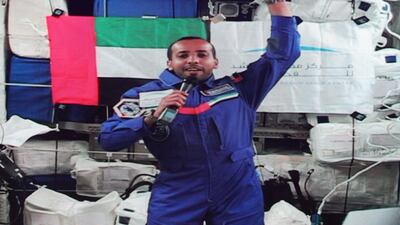
The UAE's first astronaut, Maj Hazza Al Mansouri, takes part in a Q&A session from the International Space Station with an audience at the Mohammed bin Rashid Space Centre, Dubai, in 2019. Chris Whiteoak / The National -
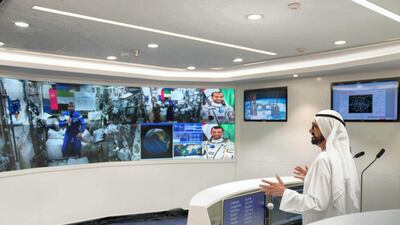
Sheikh Mohammed bin Rashid, Vice President and Ruler of Dubai, talks with Emirati astronaut Maj Hazza Al Mansouri, during a live satellite feed from the International Space Station. Courtesy: Dubai Media Office -
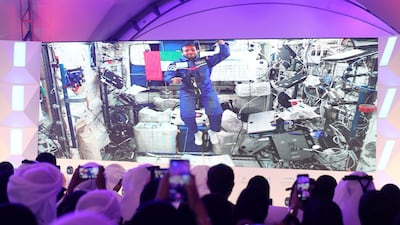
The Emirati astronaut takes questions from the audience gathered at the Mohammed bin Rashid Space Centre. Chris Whiteoak / The National -
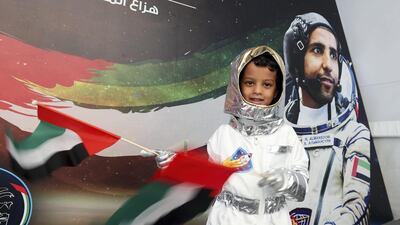
An aspiring young astronaut poses in front of a picture of the first Emirati in space, Maj Hazza Al Mansouri. Chris Whiteoak / The National -
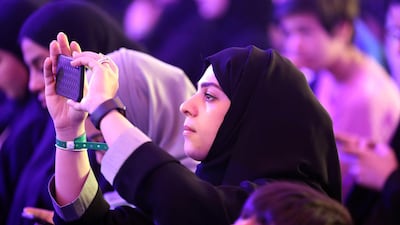
A woman films the Q&A session with Maj Hazza Al Mansouri from the International Space Station. Chris Whiteoak / The National -
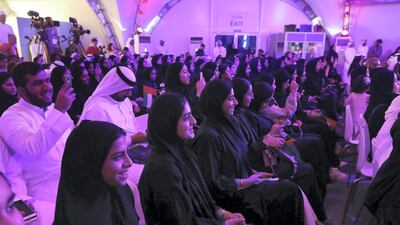
The audience at the Mohammed bin Rashid Space Centre are delighted to hear from Maj Hazza Al Mansouri. Chris Whiteoak / The National -
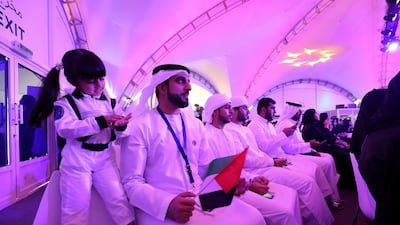
An aspiring young astronaut and her family at the Mohammed bin Rashid Space Centre event. Chris Whiteoak / The National -
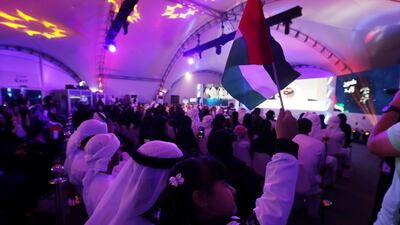
A young audience member celebrates the first Emirati in space. Chris Whiteoak / The National -
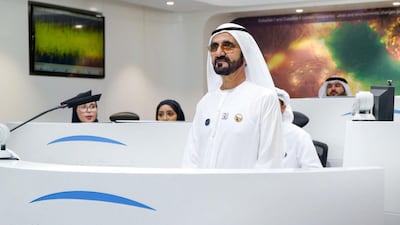
Sheikh Mohammed bin Rashid talks to Maj Hazza Al Mansouri. Courtesy Dubai Media Office -
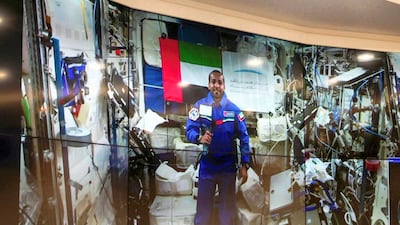
Emirati astronaut Hazza Al Mansouri, during a live satellite feed from the International Space Station. Courtesy Dubai Media Office -
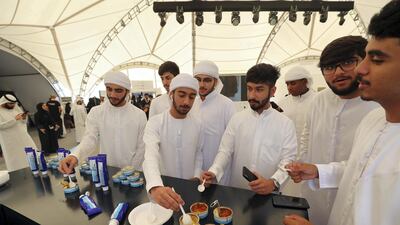
Audience members at the Mohammed bin Rashid Space Centre event sample space food. Chris Whiteoak / The National -
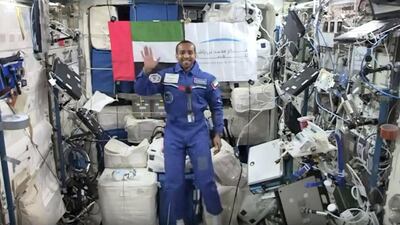
Emirati astronaut Maj Hazza Al Mansouri gives his audience on Earth a tour of the International Space Station. Screengrab via Youtube Live -
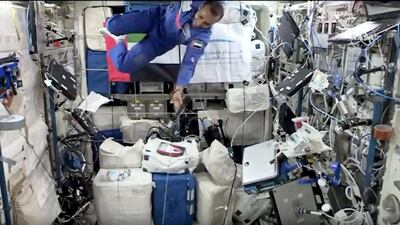
Maj Hazza Al Mansouri demonstrates the effects of weightlessness. Screengrab via Youtube Live -
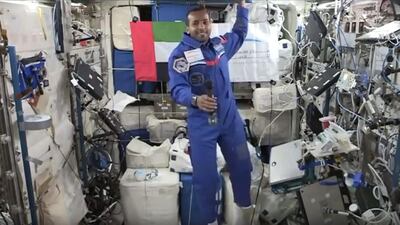
Hazza Al Mansouri takes a live Q&A from space. He spent eight days on the International Space Station, in a mission from September 25 to October 3, 2019. Screengrab via Youtube Live -
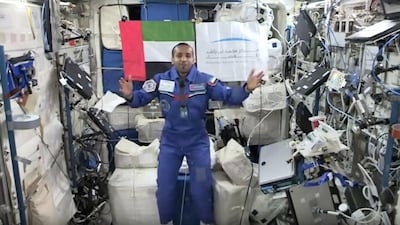
Emirati astronaut, Hazza Al Mansouri, takes live Q&A from space and gives a station tour. Screengrab via Youtube Live


"Giving younger Arab girls role models to look up to in STEM is very important, and highlighting Arab females in STEM and making sure their work is not being overlooked is the first step to doing that.
“My family and friends have been very supportive of my journey but my dream of being an astronaut had different reactions from the people around me because it seemed impossible.
“Some of my friends laughed and thought I was delusional. But once they saw how serious I was, they encouraged me.
“Increasingly, I see more and more support in the UAE - more than I saw in the STEM communities in western countries.
“I hope to see more Arab women contribute to the global science community and leave their mark.”

