
A team of researchers at Abu Dhabi’s Khalifa University have developed a promising new testing kit that can detect coronavirus in 35 minutes.
The portable device, which is slightly larger than a smartphone, is undergoing clinical validation.
So far, the results have proven to be as accurate as a PCR nasal swab test, the method currently used to identify the virus in patients.
The reusable kit can test 16 different samples at one time, the colour of which changes depending on the result.
The process involves a loop-mediated isothermal amplification (Lamp) technique, which is a low-cost method to detect certain diseases.
“Polymerase chain reaction or PCR testing is lengthy and requires bulky equipment,” said said Dr Anas Alazzam, associate professor in mechanical engineering at Khalifa University and primary investigator of the kit.
“It uses a thermal cycling approach to start the RNA replication process, which needs to be converted to DNA and detect the virus.
“Lamp, on the other hand, uses a single temperature approach to get the same results.
“It can be conducted on a single device and the process is much faster.”
Initially, the kit took 45 minutes to deliver results, including 15 minutes to prepare the sample and 30 minutes to test it.
-
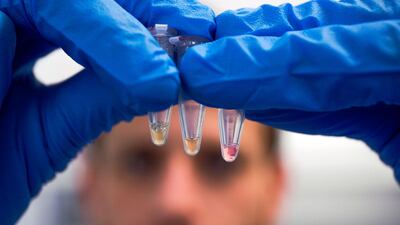
A team of researchers from Khalifa University have developed a portable Covid-19 testing kit that can deliver results in just 35 minutes. Victor Besa / The National -

When the test is complete, an alarm sounds and the person analysing the results can determine if it is positive or negative depending on the colour of the sample. Victor Besa / The National -
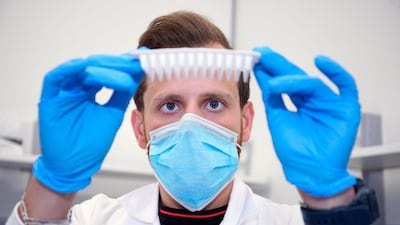
Hussein Kannout, research associate at the Centre for Biotechnology at Khalifa University. Victor Besa / The National -

The team started working on the device in May and have tested only nasal swabs so far. Victor Besa / The National -

The testing kit can process 16 different samples at the same time and can be reused. Victor Besa / The National -

Dr. Anas Alazzam, associate professor in mechanical engineering at Khalifa University. Victor Besa / The National -
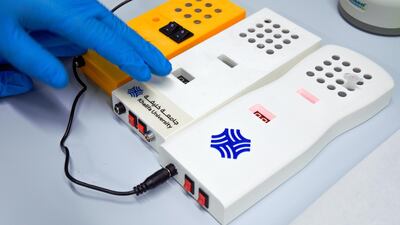
The hand-held device was designed and 3D-printed at the university and is slightly larger than a smartphone. Victor Besa / The National -

A member of the research team testing samples at the campus laboratory. Victor Besa / The National


This month, researchers working on the kit were able to reduce the preparation time to five minutes, bringing down the total time to detect coronavirus to just 35 minutes.
“We use a colorimetric detection method. When the test is complete, an alarm sounds and we see a change of colour in the samples,” said Dr Alazzam.
“Yellow represents a positive case and pink represents a negative case.
“We started working on this device in May and so far we have tested only nasal swabs.
“Starting mid-October we will be doing saliva tests, and hopefully, in the very near future we'll be able to detect coronavirus using saliva samples.”
The hand-held device, which was designed and 3D-printed at Khalifa University, is 25 centimetres long and seven centimetres wide.
The team is currently working to reduce its size further.
“Once the device is clinically validated and we receive approval from the government, we can begin its mass production,” said Dr Alazzam.
“The device could be used at home, in offices as well as for rapid testing of frontline workers.
“We could even use it to screen passengers at the airport or on board a plane.”

