• Residents wearing masks on their way home after a day's work at central Abu Dhabi. Victor Besa/The National
    Residents wearing masks on their way home after a day's work at central Abu Dhabi. Victor Besa/The National
  • A Talabat driver is all thumbs up at central Abu Dhabi. Victor Besa/The National
    A Talabat driver is all thumbs up at central Abu Dhabi. Victor Besa/The National
  • A medical staff works inside a lab for analysing the coronavirus tests, at Rafik Hariri University Hospital, in Beirut, Lebanon. REUTERS
    A medical staff works inside a lab for analysing the coronavirus tests, at Rafik Hariri University Hospital, in Beirut, Lebanon. REUTERS
  • A worker disinfects a room where patients undergo tests for the coronavirus disease at Rafik Hariri University Hospital in Beirut, Lebanon. REUTERS
    A worker disinfects a room where patients undergo tests for the coronavirus disease at Rafik Hariri University Hospital in Beirut, Lebanon. REUTERS
  • Fatiha Amahrane, director of Mansour Eddahbi college, organises students into social distancing at the entrance to the Mansour Eddahbi College in the Derb El Kabir district at the AL Fida prefecture in Casablanca, Morocco. Today it is the start of the school year in Casablanca, with a delayed start due to the COVID-19 pandemic. AP Photo
    Fatiha Amahrane, director of Mansour Eddahbi college, organises students into social distancing at the entrance to the Mansour Eddahbi College in the Derb El Kabir district at the AL Fida prefecture in Casablanca, Morocco. Today it is the start of the school year in Casablanca, with a delayed start due to the COVID-19 pandemic. AP Photo
  • Student Imane Date disinfects his hands in his classroom at Mansour Eddahbi college in the Derb El Kabir district of the AL Fida prefecture in Casablanca, Morocco. Today it is the start of the school year in Casablanca, with a delayed start due to the COVID-19 pandemic. AP Photo
    Student Imane Date disinfects his hands in his classroom at Mansour Eddahbi college in the Derb El Kabir district of the AL Fida prefecture in Casablanca, Morocco. Today it is the start of the school year in Casablanca, with a delayed start due to the COVID-19 pandemic. AP Photo
  • Tunisian artists and cultural workers observe a sit-in in front the opera theatre in the capital Tunis amid the Covid-19 coronavirus pandemic. Tunisian Prime Minister Hichem Mechichi announced the ban on all gatherings, and reiterated the obligation to wear the mask in order to slow the spread of the new coronavirus, which threatens to saturate hospitals. AFP
    Tunisian artists and cultural workers observe a sit-in in front the opera theatre in the capital Tunis amid the Covid-19 coronavirus pandemic. Tunisian Prime Minister Hichem Mechichi announced the ban on all gatherings, and reiterated the obligation to wear the mask in order to slow the spread of the new coronavirus, which threatens to saturate hospitals. AFP
  • Tunisian Health Minister Faouzi Mehdi speaks during a press conference with the Minister of the Interior Taoufik Charfeddine in Tunis, Tunisia. According to Mehdi, his ministry is currently working to increase the number of resuscitation beds through the creation of field hospitals in cooperation with the ministry of National Defense and civil society, in an effort to ease the strain on hospitals that are under pressure from the increasing numbers of COVID-19 cases. EPA
    Tunisian Health Minister Faouzi Mehdi speaks during a press conference with the Minister of the Interior Taoufik Charfeddine in Tunis, Tunisia. According to Mehdi, his ministry is currently working to increase the number of resuscitation beds through the creation of field hospitals in cooperation with the ministry of National Defense and civil society, in an effort to ease the strain on hospitals that are under pressure from the increasing numbers of COVID-19 cases. EPA
  • A woman takes a coronavirus test at the Ankara City Hospital in Ankara, Turkey. As coronavirus cases continue to rise around the globe, Turkey is also seeing a new rise in cases as it goes through a second peak of the first wave of the virus. Ankara, the nation’s capital has the highest number of confirmed cases in the country according to figures from the health ministry. In a recent press conference Health Minister Fahrettin Koca acknowledged that the daily coronavirus figures published by the health ministry are not including asymptomatic people, causing fears to grow around the true number of cases across the country. Getty Images
    A woman takes a coronavirus test at the Ankara City Hospital in Ankara, Turkey. As coronavirus cases continue to rise around the globe, Turkey is also seeing a new rise in cases as it goes through a second peak of the first wave of the virus. Ankara, the nation’s capital has the highest number of confirmed cases in the country according to figures from the health ministry. In a recent press conference Health Minister Fahrettin Koca acknowledged that the daily coronavirus figures published by the health ministry are not including asymptomatic people, causing fears to grow around the true number of cases across the country. Getty Images
  • Medical staff tend to a COVID-19 patient at the Ankara City Hospital, Intensive Care Unit (ICU) in Ankara, Turkey. Getty Images
    Medical staff tend to a COVID-19 patient at the Ankara City Hospital, Intensive Care Unit (ICU) in Ankara, Turkey. Getty Images
  • A Palestinian boy wearing a protective face mask looks through an opening in a sheet as he watches people harvest dates amid the coronavirus disease restrictions, in Deir al-Balah in the central Gaza Strip. REUTERS
    A Palestinian boy wearing a protective face mask looks through an opening in a sheet as he watches people harvest dates amid the coronavirus disease restrictions, in Deir al-Balah in the central Gaza Strip. REUTERS
  • A Palestinian fisherman repairs his net at a beach amid the coronavirus disease restrictions, in the northern Gaza Strip. REUTERS
    A Palestinian fisherman repairs his net at a beach amid the coronavirus disease restrictions, in the northern Gaza Strip. REUTERS

Covid-19 is airborne, disease control experts confirm in updated guidance


Gillian Duncan
  • English
  • Arabic

Covid-19 can spread through tiny particles that can linger in the air for hours, according to new guidance from the Centres for Disease Control and Prevention.

The CDC has until now not made a direct link about the role airborne transmission is playing in the spread of the virus.

But the US public health agency's new advice admits aerosolised virus particles can, and do, infect others under "certain circumstances".

The capacity of Covid-19 to spread through minuscule droplets, which float in the air long after an infected person coughs, breathes, or sneezes, was noted by authorities in China in February, very early in the outbreak.

There is evidence that under certain conditions, people with Covid-19 seem to have infected others who were more than six feet away

Dozens of studies conducted worldwide have since confirmed or suggested it, with growing evidence pointing to aerosol transmission.

Last month the CDC posted an update saying the virus could spread through aerosols, before hastily removing it, saying the advice was included in an “early draft” that had been published in error.

The new guidance acknowledges the virus can linger in the air – though it insists aerosolised transmission remains “uncommon”.

“There is evidence that under certain conditions, people with Covid-19 seem to have infected others who were more than six feet away,” says the guidance, which was issued on Monday.

“These transmission events appear uncommon and have typically involved the presence of an infectious person producing respiratory droplets for an extended time (greater than 30 minutes to multiple hours) in an enclosed space.

“Enough virus was present in the space to cause infections in people who were more than 6 feet away or who passed through that space soon after the infectious person had left.”

  • US President Donald Trump gestures after returning to the White House, in Washington, DC, USA, following several days at Walter Reed National Military Medical Centre for treatment for Covid-19. EPA
    US President Donald Trump gestures after returning to the White House, in Washington, DC, USA, following several days at Walter Reed National Military Medical Centre for treatment for Covid-19. EPA
  • Students exit the Gianturco primary school in Rome. A cabinet meeting on Monday was set to make wearing face masks outdoors compulsory across Italy. Lazio, the region around Rome, has already taken the measure, at the weekend. EPA
    Students exit the Gianturco primary school in Rome. A cabinet meeting on Monday was set to make wearing face masks outdoors compulsory across Italy. Lazio, the region around Rome, has already taken the measure, at the weekend. EPA
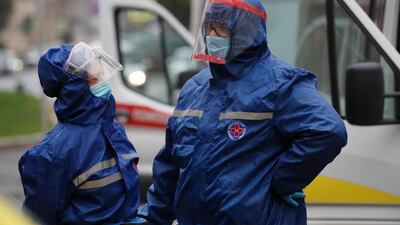
  • Emergency paramedics wearing protective equipment wait near ambulances to deliver patients to the admissions department at the Pokrovskaya hospital in St Petersburg, Russia, where patients infected with the Covid-19 are treated. EPA
    Emergency paramedics wearing protective equipment wait near ambulances to deliver patients to the admissions department at the Pokrovskaya hospital in St Petersburg, Russia, where patients infected with the Covid-19 are treated. EPA
  • A sign is displayed in the window of a student accommodation building following the outbreak of the coronavirus disease (Covid-19) in Manchester. Reuters
    A sign is displayed in the window of a student accommodation building following the outbreak of the coronavirus disease (Covid-19) in Manchester. Reuters
  • People visit Bondi beach in Sydney. AFP
    People visit Bondi beach in Sydney. AFP
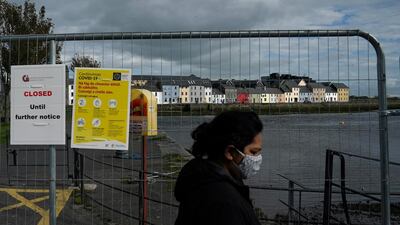
  • A woman wearing a protective face mask walks past a closed main walkway as the National Public Health Emergency Team (NPHET) announces recommendations that the government implement the highest level of Covid-19 restrictions in Galway, Ireland. Reuters
    A woman wearing a protective face mask walks past a closed main walkway as the National Public Health Emergency Team (NPHET) announces recommendations that the government implement the highest level of Covid-19 restrictions in Galway, Ireland. Reuters
  • A member of the White House cleaning staff sprays the press briefing room the evening of US President Donald Trump's return from Walter Reed Medical Centre after contracting the coronavirus disease (Covid-19), in Washington, DC, US. Reuters
    A member of the White House cleaning staff sprays the press briefing room the evening of US President Donald Trump's return from Walter Reed Medical Centre after contracting the coronavirus disease (Covid-19), in Washington, DC, US. Reuters
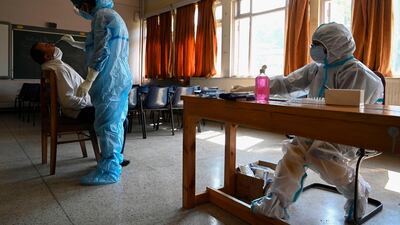
  • A medical worker collects a swab sample from a staff member of the Burnhall school inside a classroom for a Rapid Antigen Test (RAT) for the Covid-19 coronavirus, in Srinagar. AFP
    A medical worker collects a swab sample from a staff member of the Burnhall school inside a classroom for a Rapid Antigen Test (RAT) for the Covid-19 coronavirus, in Srinagar. AFP
  • A gymnastics instructor wearing personal protective equipment leads a morning exercise for patients of the Covid-19 at a hotel designated to treat asymptomatic patients in Karawaci, Indonesia's Banten province. AFP
    A gymnastics instructor wearing personal protective equipment leads a morning exercise for patients of the Covid-19 at a hotel designated to treat asymptomatic patients in Karawaci, Indonesia's Banten province. AFP
  • A passenger wearing a protective suit and face masks arrives at the Jorge Chavez International Airport in Callao, Peru, as international flights resume after more than six months due to the coronavirus pandemic. AFP
    A passenger wearing a protective suit and face masks arrives at the Jorge Chavez International Airport in Callao, Peru, as international flights resume after more than six months due to the coronavirus pandemic. AFP

Circumstances where confirmed airborne transmission has occurred, according to the CDC, include in enclosed spaces, when people were exposed shortly after the infected person left.

Aerosolised transmission has also occurred when infected people were shouting, singing or exercising, which increased the concentration of “suspended respiratory droplets in the air space”.

In addition, inadequate ventilation can increase the risk of airborne transmission by allowing the build-up of “suspended small respiratory droplets and particles,” says the CDC.

The agency said most people become infected by inhaling large droplets through close contact with sufferers.

However, writing in the journal Science this week, a group of researchers suggested incidents involving aerosol transmission were more common than the CDC has acknowledged.

“Individuals with Covid-19, many of whom have no symptoms, release thousands of virus-laden aerosols and far fewer droplets when breathing and talking,” they said.

“Thus, one is far more likely to inhale aerosols than be sprayed by a droplet, and so the balance of attention must be shifted to protecting against airborne transmission.”

Cases in which the coronavirus spread through the air include a bus trip in China where 23 out of 68 passengers became infected with the virus, some of whom were sitting farther than the 6ft experts say large droplets can travel.

In another instance, a singer at a choir practice in the US spread the virus to 52 people, including one person who was sitting 45 feet away.

Mounting evidence prompted a group of more than 200 aerosol biologists and other experts to sign a letter addressed to the World Health Organisation in July calling for greater recognition of the role of aerosol transmission in the outbreak.

"It is becoming clear that the pandemic is driven by superspreading events, and that the best explanation for many of those events is aerosol transmission," Jose-Luis Jimenez, a researcher at the University of Colorado Boulder, and one of 239 scientists to sign the letter, told The Washington Post.