



Covid-19 finds it harder to spread when temperatures are between 17°C and 24°C, a study by researchers in the US has found.
The findings offer a more complex picture than some previous studies, which indicated that lower temperatures were likely to result in more transmission.
“There was a lot of speculation back in 2020 that suggested that Sars-CoV-2, the virus that causes the outbreaks, would go away during summers. And we were not sure that was going to be the case,” said Antarpreet Jutla, associate professor at the University of Florida and the senior author of the study.
“We found out there were times when this viral activity decreases. This coincided with when we had very mellow temperatures — very pleasant climatic conditions.”
University of Florida
When the ambient temperature — the temperature of a person’s surroundings — is in the comfortable range of 17°C to 24°C, people spend more time outdoors.
Above and below this temperature range, people are more likely to be indoors, which has a two-fold effect on virus transmission, the study showed.
Indoors, people tend to be around others, which promotes the transmission of the virus, and they are more likely to breathe air in a “mechanically controlled environment” because of devices like air conditioners.
With these mechanical systems, the air is often drier and as a result is more likely to contain virus particles, the researchers said.
“An ambient temperature range of 17—24°C is that within which the number of Covid-19 cases decreases in cold and warm regions,” the scientists wrote in their paper, published in preliminary form in The American Journal of Tropical Medicine and Hygiene.
“Both extremes of ambient temperatures are associated with human activity shifting indoors, promoting exposure to recirculated air.
“Recent examples of indoor congregating in warm regions resulted in Covid-19 outbreaks, and these included religious gatherings in India, Pakistan, Malaysia, and South Korea.”
-
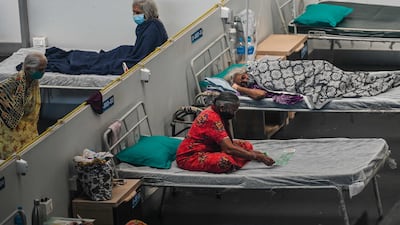
Patients rest inside a Covid-19 isolation centre in Navi Mumbai, India. AFP -

An Israeli paramedic collects a swab sample from a child at a Covid-19 testing centre in Jerusalem. AFP -

A caricature of Serbian tennis champion Novak Djokovic looks over a market in the Indian city of Siliguri, a day after a court overturned the Australian government's decision to cancel his visa on Covid-19 vaccination grounds. AFP -
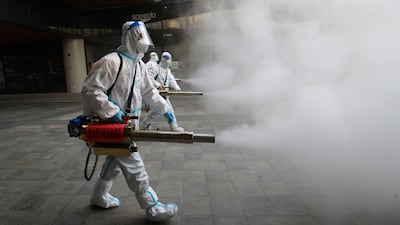
Workers spray disinfectant outside a shopping mall in Xi'an, northern China. AFP -
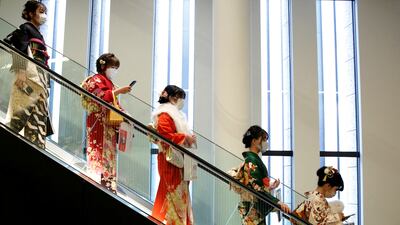
Women wearing kimonos and protective masks ride on an escalator in Tokyo. Reuters -

Dr Anthony Fauci speaks during a US Senate committee hearing to examine the federal response to Covid-19. AP -
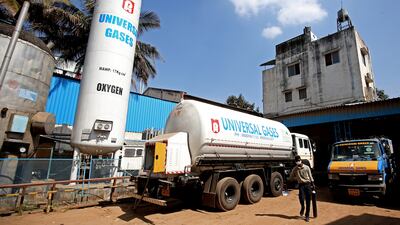
A centre for filling oxygen tanks in Bangalore, India. EPA -

Medical staff dressed in superhero costumes accompany children aged 6 to 11 as they receive a vaccine at a school in Yogyakarta, Indonesia. AFP -

A shopper walks past empty frozen-food coolers at a shop in Cranberry Township, Pennsylvania. Shortages at US shops have grown in recent weeks amid supply-chain struggles and labour issues. AP -
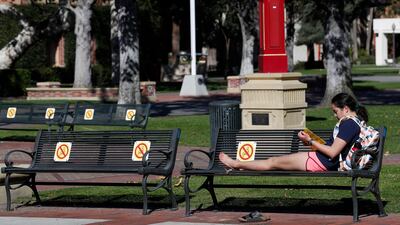
Students and staff at the University of Southern California are required to get Covid-19 vaccine booster shots and show proof of a negative test to return to in-person classes. EPA -

A teacher takes a class remotely at Hazelwood Elementary School in Louisville, Kentucky. Getty -
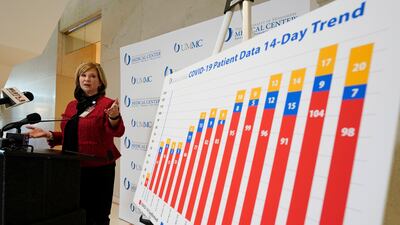
Dr LouAnn Woodward of the University of Mississippi refers to a graph outlining the rising number of Covid-19 patients over a 14-day period. AP -

Medics tend to a Covid-19 patient at the intensive care unit of Cremona Hospital in northern Italy. AFP -

Pharmacy workers remove Christmas decorations from a window in Lisbon, Portugal. While Portugal has been reporting record figures of daily new coronavirus cases driven by the Omicron variant, the number of patients in intensive-care units has fallen. Bloomberg -
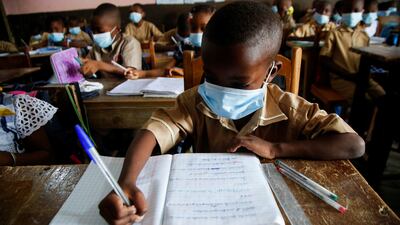
Students wearing protective masks study in a classroom at the Merlan school in Paillet, Ivory Coast. Reuters -
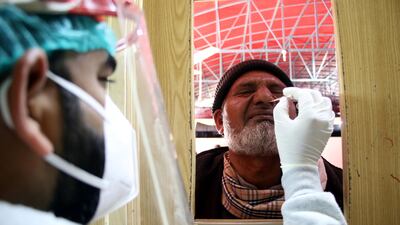
A Pakistani health worker takes a sample to test for Covid-19 during a surge in Omicron cases in Islamabad. EPA -

A general view of the Nightingale Covid-19 Surge Hub which is being erected at the Royal Preston Hospital in Preston, England. Getty -
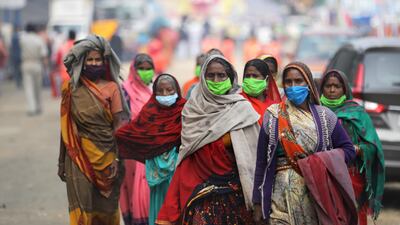
Indian devotees walk for a health check-up at the Babughat transit camp before the Ganga Sagar annual fair in Kolkata, eastern India. EPA


The researchers initially looked at how temperatures affected the spread of the virus in both warm and cool regions of the US and, using data from 2020, built a complex mathematical model to predict when risks would be highest.
Instead of publishing their findings based on 2020 alone, they waited to confirm the accuracy of their work by testing it last year.
“We [decided to see] if this is going to be valid for the data from 2021. It was and [the relationship] was stronger than in 2020,” Dr Jutla said.
“Right now, the model has been validated in the US, it’s been validated with data sets from India and, to some extent, we’re re-evaluating the model for Omicron. We have the intention to cover the entire globe.”
Influenza, another viral illness, typically spreads more rapidly in the winter because during cooler times, people spend more time around others indoors.
With the coronavirus, a more varied picture may develop, with Dr Jutla saying that some parts of the world may experience more than one peak a year because of climatic factors.
In colder parts of the world where ambient temperatures do not exceed 24°C, the researchers predict there will be a single peak in cases in winter.
In contrast, in warmer regions where ambient temperatures do not typically drop below 17°C during the winter, a single peak in case numbers is likely during the summer.
In areas where ambient temperatures can fall below 17°C and at other times exceed 24°C, then two peaks of Covid-19 cases can be expected during the year.
The new study, which did not highlight a specific temperature when the possibility of transmission is highest, was written by six researchers from the University of Florida, one from the University of Maryland and one from the UN.
Asymmetric Relationship between Ambient Air Temperature and Incidence of Covid-19 in the Human Population has been published as early proof and will be reviewed by other scientists.

