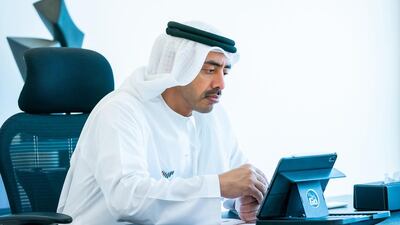
Sheikh Abdullah bin Zayed, Minister of Foreign Affairs and International Co-operation, is in India on an official visit. Wam

Sheikh Abdullah praises strong relations between UAE and Pakistan


  • English
  • Arabic

Sheikh Abdullah bin Zayed, Minister of Foreign Affairs and International Co-operation, spoke of the strong ties between the UAE and Pakistan on Sunday.

Pakistan’s Minister of Foreign Affairs, Shah Mahmood Qureshi, is in the Emirates on an official visit.

During their meeting, the foreign ministers discussed ways to further strengthen co-operation in various fields.

Both discussed the challenges of the pandemic, economic and investment issues and joint initiatives between the two countries.

They also spoke of the latest developments in the region.

Sheikh Abdullah said more than 1.5 million Pakistanis live in the UAE and they contribute to the growth of the country.

He said the recent visa restrictions on Pakistanis was temporary to limit the spread of the coronavirus.

The people of both countries share strong and historic ties. Pakistan was among the first countries to establish diplomatic relations with the UAE and has maintained good relations since 1971.

"The close relations between the UAE and Pakistan have strengthened over the past decades,” said Sheikh Abdullah.

“It represents a unique case in Arab-Asian relations in the region, as political relations between the UAE and Pakistan are based on a long history of joint action, trust and respect."

Both countries work on the principles of tolerance, inclusiveness and an agenda to ensure peace and stability in the region.

"The UAE and Pakistan enjoy close relations and historical ties across political, economic, cultural and social domains, established on solid foundations of mutual friendship and respect,” said Sheikh Abdullah.

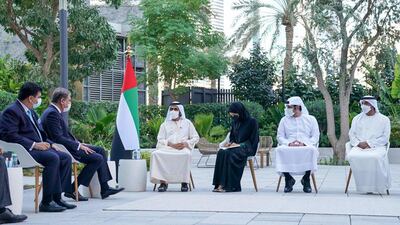
Sheikh Mohammed bin Rashid, Vice President and Ruler of Dubai, also met Mr Qureshi on Thursday.

In January, Pakistan's Prime Minister Imran Khan visited the UAE capital to meet Sheikh Mohamed bin Zayed almost a year after the Crown Prince of Abu Dhabi and Deputy Supreme Commander of the Armed Forces visited Pakistan.

During Mr Khan's visit, the UAE pledged Dh734 million ($200m) in development aid to the country, which was struggling economically at the time.

The UAE is also involved in efforts to eradicate polio in Pakistan by 2022.

Sheikh Mohammed meets Pakistan’s Minister of Foreign Affairs - in pictures

  • Sheikh Mohammed bin Rashid, Vice President and Ruler of Dubai, meets Pakistan’s Minister of Foreign Affairs, Shah Mahmood Qureshi, on Thursday.Courtesy: Dubai Media Office
    Sheikh Mohammed bin Rashid, Vice President and Ruler of Dubai, meets Pakistan’s Minister of Foreign Affairs, Shah Mahmood Qureshi, on Thursday.Courtesy: Dubai Media Office
  • Sheikh Mohammed bin Rashid, Vice President and Ruler of Dubai, meets Pakistan’s Minister of Foreign Affairs, Shah Mahmood Qureshi, on Thursday. Seen with Sheikh Maktoum bin Mohammed, Deputy Ruler of Dubai; Sheikh Ahmed bin Saeed, chairman of Dubai Civil Aviation Authority and chief executive of Emirates Airline and Group; Mohammad Al Gergawi, Minister of Cabinet Affairs; and Reem Al Hashemy, Minister of State for International Co-operation. Courtesy: Dubai Media Office
    Sheikh Mohammed bin Rashid, Vice President and Ruler of Dubai, meets Pakistan’s Minister of Foreign Affairs, Shah Mahmood Qureshi, on Thursday. Seen with Sheikh Maktoum bin Mohammed, Deputy Ruler of Dubai; Sheikh Ahmed bin Saeed, chairman of Dubai Civil Aviation Authority and chief executive of Emirates Airline and Group; Mohammad Al Gergawi, Minister of Cabinet Affairs; and Reem Al Hashemy, Minister of State for International Co-operation. Courtesy: Dubai Media Office
  • Sheikh Maktoum bin Mohammed, Deputy Ruler of Dubai; Sheikh Ahmed bin Saeed, chairman of Dubai Civil Aviation Authority and chief executive of Emirates Airline and Group; Mohammad Al Gergawi, Minister of Cabinet Affairs; and Hamad Al Zaabi, UAE Ambassador to Pakistan, attend a meeting between Sheikh Mohammed bin Rashid, Vice President and Ruler of Dubai, and Pakistan’s Minister of Foreign Affairs, Shah Mahmood Qureshi. Courtesy: Dubai Media Office
    Sheikh Maktoum bin Mohammed, Deputy Ruler of Dubai; Sheikh Ahmed bin Saeed, chairman of Dubai Civil Aviation Authority and chief executive of Emirates Airline and Group; Mohammad Al Gergawi, Minister of Cabinet Affairs; and Hamad Al Zaabi, UAE Ambassador to Pakistan, attend a meeting between Sheikh Mohammed bin Rashid, Vice President and Ruler of Dubai, and Pakistan’s Minister of Foreign Affairs, Shah Mahmood Qureshi. Courtesy: Dubai Media Office
The biog

Name: Marie Byrne

Nationality: Irish

Favourite film: The Shawshank Redemption

Book: Seagull by Jonathan Livingston

Life lesson: A person is not old until regret takes the place of their dreams

PROFILE OF HALAN

Started: November 2017

Founders: Mounir Nakhla, Ahmed Mohsen and Mohamed Aboulnaga

Based: Cairo, Egypt

Sector: transport and logistics

Size: 150 employees

Investment: approximately $8 million

Investors include: Singapore’s Battery Road Digital Holdings, Egypt’s Algebra Ventures, Uber co-founder and former CTO Oscar Salazar

Ten tax points to be aware of in 2026

1. Domestic VAT refund amendments: request your refund within five years

If a business does not apply for the refund on time, they lose their credit.

2. E-invoicing in the UAE

Businesses should continue preparing for the implementation of e-invoicing in the UAE, with 2026 a preparation and transition period ahead of phased mandatory adoption. 

3. More tax audits

Tax authorities are increasingly using data already available across multiple filings to identify audit risks. 

4. More beneficial VAT and excise tax penalty regime

Tax disputes are expected to become more frequent and more structured, with clearer administrative objection and appeal processes. The UAE has adopted a new penalty regime for VAT and excise disputes, which now mirrors the penalty regime for corporate tax.

5. Greater emphasis on statutory audit

There is a greater need for the accuracy of financial statements. The International Financial Reporting Standards standards need to be strictly adhered to and, as a result, the quality of the audits will need to increase.

6. Further transfer pricing enforcement

Transfer pricing enforcement, which refers to the practice of establishing prices for internal transactions between related entities, is expected to broaden in scope. The UAE will shortly open the possibility to negotiate advance pricing agreements, or essentially rulings for transfer pricing purposes. 

7. Limited time periods for audits

Recent amendments also introduce a default five-year limitation period for tax audits and assessments, subject to specific statutory exceptions. While the standard audit and assessment period is five years, this may be extended to up to 15 years in cases involving fraud or tax evasion. 

8. Pillar 2 implementation 

Many multinational groups will begin to feel the practical effect of the Domestic Minimum Top-Up Tax (DMTT), the UAE's implementation of the OECD’s global minimum tax under Pillar 2. While the rules apply for financial years starting on or after January 1, 2025, it is 2026 that marks the transition to an operational phase.

9. Reduced compliance obligations for imported goods and services

Businesses that apply the reverse-charge mechanism for VAT purposes in the UAE may benefit from reduced compliance obligations. 

10. Substance and CbC reporting focus

Tax authorities are expected to continue strengthening the enforcement of economic substance and Country-by-Country (CbC) reporting frameworks. In the UAE, these regimes are increasingly being used as risk-assessment tools, providing tax authorities with a comprehensive view of multinational groups’ global footprints and enabling them to assess whether profits are aligned with real economic activity. 

Contributed by Thomas Vanhee and Hend Rashwan, Aurifer