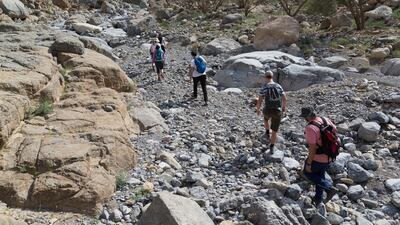
Police and mountain rescue groups have reiterated safety warnings about hiking during the day.
Despite September ushering in slightly cooler weather, experts said the daytime heat is still fierce.
Complacent day-trippers still treat hiking like an easy walk and do not bring enough water, they said.
They are risking dehydration – and even death – by not being better prepared.
On Saturday, four hikers at Wadi Naqab in Ras Al Khaimah were flown to hospital by police.
“The ... teams managed to locate the tourists, provide them with the necessary first aid and then moved them to a less rugged area where the helicopter landed safely to transfer them to hospital,” said Maj Tariq Al Sharhan, head of the ambulance and rescue department at Ras Al Khaimah Police.
“We urge the public to avoid going to rugged areas in mountains and valleys, especially during the day.”
Ras Al Khaimah police said it had carried out 19 rescue missions of stranded hikers this year.
With more people staying in the country because of Covid-19, the mountains of the Northern Emirates are an attractive prospect.
But walking there can be dangerous. In May, three Emiratis were flown to safety after suffering from heat exhaustion while walking in Ras Al Khaimah.
The same month, Dubai resident Mohamad Hajjar, 35, from Lebanon, was found dead by search and rescue teams in the mountainous area of Sharjah’s Khor Fakkan.
Hiking experts said September still brings fierce summer heat and hikers must be cautious and prepared.
“Lots of people are tired of being stuck inside and have exhausted all of the options of pools and beaches – the mountains are the next logical outdoor activity,” said Amy Subaey, director of UAE Trekkers, a hiking company in Dubai.
Heat exhaustion leads to heat stroke and death within hours. Hiking is not the same as going for a walk
“But it is still September and it’s really still extremely hot. A hike that you could normally do in four hours in the winter will take you six hours and leave you exhausted – and dehydrated,” she said.
Ms Subaey said that even if you are “gym” fit, hiking is a different activity that requires endurance an indoor workout cannot simulate.
“Getting stranded happens when people do not understand the risks they are taking by going hiking in the summer,” she said.
“They start out too late in the morning, take enough water for [only] a few hours and underestimate the time it will take them to get back to safety.
“They also think that help is just a phone call away and don’t understand that in some remote places in UAE, you cannot make that phone call.”
Ms Subaey said getting lost is also linked to dehydration, which affects the ability to think clearly.
“What happens next can be deadly, as heat exhaustion leads to heatstroke and death within hours. Hiking is not the same as ‘going for a walk’,” she said.
Ms Subaey advisers people to walk in groups, never hike with someone that does not know the route and always carry no less than five litres [of water].
“The only time that is acceptable to go hiking in September is from 5.15am to 9am,” she said.
Night hiking brings another set of risks. “Critters like snakes and spiders come out of their holes at night in the summer and you won’t be able to see them.
“If you are bitten by something in the mountains, that is not something that you can patch up with a Band-Aid.”
She suggested using the month of September to get “hiking fit”.
“Carry a 5kg backpack while walking, start running for longer durations and climbing stairs,” she said.
“Wake up at 3am and walk around the block with a 5kg backpack.”

Mercer, the investment consulting arm of US services company Marsh & McLennan, expects its wealth division to at least double its assets under management (AUM) in the Middle East as wealth in the region continues to grow despite economic headwinds, a company official said.
Mercer Wealth, which globally has $160 billion in AUM, plans to boost its AUM in the region to $2-$3bn in the next 2-3 years from the present $1bn, said Yasir AbuShaban, a Dubai-based principal with Mercer Wealth.
“Within the next two to three years, we are looking at reaching $2 to $3 billion as a conservative estimate and we do see an opportunity to do so,” said Mr AbuShaban.
Mercer does not directly make investments, but allocates clients’ money they have discretion to, to professional asset managers. They also provide advice to clients.
“We have buying power. We can negotiate on their (client’s) behalf with asset managers to provide them lower fees than they otherwise would have to get on their own,” he added.
Mercer Wealth’s clients include sovereign wealth funds, family offices, and insurance companies among others.
From its office in Dubai, Mercer also looks after Africa, India and Turkey, where they also see opportunity for growth.
Wealth creation in Middle East and Africa (MEA) grew 8.5 per cent to $8.1 trillion last year from $7.5tn in 2015, higher than last year’s global average of 6 per cent and the second-highest growth in a region after Asia-Pacific which grew 9.9 per cent, according to consultancy Boston Consulting Group (BCG). In the region, where wealth grew just 1.9 per cent in 2015 compared with 2014, a pickup in oil prices has helped in wealth generation.
BCG is forecasting MEA wealth will rise to $12tn by 2021, growing at an annual average of 8 per cent.
Drivers of wealth generation in the region will be split evenly between new wealth creation and growth of performance of existing assets, according to BCG.
Another general trend in the region is clients’ looking for a comprehensive approach to investing, according to Mr AbuShaban.
“Institutional investors or some of the families are seeing a slowdown in the available capital they have to invest and in that sense they are looking at optimizing the way they manage their portfolios and making sure they are not investing haphazardly and different parts of their investment are working together,” said Mr AbuShaban.
Some clients also have a higher appetite for risk, given the low interest-rate environment that does not provide enough yield for some institutional investors. These clients are keen to invest in illiquid assets, such as private equity and infrastructure.
“What we have seen is a desire for higher returns in what has been a low-return environment specifically in various fixed income or bonds,” he said.
“In this environment, we have seen a de facto increase in the risk that clients are taking in things like illiquid investments, private equity investments, infrastructure and private debt, those kind of investments were higher illiquidity results in incrementally higher returns.”
The Abu Dhabi Investment Authority, one of the largest sovereign wealth funds, said in its 2016 report that has gradually increased its exposure in direct private equity and private credit transactions, mainly in Asian markets and especially in China and India. The authority’s private equity department focused on structured equities owing to “their defensive characteristics.”
MOUNTAINHEAD REVIEW
Starring: Ramy Youssef, Steve Carell, Jason Schwartzman
Director: Jesse Armstrong
Rating: 3.5/5
Stamp duty timeline
December 2014: Former UK finance minister George Osbourne reforms stamp duty, replacing the slab system with a blended rate scheme, with the top rate increasing to 12 per cent from 10 per cent:
Up to £125,000 - 0%; £125,000 to £250,000 – 2%; £250,000 to £925,000 – 5%; £925,000 to £1.5m: 10%; Over £1.5m – 12%
April 2016: New 3% surcharge applied to any buy-to-let properties or additional homes purchased.
July 2020: Rishi Sunak unveils SDLT holiday, with no tax to pay on the first £500,000, with buyers saving up to £15,000.
March 2021: Mr Sunak decides the fate of SDLT holiday at his March 3 budget, with expectations he will extend the perk unti June.
April 2021: 2% SDLT surcharge added to property transactions made by overseas buyers.
Polarised public
31% in UK say BBC is biased to left-wing views
19% in UK say BBC is biased to right-wing views
19% in UK say BBC is not biased at all
Source: YouGov
Western Region Asia Cup T20 Qualifier
Sun Feb 23 – Thu Feb 27, Al Amerat, Oman
The two finalists advance to the Asia qualifier in Malaysia in August
Group A
Bahrain, Maldives, Oman, Qatar
Group B
UAE, Iran, Kuwait, Saudi Arabia
